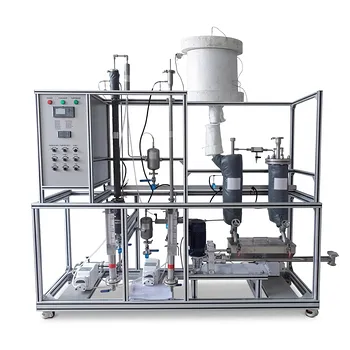
The direct answer is clear: educational unit operations pilot plants transform abstract textbook theory into a tangible, physical reality.
They are scaled-down, fully functional replicas of industrial refinery columns. Students don't just calculate a boiling point curve; they physically perform the thermal separation of a hydrocarbon mixture, manipulate the reflux ratio, and watch as distinct fractions like naphtha and diesel are drawn from specific side-streams. This direct interaction turns complex, multi-variable separation steps into an intuitive, observable process.
The core challenge isn't understanding distillation in theory—it's grasping how dozens of interacting variables simultaneously influence purity, yield, and energy consumption. A pilot plant bridges this gap by letting students cause and observe these interactions firsthand, building a mental model of the fractionator not as a static diagram, but as a dynamic, living system.
Moving from Abstract Theory to Tangible Reality
Crude oil refining is the most complex separation problem students will encounter. A textbook can show you a graph of boiling points, but it cannot replicate the experience of controlling a live fractionator. The pilot plant’s primary function is to make the invisible, visible.
Physically Performing the Core Process
Industrial fractional distillation involves preheating crude, flashing it into a column, and separating components by boiling point. A pilot plant lets students do this themselves.
They load the feed, manage the temperature-controlled reboilers at the bottom, and control the condensation systems at the top. The fractions aren't just names on a page—from light gases at the overhead to atmospheric residue at the bottom—they are physical liquids collecting in product receivers.
Visualizing the Column's Internal Anatomy
Students study column hydraulics by directly observing the impact of vapor and liquid traffic on tray efficiency and pressure differentials. They can sample products at specific tray heights, learning how a temperature gradient along the column correlates directly with the purity of a side-draw.
This deconstructs the "black box" of the column. It becomes a clear sequence of equilibrium stages, where manipulating the feed position or adjusting side-draw strippers has a logical, observable outcome.
Discovering Cause and Effect in Real Time
The true learning begins when students ask "what if?" They can vary a Critical Process Parameter (CPP) —like reflux ratio—and measure its immediate impact on the purity of a kerosene cut.
This develops an intuitive feel for the process's sensitivity. They learn that optimizing for maximum distillate yield can compromise purity, and that counteracting an upset in the feed preheater requires a response in the reboiler duty. This dynamic interplay is impossible to teach with only a whiteboard.
Beyond Basics: Using the Pilot Plant as a Research Platform
An educational pilot plant’s value extends far beyond demonstrating atmospheric distillation. It becomes a platform for tackling modern industrial challenges and implementing advanced control philosophies.
Comparing Conventional and Advanced Configurations
Students can't research energy efficiency without a baseline. A modular pilot plant allows them to compare conventional distillation with advanced methods directly. They can measure the energy consumption of a standard setup and then reconfigure the system to test a dividing wall column (DWC) or heat-integrated distillation scheme.
This physical comparison cements understanding. It’s one thing to read that DWC reduces energy, but it’s another to physically measure a lower utility demand on your own plant. The same goes for introducing an entrainer for azeotropic distillation to separate a difficult mixture that standard distillation could not resolve.
Simulating Industrial-Scale Complexity
Real refiners use advanced automation. A modern educational pilot plant equipped with Model Predictive Control (MPC) and Real-Time Optimization (RTO) software immerses students in this reality.
Students move beyond simple PID loops to manage the multi-variable, constraint-driven nature of the process. They learn to troubleshoot automation sequences, optimize startup and shutdown procedures, and handle simulated sensor failures, mirroring the cognitive tasks of an industrial process engineer.
Deconstructing the Process with a Quality by Design (QbD) Mindset
A pilot plant is an ideal tool for teaching a systematic approach to process understanding. Using Quality by Design (QbD) principles and Cause-and-Effect (C&E) analysis, students learn to categorize every input.
They identify controllable parameters (reflux ratio), noise factors (ambient temperature), and set up a Design of Experiments (DoE) to map their impact on final fuel quality. This structured method applies risk assessment tools like Failure Mode and Effects Analysis (FMEA) to a real chemical process, moving students from simply operating equipment to truly engineering a robust process.
Understanding the Critical Trade-offs
A good advisor must highlight the limitations. The power of a pilot plant is not absolute, and its educational value depends on how it's used.
- Scale versus Fidelity: A pilot column cannot fully simulate the heat loss dynamics or construction material constraints of a 50-meter-tall industrial column. The physics of mass and momentum transfer, while present, are affected by the scale. Students must be guided to understand which observations scale up linearly and which do not.
- Safety and Complexity in Cryogenic Separations: While pilot plants allow for the study of difficult separations like ethene/ethane, the cryogenic temperatures required (below 273 K) introduce significant safety and equipment complexity. The educational benefit of studying a high-tray-count, cryogenic column must be balanced with the operational risk and cost in an academic setting.
- The "Black Box" Risk of Advanced Controls: Integrating advanced software like MPC is essential, but it can also create a new barrier. If students simply feed a setpoint to an optimizer without understanding the underlying thermodynamics, the pilot plant becomes a software simulation with extra steps. The key is using the controls to augment, not replace, a deep physical understanding.
Making the Right Choice for Your Curriculum
How you leverage a unit operations pilot plant must align with your primary educational objective. The same tool serves different masters, from the technician to the theoretical researcher.
- If your primary focus is producing competent plant operators: Prioritize hands-on time with startup, shutdown, and troubleshooting of the distillation column. Focus on the physical interaction with valves, pumps, and manual sampling, and the direct cause-and-effect of changing a single operational parameter.
- If your primary focus is developing process design engineers: Use the plant to run designed experiments (DoE) to map an operating window and validate a simulation model built in Aspen Plus. The goal is to compare physical results with theoretical predictions, analyze discrepancies, and optimize for energy consumption against yield.
- If your primary focus is training for modern, automated industries: The curriculum must center on the plant’s control system. Compare manual operation to MPC-driven operation, analyze the logic of the automation sequences, and practice the advanced troubleshooting of control loops and sensor diagnostics.
The ultimate goal is to transform the crude oil distillation process from a complex, intimidating flowchart into a system that responds predictably to a student’s touch, building the confident intuition that defines a true expert.
Summary Table:
| Educational Focus | Key Hands-On Activity | Learning Outcome |
|---|---|---|
| Process Operations | Controlling reflux ratio, temperature, & product draws | Clear grasp of cause-and-effect in multi-variable separation |
| Process Engineering | Running Design of Experiments (DoE) & model validation | Skills in energy optimization, yield analysis, & scale-up |
| Advanced Automation | Programming MPC, PID loops, & troubleshooting sensors | Competency in industrial-grade control & safety systems |
Bring Industrial Reality to Your Lab with LABPARK
Bridge the gap between complex engineering theory and hands-on practice. LABPARK provides premium Educational and Vocational Unit Operations Pilot Plants in chemical engineering, bioprocess & biotech, and environmental & water treatment.
Specially designed for universities, research institutes, and enterprises, our systems empower students and researchers to master real-world distillation, separation, and advanced process control.
Ready to elevate your department's training capabilities? Contact LABPARK today to find the perfect pilot plant for your curriculum!
Related Products
- Green Anhydrous Ethanol Refining Practical Training Pilot Plant
- Continuous Sieve-Plate Distillation Pilot Plant for Unit Operations Laboratory Education
- Multi-Modal Distillation Unit Operations Training Pilot Plant
- Continuous Batch Extractive Distillation Educational Pilot Plant
- Multi-Functional Special Distillation Educational Pilot Plant
People Also Ask
- How do deviation & overshoot serve as quality indicators in pilot plant control loop tuning?
- How is settling time measured on chemical engineering pilot plants? Master process control dynamics.
- How is an extractive distillation pilot plant configured? Setup & Entrainer Roles
- How is modular cost estimation structured for chemical engineering training pilot plants?
- How Batch vs. Continuous Pilot Plants Affect Polymer Distribution: Reactor Selection Guide