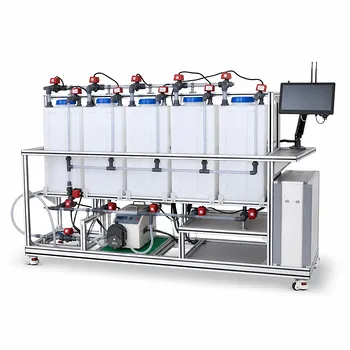
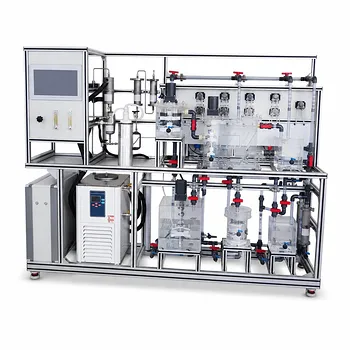
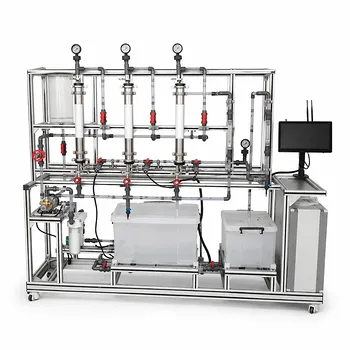
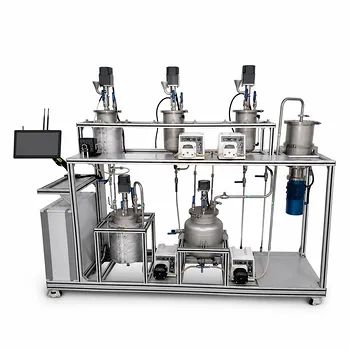
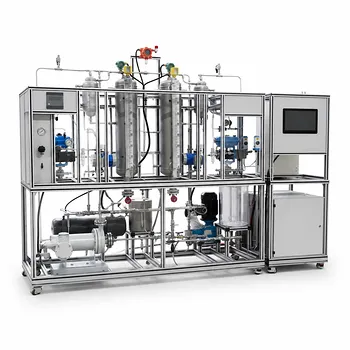
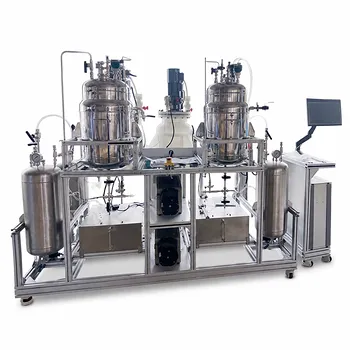
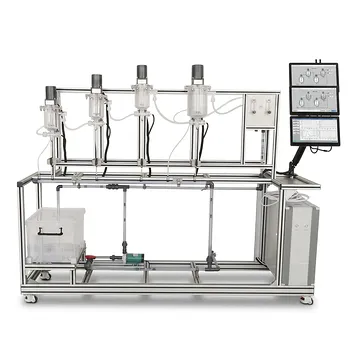
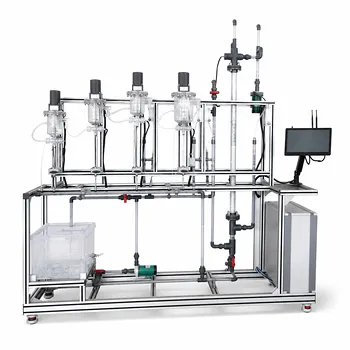
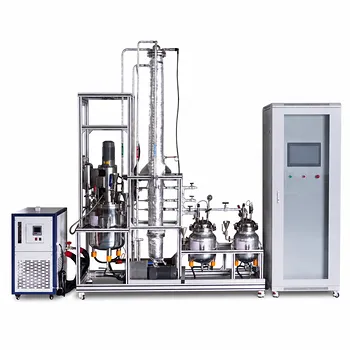
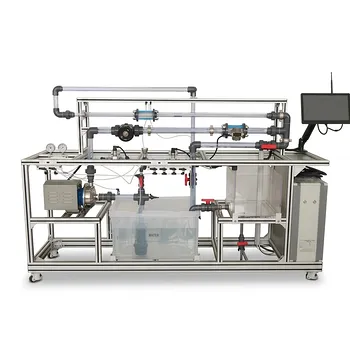
Understanding the three stages of industrial wastewater treatment requires moving beyond textbook diagrams to see how theory becomes a physical, controllable process. Educational unit operations pilot plants achieve this by letting students and researchers physically build, operate, and optimize a miniature treatment train. They can directly manipulate primary filtration media, cultivate the living ecosystems in secondary biological reactors, and fine-tune the chemical reactions of tertiary purification, transforming abstract concepts into visible, measurable outcomes.
The core value of a pilot plant is its ability to deconstruct a complex, integrated process into its individual, observable unit operations. This hands-on access allows users to not just see that each stage works, but to rigorously test how, why, and under what conditions it succeeds or fails, bridging the critical gap between theoretical knowledge and practical engineering skill.
Deconstructing the Treatment Train into Tangible Stages
Textbooks present wastewater treatment as a linear flow chart. A pilot plant converts this into a sequence of physical machines. This modular setup is the first key to deep understanding.
Making the Invisible Visible
In a full-scale plant, processes happen behind steel walls. A pilot plant is designed for visibility. You can see the primary sludge accumulating in a sedimentation unit, observe the color and consistency of the activated sludge in a bioreactor, and watch the immediate effect of a chemical coagulant. This sensory feedback creates a direct link between conceptual knowledge and a physical phenomenon, solidifying learning far more effectively than theory alone.
Isolating Variables for Cause-and-Effect Analysis
Real-world treatment is a web of interdependencies. A pilot plant enables isolation. A student can keep all variables constant in the primary and tertiary stages while systematically changing only the aeration rate in the secondary bioreactor. This direct experimentation reveals how a single change—like dissolved oxygen—cascades to impact microbe health and pollutant removal efficiency, a crucial insight that is lost in the complexity of a full-scale facility.
Mastering the Primary Stage: Physical Separation
The primary stage is often dismissed as a simple screen, but a pilot plant reveals it as a science of physical forces and material performance.
Experimenting with Filtration Media
The first interaction users have is with physical separation. A pilot plant’s modular design allows for the testing of vastly different filtration media. A researcher can run the same high-solids influent through a coarse screen, a sand filter, and a membrane in parallel experiments. By measuring turbidity and particle size distribution at each outlet, they directly learn how pore size and material type dictate separation efficiency, energy consumption, and the rate of clogging. You are not just learning that a filter works; you're learning how to select the right one for a specific industrial effluent.
Optimizing Sedimentation Dynamics
Beyond filtration, a primary sedimentation tank in a pilot plant is a tool for studying fluid dynamics and particle settling. Users can alter the inlet flow rate and use a tracer dye to visualize short-circuiting or dead zones. They learn firsthand how factors like tank geometry and hydraulic loading rate dictate the quality of primary sludge and the protection of the downstream biological process. This transforms a theoretical concept into a hands-on design challenge.
Demystifying the Secondary Stage: Biological Transformation
The secondary stage is a living process, often the most mysterious part of treatment. Pilot-scale bioreactors demystify it by turning the invisible microbiome into a manageable workforce.
Cultivating and Stressing a Microbial Culture
A pilot biological reactor is essentially a high-tech farm. Students are responsible for the health of their microbial community. They must monitor and adjust nutrients, temperature, pH, and dissolved oxygen—all Critical Process Parameters (CPPs). A hands-on experiment in reducing the air supply immediately demonstrates the shift from efficient aerobic degradation to a failing, smelly anaerobic state. This tangible experience of a "process upset" teaches operational vigilance that a lecture simply cannot convey.
Measuring Biodegradation Efficiency
The learning is solidified through quantitative analysis. A student can measure the Chemical Oxygen Demand (COD) of the influent entering the bioreactor and the effluent leaving it, and directly calculate the removal efficiency of a specific organic load. By then analyzing the growth of the sludge blanket, they close the mass balance loop, visually confirming that the pollutants were converted into new microbial cells. This direct correlation between degradation as a theoretical concept and a measurable outcome is the essence of engineering education.
Polishing with Precision: The Tertiary Stage
The tertiary stage is where the water is polished to meet exacting discharge standards. A pilot plant reveals this not as a magic step, but as a controlled application of chemistry and advanced mass transfer.
Optimizing Chemical Dosing and Reaction Kinetics
In a pilot-scale chemical dosing unit, the user becomes a reaction engineer. They can experiment with jar tests to determine the optimal coagulant dose, then immediately test it in a continuous flow system. By adjusting the rapid mix and slow mix speeds, they see the direct creation of flocs. Overdosing is immediately obvious as the water turns milky, providing a cost-lesson in chemical efficiency that connects reaction kinetics to operational budget.
Studying Advanced Separation Dynamics
For advanced techniques like adsorption or ion exchange, the pilot plant provides an essential scalable platform. A researcher can load a column with activated carbon or an ion-exchange resin and pump a solution containing a heavy metal dye, like methylene blue, through it. By collecting samples over time, they plot an S-shaped adsorption breakthrough curve. This visual representation of saturation, mass transfer zones, and column exhaustion transforms the abstract mathematics of adsorption isotherms into a practical tool for sizing industrial-scale equipment.
Understanding the Trade-offs
A pilot plant’s greatest lesson is that no single solution is perfect. It teaches the critical skill of navigating trade-offs.
Efficiency vs. Cost
Users quickly discover that the most efficient filter—like a reverse osmosis membrane—comes with a steep trade-off in energy cost and a propensity for fouling. The pilot plant provides the data to plot removal efficiency against energy consumption and operational expenditure, forcing a real-world cost-benefit analysis that defines modern engineering.
Performance vs. Stability
An optimized secondary bioreactor running at peak removal efficiency can be knocked into failure by a slight spike in toxic influent. A pilot plant allows experimentation with operational resilience. Students learn to choose between running a high-rate system at its edge of failure and a more robust, but slower, process. This teaches the essential principle of designing for operability, not just theoretical maximum performance.
Making the Right Choice for Your Learning Goal
The modularity of a unit operations pilot plant means the learning can be tailored to a specific objective. The same hardware can answer vastly different questions.
- If your primary focus is mastering process design: Configure the pilot plant as an integrated train. Your goal is to study the interdependency of stages, like how poor primary sedimentation triggers catastrophic biomass washout in the secondary stage. Use this to build and validate a complete process simulation model.
- If your primary focus is optimizing a specific unit operation: Isolate that single stage, such as the ion exchange column. Run detailed parametric studies on flow rate, concentration, and pH to master that specific mass transfer operation. Use this data to predict the scale-up performance and lifecycle costs of that one unit.
- If your primary focus is operational troubleshooting and training: Deliberately create failure scenarios. Spike the system with a toxin to crash the bioreactor, then experiment with recovery procedures. Or foul a membrane and test different chemical cleaning protocols. This builds the diagnostic and problem-solving muscle memory essential for plant operators.
The true power of an educational pilot plant lies not in showing the ideal path of clean water, but in providing a safe space to learn from the messy, complex, and deeply instructive reality of process engineering.
Summary Table:
| Treatment Stage | Pilot Plant Operations | Key Learning & Insights |
|---|---|---|
| Primary (Physical) | Filtration media tests, sedimentation tank dynamics | Fluid dynamics, settling velocity, and media selection |
| Secondary (Biological) | Bioreactor control (DO, pH, nutrients, flow rate) | Microbial health, COD/BOD removal, and process upsets |
| Tertiary (Chemical/Advanced) | Coagulant dosing, carbon adsorption columns | Reaction kinetics, breakthrough curves, and scale-up dynamics |
Bring Hands-On Process Engineering to Your Lab with LABPARK
Are you looking to bridge the gap between theoretical engineering and practical application? LABPARK designs and manufactures premium Educational and Vocational Unit Operations Pilot Plants in chemical engineering, bioprocess & biotech, and environmental & water treatment for universities, research institutes, and progressive enterprises worldwide.
Our modular pilot systems allow students and researchers to simulate real-world industrial scenarios, optimize process parameters, and master complex unit operations in a safe, controlled environment.
Ready to upgrade your laboratory facilities? Contact LABPARK today to discuss your training requirements and request a customized equipment proposal!
Related Products
- Solid Waste Pyrolysis and Refining Educational Pilot Plant for Unit Operations
- Electrochemical Water Treatment Educational Unit Operations Pilot Plant
- Thermal Desorption Exhaust Gas and Tail Water Treatment Educational Pilot Plant
- Multi-Functional Special Distillation Educational Pilot Plant
- Multifunctional Membrane Separation Educational Pilot Plant with Ultrafiltration, Nanofiltration, Reverse Osmosis
People Also Ask
- How do educational unit operations pilot plants bridge theory and design? Bridge the Engineering Gap
- How do educational unit operations pilot plants address safety and waste management when scaling up?
- When to transition from PID to adaptive control in pilot plants? Key process indicators.
- Why is the chemical plant startup schedule crucial? De-risk scale-up with pilot plants.
- How do deviations in estimating latent heat impact pilot plant thermal systems? Avoid hardware mis-sizing.