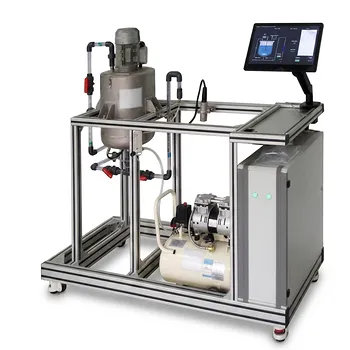
Practical, hands-on training is the missing link. Educational unit operations pilot plants directly address the lack of process intensification (PI) expertise by transforming theoretical knowledge into tangible skill. They provide a safe, scaled-down environment where students and engineers can physically configure, control, and optimize intensified processes, learning to manage reduced residence times, elevated pressures, and the advanced automation systems that define modern, compact chemical plants.
Without the ability to safely test and experiment with integrated, miniaturized systems, PI remains an abstract concept. Pilot plants bridge this gap by building the practical intuition required to design and operate the sustainable, high-efficiency facilities the industry urgently needs.
The PI Expertise Gap: A Barrier to Innovation
Process intensification promises smaller footprints, lower energy use, and improved safety, yet its adoption stalls due to a critical shortage of hands-on experience.
Why Theory Isn't Enough
Chemical engineering curricula often teach PI as a set of design equations and case studies. But PI fundamentally changes how a plant behaves.
Reduced liquid holdups mean reactions can run away in seconds, not hours. Integrated units blur the lines between reaction and separation, creating complex dynamic interactions that no textbook can fully capture. Without practical exposure, engineers lack the “feel” for these systems, making industrial implementation too risky.
The Missing Piece in Professional Development
For practicing engineers, the gap is equally severe. They are asked to revamp legacy batch processes into continuous, intensified ones.
Without pilot-scale proof, projects fail at the gate. The hesitation is not about the technology’s potential—it’s about the team’s confidence in executing it safely and reliably. Pilot plants provide that confidence by allowing failures in a low-consequence setting.
How Unit Operations Pilot Plants Bridge the Gap
These platforms are not just miniature factories; they are dynamic, programmable learning environments that address the specific skill deficits holding PI back.
Gaining Hands-On Experience with Integrated Processes
Traditional unit ops labs keep reaction and distillation in separate silos. PI education pilot plants deliberately merge them.
A student operating a reactive distillation column sees firsthand how the heat of reaction drives the separation, and how the separation shifts the reaction equilibrium. By physically plumbing a microreactor in series with a compact heat exchanger, they learn to manage the vanishingly small residence times—often seconds—that define intensified systems. This direct confrontation with integrated complexity builds a mental model that theory alone cannot create.
Observing Core PI Principles in Action
Intensified equipment relies on maximizing driving forces and surface-to-volume ratios. Pilot plants turn these principles into observable phenomena.
Students use advanced mixing methods—static mixers, spinning disc reactors—to see how uniform processing improves yield. They operate monolithic or micro-channel reactors and measure the dramatic temperature control possible due to high surface-area-to-volume ratios. By deliberately running suboptimal flow rates, they witness how transport limitations choke a reaction, reinforcing the “why” behind every design choice.
Mastering Advanced Control and Safety Systems
Reduced scale means reduced inertia. A process can drift from stable to unsafe in moments, demanding a new level of control.
Educational pilot plants are instrumented with the same distributed control systems (DCS) and safety interlocks found in industrial PI installations. Trainees learn to configure cascaded control loops that manage pressure and temperature simultaneously. They practice emergency shutdown procedures on a system where a blocked micro-channel could lead to a rapid exotherm. This builds a safety culture that is not theoretical but reflexively ingrained.
Training for Scalability and Predictive Engineering
Modern industry de-risks scale-up through modeling, not trial-and-error pilot runs. These pilot plants teach that mindset.
Instead of simply “making product,” students use the pilot unit to validate a mathematical model. They run experiments to measure kinetic constants and transport parameters, then use scale-down techniques to predict full-scale behavior. By tracking occupancy times of equipment like Nutsche filters and dryers in a multi-step batch process, they learn to identify scheduling bottlenecks and use simulation to test how adding a second reactor shifts that constraint—a fundamental skill for designing intensified, continuous plants.
Understanding the Trade-Offs
No educational tool is a perfect surrogate for industrial reality. Honesty about these limits is essential for setting expectations.
The Fidelity Gap
A university pilot plant operates at a tiny fraction of commercial throughput. Some physical phenomena—like large-scale mixing or radiative heat transfer in huge vessels—do not scale down perfectly. Trainees must understand that while the principles hold, the specific control strategies may shift at the 1000x scale. The pilot plant teaches how to think about scale-up, not just a recipe for a single process.
Cost and Maintenance Complexity
Compact, intensified equipment is often more expensive per unit volume and requires meticulous maintenance. Microreactors clog, compact heat exchangers foul, and advanced sensors need frequent calibration. An institution must budget not just for the hardware but for a skilled technician to keep the platform running, or the learning experience quickly degrades into troubleshooting faulty wiring.
The Danger of Oversimplification
There’s a risk that a highly automated, safety-interlocked educational rig can make PI feel easy. Students may not fully appreciate the catastrophic potential of a runaway reaction in a true dead-end system because the safety system always saves them. Educators must build in deliberate, controlled failure modes—like forcing a sensor fault—to teach resilience and diagnostic skills, not just operational comfort.
Making the Right Choice for Your Goal
The decision to invest in a PI-focused pilot plant must align with a clear training outcome.
- If your primary focus is preparing undergraduates for modern industry: Prioritize a flexible skid that integrates at least two unit operations (e.g., reaction + separation) with a modern DCS. The goal is to ingrain the dynamics of integrated control.
- If your primary focus is research into novel PI technologies: Choose a highly modular platform with interchangeable microreactors, compact heat exchangers, and advanced PAT (Process Analytical Technology) sensors. You need maximum configurability to generate high-quality data for model validation.
- If your primary focus is reskilling practicing process engineers for a specific retrofit project: Build a dedicated pilot unit that mimics the target intensified process as closely as possible. Use it as a safe sandbox to prove the control strategy and train operators on the new procedures before the plant shutdown.
A well-designed educational pilot plant doesn’t just teach about process intensification; it forges the intuitive understanding and confident operation that turn the promise of PI into industrial reality.
Summary Table:
| Training Focus | Target Audience | Key Pilot Plant Features |
|---|---|---|
| Undergraduate Education | University Students | Integrated unit ops, DCS controls, basic scale-up dynamics |
| Advanced Research | Research Institutes | Modular configurations, PAT sensors, microreactors |
| Industrial Reskilling | Process Engineers | Process-specific replication, safety interlock testing |
Equip Your Lab with the Future of Process Engineering
Bridge the gap between theory and industrial reality. LABPARK designs and delivers high-performance Educational and Vocational Unit Operations Pilot Plants in chemical engineering, bioprocess & biotech, and environmental & water treatment. Specifically built for universities, research institutes, and enterprises, our modular systems give students and engineers the hands-on control experience they need to master process intensification safely.
Ready to elevate your training and research capabilities? Contact LABPARK today to discuss your custom pilot plant needs.
Related Products
- Multi-Reactor Educational Pilot Plant for Reaction Engineering Unit Operations
- Multi-Functional Membrane Separation Educational Pilot Plant for Unit Operations Lab
- Electrolytic Hydrogen Production Educational Unit Operations Pilot Plant
- Comprehensive Fluid Mechanics Educational Unit Operations Pilot Plant
- Multi-Functional Drying Educational Unit Operations Pilot Plant
People Also Ask
- How do reactor pilot plants define QbD design space? Master chemical process scale-up.
- When configuring a reactor unit operations pilot plant for highly exothermic reactions, how to prevent thermal runaway?
- How do metal ion-catalyzed reaction mechanisms inform chemical engineering pilot plant design? From kinetics to scale-up
- What role do educational pilot plants play in scaling green chemistry? Bridging the Lab-to-Industry Gap
- What are the barriers to process intensification & how do pilot plants help?