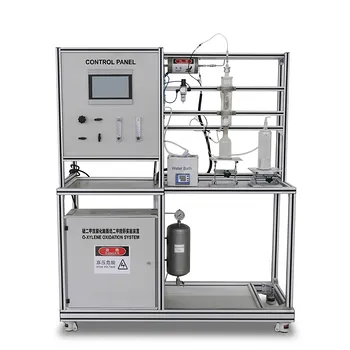
For chemical engineering students, the difference between a “conservative” and a “realistic” reactor runaway criterion becomes visceral when they can cause a near-runaway—and then prevent it—on a pilot scale. By systematically varying the cooling-fluid flow rate and the feed concentration in a tubular reactor pilot plant, students directly plot temperature–conversion trajectories and observe that criteria anchored in the temperature–conversion plane (such as the Morbidelli–Varma approach) delineate a significantly wider, yet intrinsically safe, operating window than older, purely thermal explosion criteria. This hands-on comparison transforms abstract safety theory into a tangible skill for optimizing reactor throughput without compromising margins.
The core insight: Educational pilot plants let students move from memorizing runaway criteria to experimentally mapping the actual, less-conservative boundary of safe operation. By manipulating heat transfer and heat of reaction parameters, they see firsthand why the Morbidelli–Varma and van Welsenaere–Froment criteria—rooted in the temperature–conversion trajectory—permit higher productivity, especially for low activation energy reactions, while still flagging the true onset of parametric sensitivity.
The Foundation: Conservative vs. Realistic Runaway Criteria
What Makes a Criterion “Conservative”?
Classical runaway criteria often treat the reactor as a simple thermal mass, comparing heat generation to heat removal at a single point.
These methods err on the side of caution: they flag a potentially dangerous condition earlier, sometimes unnecessarily restricting the feed rate or cooling duty.
While safe, such conservatism can force an industrial reactor to operate far below its true capacity—costing productivity.
The Shift to the Temperature–Conversion Plane
More realistic criteria examine the entire temperature–conversion trajectory.
Instead of checking a single temperature maximum, they look for parametric sensitivity—the point where a tiny change in an operating parameter (like inlet concentration) causes a disproportionate rise in temperature.
The Morbidelli–Varma criterion and the van Welsenaere–Froment criterion both use this trajectory-based logic. The latter, in particular, predicts runaway by evaluating whether the temperature maximum in the reactor exceeds a critical value derived from the sensitivity of the conversion path.
Why the Difference Matters in Practice
A conservative criterion might tell a student, “Do not exceed 60% conversion in this tubular reactor,” while a trajectory-based criterion shows that 75% conversion is perfectly safe under the same cooling conditions.
For an industrial team, that 15% gap can represent millions in throughput.
Teaching students to distinguish these boundaries prepares them to design reactors that are both inherently safe and economically optimized.
How Pilot Plants Make the Abstract Tangible
Beyond the Lecture Slide
In a classroom, runaway criteria are equations.
In a pilot plant, they become sound, sight, and data: the hum of a pump, a sudden spike on a temperature trend, the relief system’s readiness.
The primary reference emphasizes that educational tubular reactor setups give students the ability to physically observe how operating decisions shift the reactor toward—or away from—runaway.
The Unique Role of a Tubular Reactor Pilot Plant
A tubular reactor (continuous plug-flow type) is ideal for this demonstration because it naturally develops axial temperature and conversion profiles.
Students can install multiple thermocouples along the reactor length, then sample at various points to measure conversion.
Plotting temperature versus conversion in real time lets them see the trajectory curve that defines the realistic criteria.
Safety as the Enabler
The same pilot plants incorporate automated safety relief systems, precise temperature sensors, and emergency quench capabilities.
Supplementary references confirm that scaled-down jacketed reactors with these features allow safe study of exothermic runaway hazards from polymerization, sulfonation, and similar reactions.
This safety envelope gives instructors the confidence to let students approach—but never exceed—the true runaway boundary.
Designing the Experiment: Manipulating the Two Key Parameters
Cooling Fluid Flow Rate: Tuning the Heat Transfer Parameter
In any exothermic continuous reaction, the heat transfer parameter (often denoted St, the Stanton number) governs how quickly the cooling jacket can remove heat relative to the process stream’s thermal mass.
Students alter this parameter by adjusting the cooling water flow rate.
A high flow rate simulates a “large” St—efficient cooling—while a low flow rate shrinks the safe operating region, moving the reactor closer to the parametric sensitivity zone.
Feed Concentration: Shifting the Heat of Reaction Parameter
The heat of reaction parameter (often B, the dimensionless adiabatic temperature rise) is proportional to the inlet reactant concentration.
By changing the feed concentration, students directly control how much heat is released for a given conversion.
Increasing B makes the same conversion generate a higher temperature spike, pushing the trajectory toward runaway territory.
The Experimental Protocol
A typical instructional run might start with a baseline condition: moderate cooling and moderate feed concentration.
The students note the temperature–conversion profile and confirm it lies well within the safe region according to both conservative and realistic criteria.
They then reduce cooling (lower St) or raise concentration (higher B) in small increments, re-plotting the trajectory each time. At some boundary, the temperature peak becomes extremely sensitive to these parameters—the precise point that the realistic criteria aim to detect.
Interpreting the Temperature–Conversion Profiles
How the Curves Reveal Runaway
When students plot discrete (T, X) data pairs, a stable, non-runaway reaction shows a relatively flat temperature maximum that shifts only gently as St or B change.
As the reactor approaches the runaway region, the temperature maximum climbs sharply with just a tiny increase in feed concentration or decrease in cooling.
This is parametric sensitivity, and it is far more intuitive when seen on a graph than when derived from an eigenvalue analysis.
Conservative Criteria Cry “Stop” Too Early
Students overlay the conservative limit (often based on a maximum allowable temperature rise or a simple Semenov-type analysis) on the same plot.
They see that this line cuts through the trajectory well before the curvature becomes dangerously steep.
For example, at low activation energies, the Morbidelli–Varma boundary can be substantially more permissive because the reaction’s sensitivity is lower, yet the older criterion still imposes the same rigid cap.
The van Welsenaere–Froment Distinction
The van Welsenaere–Froment criterion specifically evaluates the temperature at the hottest spot in the reactor relative to the conversion at that point.
Students can mark this point on their experimental curve and check whether it exceeds a critical ratio.
The primary reference notes that criteria built on the temperature–conversion plane “yield less conservative, more realistic boundaries for safe operation, especially at low activation energies.” The pilot plant turns this sentence into a visual, data-backed fact.
Why This Matters: Bridging Theory and Industrial Safety
From Classroom to HAZOP
An engineer who has manipulated a pilot reactor to the edge of runaway understands what “loss of cooling” truly means.
Supplementary references underscore that simulating process deviations—cooling water failure, agitation loss—on a pilot scale is vital for developing the skills needed to run HAZOP studies and design automatic safety backup systems.
The runaway criteria demonstration is the first building block of that mental model.
Optimizing Throughput with Confidence
Manufacturers are under constant pressure to increase reactor throughput.
A student trained only on conservative criteria will instinctively design reactors with oversized heat exchangers or low conversion limits, sacrificing yield.
A student who has seen the realistic boundary in action can propose a higher conversion target—with the data to justify it—knowing the safety margin is still intact.
Anchoring the Concept of Stoessel Criticality
While the primary reference focuses on continuous tubular reactors, the pilot plant setup can be extended to batch or CSTR vessels where Stoessel criticality classes (1 to 5) are taught.
In both cases, the core lesson is the same: safety is not a binary “safe/unsafe” switch, but a continuous region that must be characterized by the sensitivity of the temperature profile to upset conditions.
Understanding the Trade-offs
Realistic Criteria Still Rely on Model Assumptions
The Morbidelli–Varma and van Welsenaere–Froment criteria assume idealized plug flow, constant physical properties, and a single irreversible reaction.
In a pilot plant, deviations from ideality—axial dispersion, wall heat effects, catalyst deactivation—can blur the exact boundary.
Students must learn that the “realistic” boundary is more accurate than the conservative one, but still a model-informed guideline, not an absolute crystal ball.
The Danger of Overconfidence
A less conservative boundary might embolden a student to push the reactor too close to the true limit.
The pilot plant must be equipped with independent overtemperature alarms and automated quench so that if students misinterpret the data, the system steps in.
This teaches a second, equally important lesson: safety layers are never removed based on a calculation alone.
Scale-Up Nuances
The supplementary references highlight that pilot-scale reactors (50–4,000 L) can have different heat transfer surface-to-volume ratios and flow dynamics than industrial units (400–12,000 L).
A boundary that appears safe at pilot scale may shift at manufacturing scale due to reduced cooling efficiency.
Effective teaching explicitly addresses this scale-up caution, ensuring students do not assume the pilot-observed curves are universal.
Making the Right Choice for Your Educational Goal
Different curricula will emphasize different takeaways from this experiment. Align the demonstration with your primary learning objective.
- If your primary focus is inherently safer design: Emphasize the visual contrast between the conservative and realistic boundaries and have students map the required cooling capacity at each point. This drills home that safety is a design parameter, not an afterthought.
- If your primary focus is reaction engineering optimization: Ask students to calculate the increase in allowable conversion (or feed rate) when switching from a conservative to a trajectory-based criterion, then verify experimentally that the reactor remains stable.
- If your primary focus is preparing students for industrial HAZOP studies: Introduce intentional failures (pump trip, cooling valve closure) during the experiment and have students predict—using both criteria—when runaway will initiate.
- If your primary focus is data analysis and modeling: Provide students with the raw temperature–conversion data and challenge them to identify the parametric sensitivity point themselves before revealing the Morbidelli–Varma boundary.
Bringing reactor runaway criteria to life through a pilot plant turns a dry safety checklist into an unforgettable lesson in process optimization and professional judgment—exactly the skill that distinguishes a theoretically trained engineer from a plant-ready one.
Summary Table:
| Feature / Metric | Conservative Runaway Criteria | Realistic Runaway Criteria (e.g., Morbidelli-Varma) |
|---|---|---|
| Core Focus | Heat generation vs. removal at a single point | The entire temperature–conversion trajectory |
| Safe Operating Window | Narrower; flags runaway conditions unnecessarily early | Wider; identifies the true onset of parametric sensitivity |
| Reactor Throughput | Lower; limits conversion and feed rates conservatively | Higher; optimizes yield and productivity safely |
| Key Parameters Tracked | Peak temperature or simple thermal limits | Stanton number ($St$) and dimensionless adiabatic temperature rise ($B$) |
| Practical Application | Basic thermal explosion prevention | Advanced industrial reactor design and HAZOP optimization |
Bridge the Gap Between Theory and Industrial Safety with LABPARK
Transform abstract chemical engineering concepts into tangible, hands-on skills. LABPARK provides high-quality Educational and Vocational Unit Operations Pilot Plants in chemical engineering, bioprocess & biotech, and environmental & water treatment.
Designed for universities, research institutes, and enterprises, our pilot plants are equipped with built-in safety systems, automated controls, and precise sensors to let students safely explore the boundaries of reactor dynamics, HAZOP scenarios, and throughput optimization.
Ready to elevate your engineering curriculum? Contact LABPARK today to discuss your laboratory needs!
Related Products
- Fixed-Bed Chemical Reaction and Gas Dust Tar Removal Unit Operations Pilot Plant
- Fixed Bed Gas Solid Catalytic Reaction Educational Pilot Plant
- 100L Continuous Loop Hydrogenation Educational Unit Operations Pilot Plant
- Multi-Reactor Educational Pilot Plant for Reaction Engineering Unit Operations
- Residence Time Distribution and Reactor Flow Characteristics Determination Educational Pilot Plant
People Also Ask
- When to transition from PID to adaptive control in pilot plants? Key process indicators.
- How do deviations in estimating latent heat impact pilot plant thermal systems? Avoid hardware mis-sizing.
- Why Compare Predicted and Experimental Excess Enthalpy? Key to Accurate Pilot Plant Scale-up
- Why Use PTFE & Hastelloy in Chemical Pilot Plants? Prevent Corrosion & Ensure Safety
- How can unit operations pilot plants demonstrate simultaneous removal of light and heavy impurities? Configure a modular setup