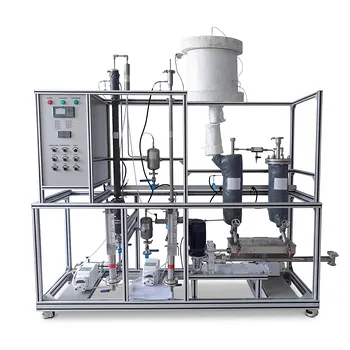
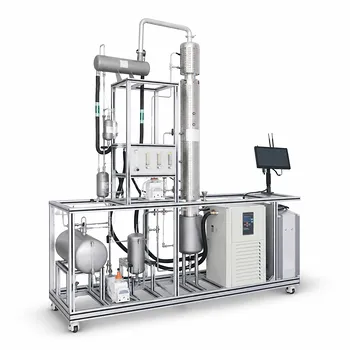
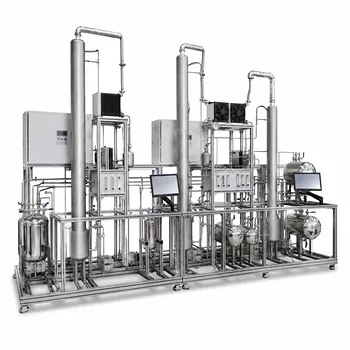
The key to demonstrating Dalton's Law vividly and safely in the classroom lies in a purpose-built steam distillation pilot plant. To configure such a system for extracting limonene from orange peel, you need a steam generator, a packed biomass vessel, a chilled condenser, and a decanter—all instrumented to show that the mixture boils below 100 °C solely because the immiscible water and oil vapors behave as independent gases. When these two immiscible liquids are heated together, their partial pressures add up to atmospheric pressure at a temperature lower than either pure component's boiling point, enabling the high-boiling limonene (175.5–176.5 °C) to vaporise gently with the steam and avoid thermal breakdown.
Proving Dalton's Law of Partial Pressures in a pilot plant is not about complex equipment—it’s about configuring a simple, transparent flow path that lets students measure, control, and physically see how two immiscible liquids co-distil. The real educational value emerges when students can vary steam flow, record the resulting vapour temperature, and then calculate the individual partial pressures to confirm they sum to ambient pressure.
Why Steam Distillation Instantly Embodies Dalton’s Law
The Thermodynamic Principle at Play
Dalton’s Law states that in a mixture of immiscible liquids, each component exerts its own vapor pressure independently, as if the other were not present. The total pressure above the liquid is simply the sum of those individual pressures. This means the mixture will boil when the combined partial pressures equal the external (typically atmospheric) pressure, not when either liquid would boil on its own.
For water and limonene, this is transformative. Pure limonene would require a temperature near 176 °C to boil, a condition that would rapidly degrade the heat-sensitive oil. By co-distilling with water, the system reaches a boiling point somewhere below 100 °C—typically around 95–98 °C at sea level—because the water’s vapour pressure contributes most of the required push while the limonene adds the remaining fraction.
Why This Protects the Essential Oil
The low-temperature operation is the second educational hook. Because the boiling temperature never exceeds that of pure water at the ambient pressure, the limonene volatilizes without charring or polymerizing. Students can observe that a compound with a boiling point nearly twice that of water is gently swept into the condenser, preserving both its chemical integrity and its characteristic orange aroma—a direct consequence of the thermodynamic law.
Configuring the Pilot Plant for Clear, Measurable Proof
The Core Hardware Sequence
A demonstration-grade pilot plant needs four integrated sections, each deliberately instrumented:
- Steam generator: A controlled boiler (often electric) that produces saturated steam at a known, steady rate. A pressure gauge and a flow meter on the steam line allow students to relate steam input to distillate output.
- Biomass vessel: A vertical glass or stainless-steel column packed with fresh orange peel. The steam enters at the bottom, stripping the essential oil from the plant material as it rises. A thermocouple at the vessel outlet captures the mixed vapour temperature—the critical data point that stays well below 100 °C.
- Condensation system: A shell-and-tube or coil condenser cooled by chilled water. The mixed vapours condense into a two-phase liquid that flows into a separator.
- Separation unit (Decanter): A continuous decanter or a graduated glass separator where the lighter limonene floats atop the water. A calibrated collection port lets students measure the volume of oil recovered per unit time.
The Measurements That Anchor the Proof
Configuration alone is not enough; the plant must be instrumented so students can test the law directly. The essential measurements include:
- Inlet steam flow rate (litres of condensate per hour or kg/h).
- Vapour temperature at the still head (T_vapour). This should be recorded as the system reaches a steady state—if Dalton's Law holds, T_vapour will remain constant for a given pressure despite changes in steam rate within the normal operating range.
- Ambient pressure (barometric reading), which sets the total pressure the vapours must overcome.
From these, students can calculate the partial pressure of water (p_water) at T_vapour using steam tables, and subtract it from the ambient pressure to find the limonene partial pressure (p_limonene). The sum of p_water and p_limonene will closely equal atmospheric pressure, confirming the law.
Adjusting Variables to Reveal the Principle
To move beyond a static demonstration, the pilot plant should be designed for deliberate upsets. Varying the steam generator output while monitoring T_vapour shows that the boiling temperature does not change, as long as the mixture composition remains immiscible; only the distillation rate changes. Conversely, if the system is temporarily closed or pressurized (only with safety valves), the boiling point will rise—another powerful illustration of the pressure dependence.
Understanding the Trade-offs and Educational Pitfalls
The Limitation of Ideal Behaviour
Real-world mixtures are never completely immiscible; a tiny fraction of water dissolves in limonene and vice versa. This causes a slight deviation from the ideal Dalton’s Law prediction. For pure pedagogical purposes, this deviation is negligible, but students should be warned that the measured oil vapor pressure might differ from literature values by a few percent. A discussion of Raoult’s Law deviations for slightly soluble liquids makes an excellent bridging topic.
Thermal Degradation Is Still Possible
Even below 100 °C, prolonged exposure to steam can hydrolyse some delicate compounds or cause undesirable reactions in the orange peel’s matrix. The pilot plant configuration must allow for short batch times and rapid cooling to preserve the limonene’s purity. Otherwise, the demonstration can subtly fail as the oil’s aroma changes, undermining the “gentle extraction” message.
Scale and Material Challenges
Small educational units often struggle with stable steam generation at very low flow rates. Fluctuations cause surging in the decanter and make mass balance calculations messy. Using a glass-packed column that allows visual tracking of steam channelling can actually help here—it shows where the extraction becomes inefficient, leading to a deeper conversation about mass transfer limitations.
Making the Right Choice for Your Educational Goals
The configuration you adopt should mirror what this lesson aims to deliver beyond the chemical engineering principle.
- If your primary focus is teaching thermodynamics: Choose a plant with high-quality temperature and pressure instrumentation, and keep the biomass loading minimal. The goal is clean vapour mixture data, not high oil yield. Include a barometer and pre-printed steam tables in the lab manual.
- If your primary focus is natural product extraction: Add a secondary condenser or a vacuum option to experiment with pressure-dependent boiling points. Emphasize the decanter design and recovery calculations, showing how Dalton’s Law directly enables gentler oil isolation.
- If your primary focus is process control and scale-up: Integrate steam flow controllers and data logging. Let students map steam consumption ratios (kg steam per kg oil) and discuss how this energy balance ties back to the partial pressure relationship—a critical bridge to industrial distillation design.
A single well-instrumented pilot plant, set up to isolate limonene from orange peel, transforms an abstract gas law into a memorable, fragrant, and measurable reality. Let your students see the temperature gauge stall below 100 °C, and they will never forget that immiscible liquids respect no boundary but their own vapor pressures.
Summary Table:
| Component | Function in Dalton's Law Demonstration | Key Measurement |
|---|---|---|
| Steam Generator | Provides steady steam to drive distillation below 100°C | Steam flow rate |
| Biomass Vessel | Holds orange peel; extraction site for limonene | Vapor temperature (T_vapour) |
| Condenser | Cools mixed water and oil vapors into liquid | Coolant temperature |
| Decanter | Separates immiscible limonene and water phases | Limonene recovery volume |
Bring Thermodynamics to Life in Your Lab
Looking to enhance your engineering curriculum with hands-on learning? LABPARK provides state-of-the-art Educational and Vocational Unit Operations Pilot Plants in chemical engineering, bioprocess & biotech, and environmental & water treatment. Designed specifically for universities, research institutes, and enterprises, our systems make complex concepts like Dalton's Law tangible, visual, and measurable.
Contact LABPARK today to discover how we can customize the perfect pilot plant solution for your educational and research needs!
Related Products
- Steam Methane Reforming Hydrogen Production and Purification Educational Pilot Plant
- Continuous Sieve-Plate Distillation Pilot Plant for Unit Operations Laboratory Education
- Multi-Functional Special Distillation Educational Pilot Plant
- Multi-Modal Distillation Unit Operations Training Pilot Plant
- Continuous Batch Extractive Distillation Educational Pilot Plant
People Also Ask
- How Do Temp, Pressure & S:C Ratio Affect Methane Reforming? Optimize Your Pilot Reactor
- How to Integrate WGS & Purification in Steam Reforming Pilot Plants to Protect Fuel Cells from CO Poisoning
- What are the differences between steam reforming and ATR in pilot plants? Key Design Guide
- How is carbon deposition controlled in steam reforming? The Critical Role of S/C Ratio
- What is the difference between allothermal and autothermal steam reforming in pilot plants?