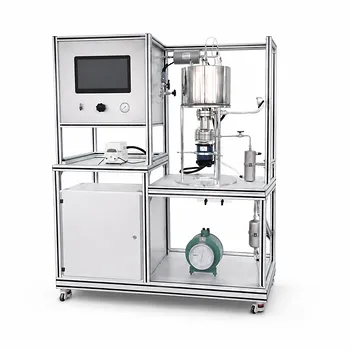
By bridging the chasm between ordinary differential equations and physical operations, educational reactor pilot plants provide the definitive platform for students to validate their mathematical models through direct, empirical comparison. These systems transform abstract terms like reaction rate and heat transfer coefficient from variables to be solved into measurable, tunable parameters that students can adjust to make their simulations match reality.
The core purpose of a batch reactor pilot plant is to give students a physical control volume where they can test the assumptions of their theoretical models. By measuring real-time concentration and temperature data, they can rigorously compare predicted dynamic behavior against experimental truth, learning not just if their equations are correct, but how to quantify and explain the inevitable deviations.
Moving from Equations to Experimental Reality
The mathematical model of a batch reactor is elegantly simple: ordinary differential equations describing how concentration and temperature change over time. The educational pilot plant makes these equations tangible.
The Material Balance in Action
The theoretical material balance, $d(C_A)/dt = -r_A$, predicts the consumption of reactant based on a kinetic model. In the pilot plant, this equation becomes testable.
Students sample the reactor at specific times or use online analytical tools to measure the actual concentration $C_A$ of the limiting reactant. By comparing these discrete data points against integrated rate equations for zero, first, or second-order kinetics, they can plot the data in the appropriate linearized form. The plot that yields a straight line confirms the reaction order and directly yields the rate constant $k$ from its slope.
This empirical determination of kinetics is a deeper validation than simply reading a textbook value. It forces students to confront whether their assumptions about reaction order hold under real mixing, temperature gradients, and impurity levels.
Visualizing the Energy Balance
The energy balance, $\rho C_p d(T)/dt = \Delta H r_A - U A (T-T_c)$, couples heat generation with heat removal. The pilot plant’s real-time sensors for reactor temperature $T$ and coolant temperature $T_c$ turn this equation into a dynamic story.
Students can observe the exothermic temperature rise when the reaction begins, and then watch the jacket temperature adjust to control it. By running the same reaction under different jacket temperature settings, they can generate multiple temperature profiles. Overlaying the experimental $T(t)$ curves with simulation predictions from MATLAB or Python reveals how well the chosen heat transfer coefficient $U$ describes the system.
When the model overpredicts the peak temperature, students learn to identify real-world thermal capacitance effects or imperfect mixing. When it underpredicts, they may uncover environmental heat losses or sensor lag. This diagnostic process is where true model validation occurs.
The Critical Role of Parameter Estimation
Model validation is not just a binary pass/fail check. It is an iterative loop of parameter estimation that makes the pilot plant a uniquely powerful learning tool.
From Fudge Factors to Physical Insight
In a purely theoretical course, the heat transfer coefficient $U$ is often a given constant. In the pilot plant, it becomes a parameter to be extracted from data. Students vary the jacket temperature or the initial reactant concentration, fit their models to the resulting profiles, and back-calculate $U$.
They quickly discover that $U$ is not necessarily constant but may vary with batch viscosity or stirrer speed. This teaches the critical lesson that model parameters are context-dependent and must be validated under conditions similar to the intended application.
Similarly, reaction rate constants $k$ determined experimentally can be checked against Arrhenius behavior. By repeating the batch experiment at different temperatures, students can validate or refine the activation energy originally assumed from literature.
Understanding the Trade-offs and Pitfalls
No validation exercise is complete without confronting the limitations of both physical equipment and mathematical models. The pilot plant excels at surfacing these lessons.
The Gap Between Ideal and Real Mixing
The model assumes perfect mixing, but the physical reactor may exhibit concentration gradients. A student who blindly trusts the ideal model will see discrepancies. By probing the system—perhaps by sampling from different reactor locations—they learn that model validation must include an assessment of the mixing regime. This introduces the concept of model applicability limits.
Sensor Dynamics and Data Noise
Real-time sensors bring their own dynamics, including time lags and noise. A student comparing raw experimental temperature data against a smooth simulation may initially think their model is wrong. The pilot plant teaches them to filter signals appropriately and account for sensor dynamics before declaring a model invalid.
Heat Losses to the Environment
The basic energy balance equation rarely accounts for heat lost to the ambient air through the reactor lid or walls. The pilot plant, with its exposed surfaces, makes these losses painfully apparent. Students learn to extend their energy balance with an empirical heat loss term, turning a textbook equation into a more robust, real-world model. This is perhaps the most direct validation of how theoretical models must be adapted for physical systems.
Making the Right Choice for Your Learning Goal
How you use the pilot plant should directly reflect your primary educational objective. The data it provides is a means to an end, not an end in itself.
- If your primary focus is mastering reaction kinetics: Place the greatest emphasis on concentration sampling and fitting the integrated rate law. Use isothermal conditions to decouple the energy balance and focus solely on determining $k$ and the reaction order with high precision.
- If your primary focus is understanding heat transfer and thermal safety: Design experiments with deliberate temperature excursions. Compare the measured $T(t)$ curve with simulations using different $U$ values, and pay close attention to the mismatch between the ideal adiabatic prediction and the actual cooled profile.
- If your primary focus is developing process modeling and coding skills: Use the plant to generate rich datasets and then challenge yourself to build the simulation from scratch in software. Focus on implementing the ODE solver and on automating the parameter estimation routine to minimize the error between your simulation and the physical data.
The batch reactor pilot plant is not just a piece of equipment; it is a truth-teller for your mathematical models. By putting your equations to the test, it reveals which assumptions hold, which parameters truly govern the system, and how to think critically when simulation and reality diverge.
Summary Table:
| Validation Aspect | Theoretical Assumption | Pilot Plant Empirical Validation |
|---|---|---|
| Material Balance | Ideal kinetics: $d(C_A)/dt = -r_A$ | Time-series concentration sampling to determine reaction order and rate constant $k$. |
| Energy Balance | Ideal heat transfer: $U$ is constant | Real-time monitoring of $T$ and $T_c$ to extract $U$ and account for ambient heat loss. |
| Parameter Estimation | Static literature parameters | Dynamic fitting of parameters ($U, k, E_a$) under actual operating and mixing conditions. |
| System Dynamics | Perfect mixing & zero sensor lag | Diagnostic evaluation of concentration gradients, sensor delays, and noise. |
Elevate Chemical Engineering Education with LABPARK
Bridge the gap between complex mathematical models and physical operations in your laboratory. LABPARK provides premium Educational and Vocational Unit Operations Pilot Plants across chemical engineering, bioprocess & biotech, and environmental & water treatment.
Tailored for universities, research institutes, and enterprises, our advanced pilot plants enable students to gain hands-on experience, validate real-time mass and energy balances, and master process control.
Ready to upgrade your laboratory capabilities? Contact LABPARK today to explore our custom pilot plant solutions!
Related Products
- Continuous Batch Extractive Distillation Educational Pilot Plant
- Multi-Reactor Educational Pilot Plant for Reaction Engineering Unit Operations
- Fixed-Bed Chemical Reaction and Gas Dust Tar Removal Unit Operations Pilot Plant
- Methanol Synthesis and Catalyst Performance Evaluation Educational Unit Operations Pilot Plant
- Fluidized Bed Gas Solid Catalytic Reaction Educational Pilot Plant
People Also Ask
- Wilson vs. UNIQUAC: How to Choose the Right Thermodynamic Model for Your Pilot Plant
- Why use non-ideal VLE calculations in distillation pilot plants? Ensure accurate scale-up & purity
- How does the feed thermal state influence distillation pilot plant design and utility consumption?
- How to Configure a Distillation Pilot Plant? Key Steps for Multi-Mode Setup
- How to Integrate Spectroscopy in Distillation Pilot Plants for Advanced Process Control