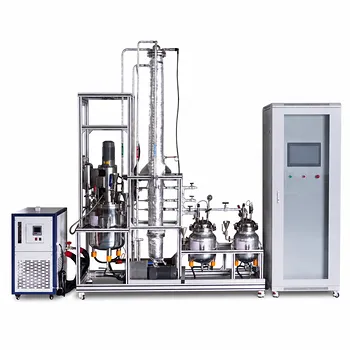
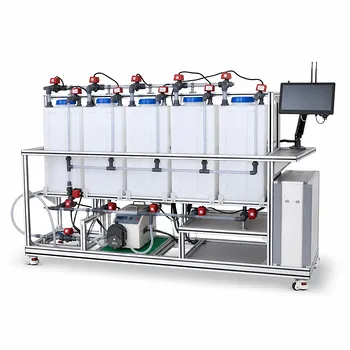
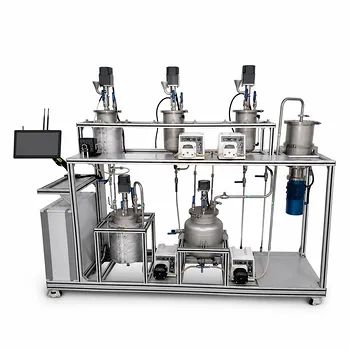
Pilot plants turn abstract concepts of material recycling and energy recovery into tangible, measurable skills. They provide physical, scaled-down chemical processes where students can manipulate recycle loops to recover unreacted feedstocks and solvents, and physically configure heat exchanger networks to capture waste energy. This direct interaction bridges the critical gap between textbook theory and the operational realities of minimizing waste and utility consumption in an industrial setting.
The true power of a pilot plant is not just demonstrating that recycling and heat integration are possible, but forcing students to confront the real-world complexities—like solving the mass balances of interconnected streams and dealing with the economic trade-offs of energy recovery—that turn a principle into a practical, sustainable process.
The Hands-On Mechanics of Material Recycling
Educational pilot plants make material conservation a physical reality. Students move beyond passive learning to actively set up, monitor, and troubleshoot systems where the goal is maximum feedstock utilization. This teaches not just what recycling is, but how it dynamically affects the entire process.
Demonstrating Closed-Loop Recovery of Unreacted Feedstocks
The core of material recycling education is the physical recycle loop. In a typical pilot plant, a reactor effluent enters a separation unit, where unreacted raw materials, solvents, or catalysts are captured. Instead of being discarded, this stream is routed back to the reactor inlet.
This setup lets students visually trace the path of materials and immediately grasp the purpose of recycling. They can physically sample the recycle stream and reactor feed to measure compositions, seeing firsthand that recycling is essential because chemical reactions are rarely 100% complete. The result is a direct, intuitive understanding of why maximizing overall conversion requires this closed-loop approach.
Controlling Conversion Rates with Bypass and Purge Streams
Pilot plants often include bypass loops that redirect a portion of the feed stream around a unit and mix it with the outlet. Students manipulate these valves to observe how bypassing affects final product concentration and process control without shutting down the unit.
This hands-on manipulation directly links to the mathematical distinction between overall conversion and single-pass conversion. Students calculate overall conversion by measuring the process’s total input and output, and single-pass conversion by measuring only the reactor’s immediate surroundings. The physical system makes these abstract concepts concrete, revealing why single-pass conversion can be low while overall conversion approaches 100% with effective recycling.
Validating Mass Balances in Complex Recycle Networks
Adding a recycle stream turns a simple mass balance into an intricate puzzle. The composition of the recycle stream is dependent on the efficiency of the downstream separator, creating a circular dependency that can’t be solved in a single step.
In a pilot plant, students physically measure actual flow rates and compositions in all streams, including the recycle. They then apply theoretical methods like the tearing (iteration) method or simultaneous equations to solve the mass balance. The most powerful lesson comes when they compare their calculated results to their physical measurements, confronting the inevitable minor discrepancies that arise from real-world instrument error, transient hold-up, and non-ideal mixing.
Demystifying Energy Recovery and Thermal Integration
Beyond materials, pilot plants bring the invisible flow of energy to life. Students learn that waste heat is not an abstraction but a measurable resource that can be captured, quantified, and redirected to slash utility costs.
Quantifying Heat Transfer Efficiency in Physical Units
A pilot-scale heat exchanger, evaporator, or distillation column is an ideal laboratory for thermal analysis. Students adjust process control variables like flow rates and reflux ratios and then directly measure inlet and outlet temperatures, pressure drops, and condensate flow.
This allows them to calculate heat transfer coefficients and overall thermal efficiency. By linking a simple control change to a measurable change in energy consumption, they internalize how tightly process control and sustainability are linked. The pilot plant transforms thermal efficiency from a textbook formula into a tangible performance metric they must optimize.
Applying Pinch Analysis to Real Heat Exchanger Networks
Advanced pilot plants feature networks of hot and cold streams, including preheaters, condensers, and reboilers. Here, students can physically configure different heat exchanger arrangements to implement pinch analysis—the gold-standard methodology for energy targeting.
They can measure stream temperatures to experimentally determine the pinch point and calculate the minimum hot and cold utility requirements. This hands-on configuration task forces them to respect thermodynamic constraints, such as the minimum temperature driving force needed for heat transfer, making the fundamental rules of heat integration impossible to ignore.
Simulating Batch and Indirect Heat Recovery Strategies
Not all processes run continuously, and pilot plants can simulate batch scheduling to demonstrate a more complex energy recovery challenge: indirect heat transfer. Since hot and cold streams may not exist simultaneously, students can use systems with thermal storage tanks or intermediate utility loops.
This teaches them to evaluate practical solutions for process scheduling problems and the inherent thermodynamic trade-offs. They learn that storing heat introduces temperature degradation, and that recovering energy across time, not just space, requires a more sophisticated design strategy.
Bridging the Gap Between Theory and Industrial Sustainability
The ultimate value of these pilot plants is their role in building a mindset geared toward sustainable, safe, and scalable process design from the very beginning.
Fostering an Inherently Safer Design Mindset
Material and energy conservation are deeply intertwined with process safety. Pilot plants allow students to operate systems with inherently safer characteristics: smaller equipment volumes and lower inventories of hazardous substances. They can test strategies like using a safer alternative solvent in a recycling loop. This hands-on experience in conducting risk assessments and designing safety interlocks on a physical system—even a small one—teaches that an optimized, sustainable process is also often a safer one.
Overcoming Scale-Up Fears Through Problem-Based Learning
A major barrier to adopting green chemistry is a lack of practical confidence. Pilot plants are the critical intermediate step. They provide a realistic environment where students and trainee engineers can actively troubleshoot energy losses, manage environmental protocols, and optimize resource recovery without the financial risk of a full-scale failure. This problem-based learning builds the confidence and competence needed to champion sustainable practices in their future industrial roles.
Understanding the Trade-offs and Limitations
A powerful teaching tool also reveals its own constraints. The true lesson from a pilot plant is not that the optimized lab-scale solution is perfect, but that scaling it up introduces a new universe of challenges.
The Chasm Between Pilot Data and Full-Scale Reality
A successfully integrated pilot plant with a tiny utility bill can create a false sense of security. The dynamic behavior, wall effects, and heat loss ratios of a 50-liter column are fundamentally different from a 50,000-liter industrial unit. The lesson is that pilot data validates the principle, not the final design. Students must learn that the economic and thermodynamic viability of a heat recovery scheme at scale still requires rigorous modeling and often leads to different, less idealized heat exchanger network configurations.
The Seductive Danger of Oversimplifying Thermodynamic Models
Calculating the mass balance of a recycle loop using a simple tearing method can work beautifully on a small, steady-state pilot plant with minimal impurities. In a real plant where by-product buildup or catalyst degradation occurs, purge streams become a critical control variable to prevent system poisoning. The pilot plant must be used to teach this exact limitation: that idealized models fail when they ignore the accumulation of trace components, and that physical sampling is the only way to detect the problem.
Making the Right Choice for Your Educational Goal
A pilot plant’s curriculum must be tailored to achieve a specific learning outcome. The design and operation of the exercises will determine which lesson sticks.
- If your primary focus is instilling fundamental principles: Use the plant for simple, visual demonstrations of closed-loop recycling and direct heat exchange, focusing on basic mass and energy balance calculations.
- If your primary focus is advanced process simulation and validation: Design experiments around complex recycle loop dynamics and multi-stream heat exchanger networks, then challenge students to match predictive software models with real, often messy, physical data.
- If your primary focus is sustainability and waste minimization: Create projects centered on waste stream segregation and by-product recovery for new product synthesis, emphasizing the operational parameters needed to sustain zero-discharge processes.
- If your primary focus is safety and process control: Run scenarios that involve exothermic reactions with recycle, teaching students how to design interlock systems and conduct risk assessments on a system with reduced hazard inventories.
A well-designed educational pilot plant does not just demonstrate a chemical process; it compresses the entire lifecycle of sustainable engineering design—from concept, through physical validation, to the humbling confrontation with real-world data—into a single, powerful learning experience.
Summary Table:
| Focus Area | Key Concepts | Pilot Plant Application |
|---|---|---|
| Material Recycling | Closed-loop recovery, bypass & purge, mass balances | Manipulating recycle loops, measuring conversions, and validating non-ideal systems. |
| Energy Recovery | Heat transfer, pinch analysis, indirect heat recovery | Configuring physical heat exchanger networks and analyzing thermal efficiency. |
| Process Safety & Scale-up | Inherently safer design, scale-up limits, risk assessment | Troubleshooting energy losses, designing safety interlocks, and testing green chemistry. |
Empower Your Students with Hands-On Engineering Experience
Bridge the gap between textbook theory and real-world industrial sustainability. LABPARK provides state-of-the-art Educational and Vocational Unit Operations Pilot Plants in chemical engineering, bioprocess & biotech, and environmental & water treatment for universities, research institutes, and enterprises.
Enhance your curriculum and research capabilities today—contact us to discuss your pilot plant needs!
Related Products
- Natural Product Extraction Unit Operations Training Pilot Plant
- Residence Time Distribution and Reactor Flow Characteristics Determination Educational Pilot Plant
- Electrolyte Distillation Purification and Formulation Educational Pilot Plant
- Carbon Material Thermal Pretreatment Multiphase Separation Educational Pilot Plant
- Fixed-Bed Chemical Reaction and Gas Dust Tar Removal Unit Operations Pilot Plant
People Also Ask
- How to Demo Solubility Sensitivity in SFE Pilot Plants? Practical Thermodynamics
- How do pilot plants differentiate physical vs chemical extraction? Enhance Chemical Engineering Training
- How are HTU and NTU applied to determine extraction column height? Guide to Pilot Plant Scaling
- Why use split-plot designs in pilot plants instead of CRD? Optimize process parameters effectively.
- What are the limitations of acentric factor models? Avoid pilot plant errors with polar fluids.