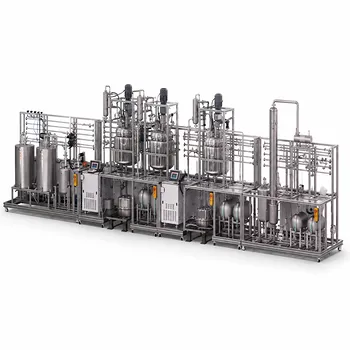
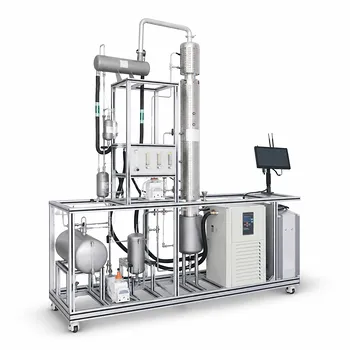
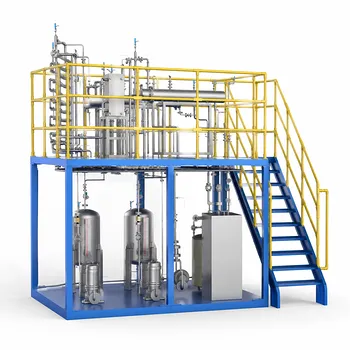
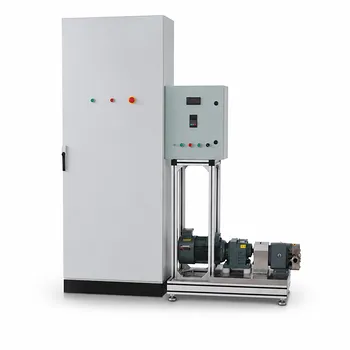
Here’s the core shift: Pilot plants transform Hess’s Law from a paper exercise into a tangible engineering challenge. Instead of simply summing tabulated enthalpy changes, students use jacketed reactor trainers with integrated sensors and data acquisition to measure temperature shifts directly during a real reaction. They then perform a dynamic energy balance and compare the empirical result with the calculated value, confronting the realities of heat loss, vessel heat capacity, and non-ideal mixing head-on.
The leap from a Hess’s Law calculation to pilot-plant measurement is a leap from an idealized, closed-system model to an open, dynamic system. The true educational value lies not in getting the two numbers to match, but in understanding why they don’t—and learning to manage the difference through sound engineering.
Beyond the Textbook: Why Hess’s Law Alone Isn’t Enough
The Purity of Theory
Hess’s Law gives students a powerful indirect method to calculate reaction enthalpy for reactions that are dangerous, slow, or plagued by side products. It assumes perfect data and a closed system. An undergraduate can confidently sum the formation enthalpies of the steps and arrive at a single, clean number for ΔH.
The Messiness of Reality
An industrial reactor is not a blackboard. Real-time heat measurement is challenged by:
- Heat losses to the surroundings that no calculation can predict with certainty.
- The thermal mass of the reactor itself, which absorbs a significant portion of the released heat.
- Non-ideal mixing that creates local hot spots and uneven temperature distributions.
A student who has only ever used Hess’s Law has no framework for managing these variables. That is the precise gap a unit operations pilot plant is designed to fill.
How a Pilot Plant Reactor Makes Heat “Visible”
The Instrumented System as a Calorimeter
An educational pilot plant, such as a jacketed batch reactor with a digital data acquisition system, acts as a large-scale calorimeter. It does not merely react chemicals; it actively measures the energy exchange.
Key components include:
- Precise temperature sensors at the inlet and outlet of the jacket, as well as inside the reactor.
- Flow meters to track the mass of the heat-transfer fluid.
- Software that logs data multiple times per second, allowing for a dynamic energy balance.
From Data to ΔH: The Dynamic Energy Balance
Students don't just watch the temperature rise. They calculate the heat released or absorbed by the reaction in real-time. They start with the fundamental equation, ( Q = m c_p \Delta T ), and then account for the accumulation of heat in the reactor walls and the heat lost to the environment. This forces them to move from a simple, static subtraction to a transient analysis of an open system.
Direct Comparison and the "Aha!" Moment
Once the run is complete, the student compares their empirically measured ΔH with the value pre-calculated using Hess’s Law. The numbers will rarely match perfectly. This discrepancy is the critical teaching moment, revealing the practical factors that theoretical models ignore.
Understanding the Trade-offs and Hidden Lessons
When Precision Meets Inefficiency
A pilot plant is not a precision calorimeter. Its larger volume and industrial design introduce intentional inefficiencies. The key trade-off is that measuring heat in this context teaches process control and safety, not just physical chemistry. The goal is to learn how to manage the heat, not just to know its final value.
The Scale-Down Challenge
Students must also learn that pilot-plant data has its own limitations. Heat loss and wall effects are disproportionately high in small-scale equipment compared to a full-scale production reactor. A direct lesson is that pilot-scale verification is essential before scaling up. You can't just plug a Hess’s Law number into a 10,000-liter reactor design and assume safety.
A Safe Space for Exothermic Hazards
Running an exothermic reaction with real-time temperature monitoring on a pilot scale provides a visceral understanding of thermal runaway. This is a safety lesson that no Hess’s Law calculation can impart. Students learn to design cooling duty not just for the theoretical peak, but with a safety factor that accounts for uncertainty and side reactions.
Making the Right Choice for Your Learning Goal
The way you integrate the pilot plant into a thermodynamics curriculum should depend on the primary skill you aim to build.
- If your primary focus is mastering fundamental thermodynamics: Use the pilot plant as a verification tool. Have students calculate ΔH via Hess’s Law and bond enthalpies, then run a simple, clean reaction to confirm the number and isolate the heat loss.
- If your primary focus is process engineering and control: Task students with using the measured heat data to tune a dynamic model of the reactor. Let them adjust the model for the vessel’s heat capacity and then predict the temperature profile for a different reaction.
- If your primary focus is safety and scale-up: Design an experiment where a small change in coolant flow rate causes a dramatic temperature spike, demonstrating the mismatch between a static theoretical heat release and a dynamic cooling system.
- If your primary focus is bridging theory to industrial practice: Structure the activity as a full-scale design challenge: calculate the necessary cooling system for a reactor using only Hess’s Law, then run the pilot plant to see if your design would fail due to real-world heat losses, and redesign accordingly.
The ultimate goal is to produce an engineer who can hold both the theoretical calculation and the live sensor data in their hands, understanding that the gap between them is where their expertise is truly needed.
Summary Table:
| Parameter | Theoretical (Hess's Law) | Real-World (Pilot Plant Reactor) |
|---|---|---|
| System Model | Closed, static, idealized | Open, dynamic, transient |
| Heat Loss | Ignored (assumes 100% adiabatic) | Measured & factored into energy balance |
| Mixing | Perfect/Ideal mixing assumed | Non-ideal mixing, local hot spots |
| Learning Value | Calculating static ΔH | Process control, scale-up, and safety |
Empower the Next Generation of Chemical Engineers
Bridge the gap between textbook calculations and industrial reality. LABPARK provides state-of-the-art Educational and Vocational Unit Operations Pilot Plants in chemical engineering, bioprocess & biotech, and environmental & water treatment. Designed specifically for universities, research institutes, and enterprises, our systems turn abstract thermodynamic equations into hands-on engineering skills.
Ready to upgrade your lab training and process research? Contact us today to discuss your pilot plant requirements!
Related Products
- Carbon Dioxide Hydrogen Methanol Synthesis Educational Unit Operations Pilot Plant
- Multi Pump Fluid Transport Process Piping Unit Operations Training Pilot Plant
- Multi-Reactor Educational Pilot Plant for Reaction Engineering Unit Operations
- Ethyl Acetate Synthesis Unit Operations Pilot Plant for Practical Training
- Multi-Modal Distillation Unit Operations Training Pilot Plant
People Also Ask
- How do temp & pressure affect methanol synthesis pilot plants? Optimize equilibrium and catalyst performance.
- Why is a purge system necessary when operating a gas recirculation loop in a methanol synthesis pilot plant? (Guide)
- Why do modern methanol pilot plants operate at lower pressures? Catalyst & Feed Requirements Explained
- What are the operational requirements for catalyst activation? Safe Methanol Pilot Plant Operation
- Why is the chemical plant startup schedule crucial? De-risk scale-up with pilot plants.