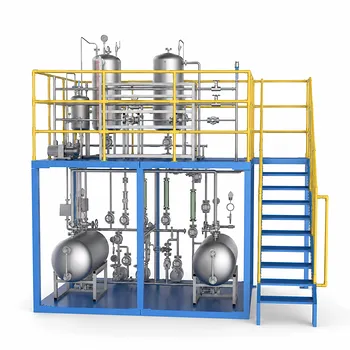
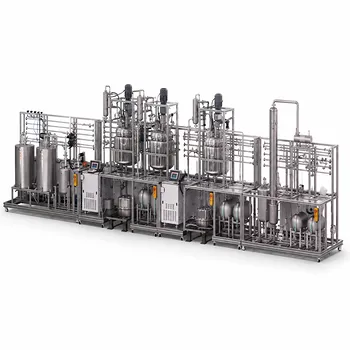
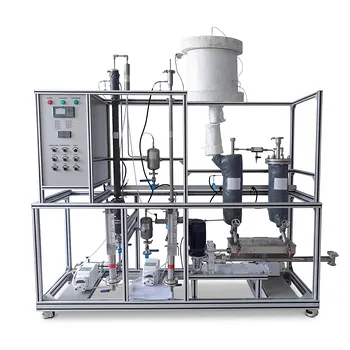
Temperature and pressure are not abstract textbook variables—in an educational pilot plant, they become dials you can turn and instantly see changing the outcome. These scaled-down reactor systems allow students to manipulate process conditions while directly measuring reaction rates and equilibrium compositions. By heating a jacketed reactor or adjusting a back-pressure valve, operators observe how the same chemical system responds to different inputs, bridging the gap between theoretical equations and industrial process dynamics.
Hands-on manipulation of temperature and pressure in a pilot plant transforms chemical theory into visceral, measurable insight. Students simultaneously witness the kinetic acceleration of reactions and the thermodynamic shifts in equilibrium, learning to balance the competing demands that define real reactor design.
How Temperature Governs Reaction Rates – The Kinetic Perspective
Temperature directly controls how fast a reaction proceeds. In an educational pilot plant, this relationship is demonstrated by deliberately changing the reactor temperature and tracking the resulting rate data.
The Arrhenius Equation at Work
Raising the temperature provides reactant molecules with greater energy, increasing the fraction that can overcome the activation energy barrier. According to the Arrhenius equation, the rate constant (k) grows exponentially with temperature, driving a clear acceleration in the reaction.
In a pilot plant, students can measure how much faster a reaction runs at 50°C versus 30°C by tracking the disappearance of a reactant or the generation of a product. The resulting data lets them calculate rate constants and even estimate the activation energy (Ea) for the system.
Instrumented Reactors Make Kinetics Visible
Educational units are equipped with online sensors—such as pressure transmitters, conductivity meters, and flowmeters—that translate molecular events into real-time trends. For a gas-producing reaction, a pressure sensor can map the rate of pressure rise, directly correlating to the reaction rate.
Colorimetric reactions can be followed with inline spectrophotometers, while acid–base neutralizations can be monitored through electrical conductivity. This continuous data stream lets students calculate reaction rate (v = Δc/Δt) and immediately see how a temperature change shifts the slope of their progress curve.
Shifting Equilibrium – The Thermodynamic Driver
Beyond rate, temperature and pressure dictate the final composition of a reversible reaction. Pilot plants make equilibrium visible by holding a reactor at steady state and analyzing the mixture.
Le Chatelier’s Principle in Practice
Le Chatelier’s principle states that a system at equilibrium will shift to counteract an imposed change. When students raise the temperature of a pilot reactor, they observe the equilibrium yield shift in the endothermic direction; for an exothermic reaction like ammonia synthesis, the product concentration drops.
Similarly, for reactions that involve a change in gas volume, increasing the system pressure pushes the equilibrium toward the side with fewer gas molecules. A pilot plant with a back-pressure regulator lets students raise the pressure and directly measure the resulting shift in product mole fractions.
Calculating Equilibrium Constants at Different Temperatures
The equilibrium constant (K) is not a fixed number—it depends on temperature, as described by the van’t Hoff equation. Educational pilot plants with precise temperature control allow students to operate the same reaction at multiple steady-state temperatures.
By taking samples or using inline gas chromatography, they can determine equilibrium concentrations and calculate K at each temperature. Plotting (\ln K) against (1/T) yields a straight line whose slope gives the reaction enthalpy (ΔH°), turning a thermodynamic derivation into a tangible data set.
The Pressure Effect on Gas-Phase Systems
For gas-phase reactions, pressure directly impacts equilibrium when the number of moles changes. The pilot plant demonstrates this by running a reaction like the thermal decomposition of a solid or a gas-phase synthesis at different pressures while maintaining constant temperature.
Reducing system pressure, for instance, lowers the temperature required for a decomposition to become spontaneous (ΔG < 0), confirming the Gibbs-Helmholtz relationship. Students can watch the composition shift on a real-time analyzer, reinforcing that industrial pressure settings are chosen for both thermodynamic and economic reasons.
The Pilot Plant as a Bridge to Industrial Reality
Educational reactors aren’t just proof-of-concept devices; they mimic industrial constraints and safety systems, making the learning directly relevant.
Downscaling the Haber Process Safely
The Haber process operates at 400–600°C and 200–1000 atm, conditions too extreme for a teaching lab. Educational pilot plants therefore scale the reaction down to safer temperature and pressure ranges while preserving the same thermodynamic principles.
These units feature pressurized tubular reactors with PID temperature controllers, mass flow controllers for nitrogen and hydrogen, and online analysis tools. Integrated overpressure relief valves, blast shields, and gas leak detectors allow students to study catalyst activation, space velocity, and equilibrium shifts within a controlled, safe environment.
Real-Time Data for Process Optimization
In a modern pilot plant, every instrument feeds a data acquisition system, letting students visualize how yield changes when they alter a single parameter. This immediate feedback loop teaches them to approach reactor operation as an optimization problem, balancing competing factors just as industrial engineers do.
For example, a student can plot conversion versus temperature and see that in an exothermic reaction, the curve initially rises due to faster kinetics but eventually falls as equilibrium limitation takes over. This direct observation cements the concept of an optimum operating point far better than any textbook graph.
Understanding the Trade-offs: Kinetics vs. Thermodynamics
The pilot plant’s most important lesson is that temperature creates a fundamental conflict between speed and maximum yield. This trade-off is unavoidable and must be managed.
For exothermic reactions (ΔH_R < 0), increasing the temperature accelerates the rate constant (k), driving faster reaction. However, the same temperature increase reduces the equilibrium constant (K_c) and thus lowers the maximum thermodynamically allowable conversion. The reactor will reach a lower final product concentration, even though it gets there quickly.
Educational pilot plants let students experience this friction firsthand. They can run a reaction at a low temperature to achieve high equilibrium yield but wait a long time, then raise the temperature and watch the yield flatten at a lower value. The insight is immediate: reactor design must balance kinetic gain against equilibrium loss. This is where the van’t Hoff and Arrhenius equations cease to be separate chapters and become part of the same optimization calculation.
Making the Right Choice for Your Goal
Your experimental objectives in the pilot plant will define which parameters you prioritize and which trade-offs you accept.
-
If your primary focus is understanding basic kinetic principles: Use a simple bath or jacketed batch reactor with a colorimetric or conductance-based detection system. Focus on measuring rate constants at different temperatures to extract the activation energy, prioritizing clean data over yield optimization.
-
If your primary focus is verifying equilibrium thermodynamics: Operate a continuous stirred-tank reactor or a catalytic tubular reactor at multiple steady-state temperatures. Equip it with online analyzers like gas chromatography to measure equilibrium concentrations and construct a van’t Hoff plot; keep reaction times long enough to ensure true equilibrium, even if that means slower experiments.
-
If your primary focus is simulating industrial process optimization: Select a pilot plant with full programmable logic control, mass flow controllers, and safety interlock systems. Deliberately map the temperature–conversion curve, identify the point where equilibrium constraints overtake kinetic gains, and practice designing a temperature profile that maximizes overall production rate.
When an educational pilot plant puts these levers in your hands, the theoretical framework of chemical reaction engineering becomes a tangible skill. You learn not just what happens, but how to navigate the inevitable trade-offs—a lesson that carries directly into any plant, from the lab bench to the production line.
Summary Table:
| Parameter | Kinetic Effect (Reaction Rate) | Thermodynamic Effect (Equilibrium) | Pilot Plant Demonstration |
|---|---|---|---|
| Temperature | Increases rate constant ($k$) exponentially via Arrhenius equation | Shifts equilibrium in the endothermic direction | Jacketed reactors with PID controllers and online sensors track real-time rate changes |
| Pressure | Minimal direct impact on rate constant | Shifts equilibrium toward fewer gas moles | Back-pressure regulators and gas analyzers measure composition changes |
Elevate Chemical Engineering Education with LABPARK
Ready to transform abstract thermodynamic equations into concrete, measurable learning experiences?
LABPARK provides state-of-the-art Educational and Vocational Unit Operations Pilot Plants in chemical engineering, bioprocess & biotech, and environmental & water treatment for universities, research institutes, and enterprises.
Our systems are designed to help students safely master reaction kinetics, equilibrium shifts, and industrial process optimization. Contact us today to discuss your laboratory requirements and request a customized equipment quote!
Related Products
- Fixed Bed Gas Solid Catalytic Reaction Educational Pilot Plant
- Multi Pump Fluid Transport Process Piping Unit Operations Training Pilot Plant
- Carbon Dioxide Hydrogen Methanol Synthesis Educational Unit Operations Pilot Plant
- Ethyl Acetate Synthesis Unit Operations Pilot Plant for Practical Training
- Natural Product Extraction Unit Operations Training Pilot Plant
People Also Ask
- How do reactor pilot plants safely study gas-solid reactions? Master kinetics with thermal & flow control.
- How does the Mears criterion evaluate transport resistance? Key Guide to Intrinsic Kinetics
- Fluidized vs. Fixed Bed Reactors: Comparing Heat & Complexity in Pilot Plants
- Why is a multibed configuration necessary for exothermic reactions? Optimize your pilot plant trajectory.
- How is the friction factor determined for fixed-bed pilot plants? Select the best pressure drop correlation.