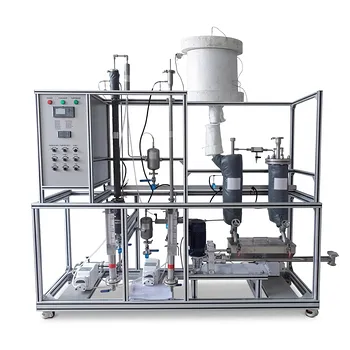
The critical lesson educational pilot plants teach is that a reactor's material of construction doesn't just change its chemical compatibility—it fundamentally reshapes the economics of scaling up.
By operating glass-lined steel (GLS) and stainless steel (SS) reactors at a pilot scale, students can move beyond abstract textbook formulas. They collect real-world performance data and apply the scaling equation Cost = A * Volume^B. The hands-on experience proves that the cost exponent B is not a universal constant. It is a direct financial fingerprint of the selected material. For glass-lined reactors, B is low (0.32-0.42), meaning bigger vessels become drastically cheaper per unit volume. For stainless steel, a higher B (around 0.75) makes scaling up disproportionately more expensive.
A reactor's material dictates its cost-capacity scaling law. Pilot plants let students prove that glass-lined steel offers superior scaling economics (lower cost exponent) for corrosive, multi-step chemistry, while stainless steel’s higher exponent reflects its different manufacturing complexity and pressure capabilities. The pilot plant is not just a small reactor; it is a capital expenditure calculator.
Bridging the Gap from Lab Bench to Boardroom Decision
The core purpose of an educational unit operations pilot plant is to bridge the gap between gram-scale laboratory glassware and ton-scale commercial manufacturing. Textbook kinetics cannot alone determine a commercial reactor’s design. Pilot plants provide the empirical data needed to verify and adjust scale-up models, exposing the complex interactions of heat transfer, mass transfer, and mixing behavior under realistic conditions.
The Pilot Plant as a Scale-Up Verification Tool
In a commercial setting, scale-up must be verified through empirical data. A pilot plant reactor, whether a catalytic fixed-bed or a stirred tank, is fully instrumented with real-time data acquisition software. This allows students to manipulate pressure, temperature, and space velocity, bridging the gap between theoretical reaction kinetics and actual industrial practice. Without this intermediate step, designing a full-scale commercial reactor is guesswork.
From Grams to Tons: The Scale-Up Journey
Pilot plants fit into a critical intermediate position in the scale-up journey. This pathway moves from bench-top lab work to kilo labs (yielding 100g to 10kg) and then to pilot plants with larger reactor scales. Here, students confront real-world process development challenges that cannot be demonstrated in lab glassware: ensuring process safety, managing heat and mass transfer limitations, and integrating multiple unit operations.
Deconstructing the Cost Scaling Equation
Industrial design investment estimation relies on the capacity ratio method, where cost scales with a specific exponent. Students operating pilot-scale units can run mass and energy balances, collect performance data, and then directly apply these scaling formulas. This transforms an academic exercise into a credible capital cost estimate for a full-scale plant.
The "B" Factor: A Material’s Economic Signature
The scaling equation Cost = A * Volume^B governs how investment changes with size. The exponent B is the variable that pilot plant experiments can illuminate. A low B indicates that increasing the reactor volume results in a significant reduction in cost per unit volume. A high B indicates the opposite: building bigger vessels from that material is progressively more expensive on a per-unit-of-volume basis.
Glass-Lined Steel: The Economics of Inertness
Glass-lined steel reactors are widely used because they offer excellent corrosion resistance, replicating chemical inertness at an industrial scale. The cost exponent B for GLS is remarkably low, ranging from 0.32 to 0.42. Students learn that this is the key economic advantage for multi-step batch chemistry. A company can significantly increase capacity with a relatively modest increase in capital investment, giving GLS a strong business case for certain chemistries.
Stainless Steel: Performance at a Premium
Stainless steel reactors tell a different economic story. Their cost exponent B is typically around 0.75, making volume scale-up relatively more expensive. Through pilot plant training, students discover why: SS reactors often support higher pressure ratings and can accommodate different heat exchange jacket configurations, like welded external coils. The higher exponent reflects the increased manufacturing complexity and material costs required to achieve these performance characteristics.
Understanding the Trade-offs
Focusing solely on the cost exponent is a common pitfall. The pilot plant’s real educational value lies in teaching students to make holistic material selections that balance capital expenditure (CAPEX) against process requirements and total lifecycle costs.
More Than Just a Price Tag
While the cost exponent B is a powerful concept, it only models CAPEX. A pilot plant demonstrates that a reactor is never chosen on scaling economics alone. Students must weigh the low exponent of GLS against the higher pressure and temperature ratings of SS. The pilot plant becomes a sandbox for modeling not just cost, but also safety, versatility, and operability for a given reaction system.
The Supply Curve and Unit Cost Reality
Pilot plants also demonstrate how material and scale choices impact a plant's position on the chemical supply curve. By directly measuring utility consumption (steam, electricity), raw material inputs, and labor requirements, students can model how scaling up reduces unit costs. This reinforces why the lowest-cost producers are often large-scale facilities, and how the choice of reactor material, with its unique cost-capacity relationship, is a strategic decision that determines a plant’s long-term competitiveness.
Making the Right Choice for an Educational Program
To maximize the learning outcome, the design of a pilot plant curriculum should focus on comparative experimentation.
- If your primary focus is teaching scaling economics: Use identical process chemistry in a small and a larger version of the same reactor material to isolate and prove the
Cost = A * Volume^Bprinciple. - If your primary focus is teaching material selection trade-offs: Run the same corrosive, multi-step batch chemistry in parallel GLS and SS pilot-plant reactors to contrast the drastically different
Bexponents and respective operating limits. - If your primary focus is process design and modeling: Use pilot plant data to iteratively determine self-adjusting parameters like hydrodynamics and mass transfer rates in stagewise nonisothermal models, enabling a true comparison of model-based vs. experimental scale-up.
The ultimate goal is to move beyond theory. Educational pilot plants empower the next generation of engineers to see a reactor not just as a vessel, but as a critical financial instrument whose material determines its economic logic.
Summary Table:
| Reactor Material | Cost Exponent (B) | Key Advantages | Ideal Applications |
|---|---|---|---|
| Glass-Lined Steel (GLS) | 0.32 - 0.42 | High corrosion resistance, excellent scaling economics | Corrosive, multi-step batch chemistry |
| Stainless Steel (SS) | ~0.75 | Higher pressure/temperature ratings, versatile jacket configurations | High-pressure reactions, standard scale-up applications |
Bring Industrial Reality to Your Classroom with LABPARK
Ready to transform abstract engineering formulas into hands-on learning experiences? LABPARK provides premium Educational and Vocational Unit Operations Pilot Plants in chemical engineering, bioprocess & biotech, and environmental & water treatment. Designed specifically for universities, research institutes, and enterprises, our systems empower students to master reactor design, material selection, and scaling economics.
Contact LABPARK today to discover how our customizable pilot plants can elevate your engineering curriculum and prepare your students for real-world industrial design!
Related Products
- Fixed Bed Gas Solid Catalytic Reaction Educational Pilot Plant
- Carbon Dioxide Hydrogen Methanol Synthesis Educational Unit Operations Pilot Plant
- Ethyl Acetate Synthesis Unit Operations Pilot Plant for Practical Training
- Natural Product Extraction Unit Operations Training Pilot Plant
- Green Anhydrous Ethanol Refining Practical Training Pilot Plant
People Also Ask
- Fixed-Bed vs. Fluidized-Bed Reactor: How to Choose the Right Pilot Plant for Gas-Solid Catalytic Reactions
- How to determine catalyst pore radius & porosity? Optimize your chemical engineering pilot plant.
- What reactor configurations study gas-solid reactions? Guide to key types and applications.
- How does identifying the rate-limiting step optimize reaction conditions? Pilot Plant Guide
- How do reactor pilot plants safely study gas-solid reactions? Master kinetics with thermal & flow control.