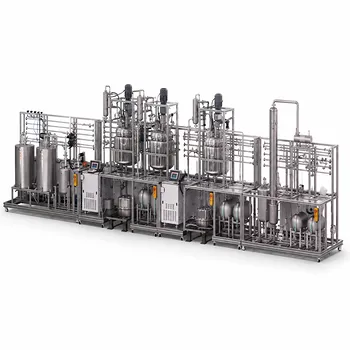
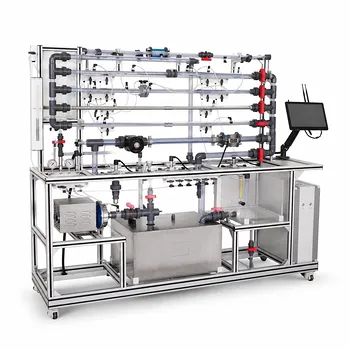
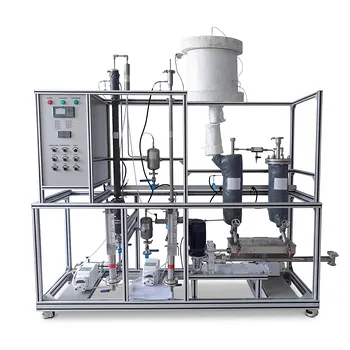
Educational pilot plants are the missing link that transform theoretical thermodynamics into actionable process design skills. By operating scaled-down unit operations—such as batch crystallizers, evaporators, and fractional distillation units—students directly investigate how temperature, solvent ratios, and agitation control the crystallization of active pharmaceutical ingredients (APIs) with low water solubility. This hands-on experience teaches them to select solvents, manipulate supersaturation, and optimize yields for compounds that dissolve poorly in water but readily in organic media, effectively preparing them for the most common purification challenge in modern drug development.
Mastering the design of a robust crystallization process for poorly water-soluble APIs is the central training goal, but true industrial readiness comes only when students can link that step to upstream reactions, downstream filtration/drying, and the systematic application of Quality by Design. The pilot plant environment uniquely delivers that interconnected understanding while embedding safety and sustainability principles at every stage.
Understanding the Unique Challenge of Low-Solubility APIs
Many high-value drug candidates exhibit high solubility in organic solvents but dissolve poorly in aqueous systems. This characteristic forces process design to revolve around solvent manipulation rather than the water-based chemistries often taught in fundamental courses.
Why Solvent Selection Becomes the Critical Design Parameter
The choice of solvent or solvent mixture dictates the crystal form, particle size distribution, and residual solvent levels—all critical-to-quality attributes of the final API. In a pilot plant, students can test ICH-classified solvents, assess miscibility, and observe how a mother liquor’s composition shifts during cooling, giving them direct insight into the practical constraints of solvent recovery and purity targets.
The Core Unit Operation: Crystallization
Crystallization is the defining purification step for low-solubility APIs because it can separate the target molecule from structurally similar impurities while building particle properties that influence downstream handling. Without hands-on experience, students struggle to grasp how meta-stable zone widths, seeding protocols, and mixing intensity translate into real-time decisions about crystal size and yield.
Hands-On Mastery of Solvent-Based Separation and Purification
Pilot plants equipped with batch crystallizers, falling-film evaporators, and fractional distillation columns turn abstract concepts like mass transfer and phase equilibrium into tangible experiments.
Manipulating Temperature and Solvent Ratios
Students can program cooling profiles and observe how fast cooling leads to nucleation bursts, small crystals, and occluded impurities, while slow cooling promotes growth and higher purity. By changing the ratio of a powerful solvent (e.g., dimethylformamide) to an anti-solvent (e.g., water), they directly measure how solubility curves shift and learn to design robust anti-solvent crystallization protocols that are staples of industrial API processing.
Investigating Agitation’s Hidden Impact
In a pilot plant, adjusting the impeller speed or type shows real-time effects on particle attrition, secondary nucleation, and mixing uniformity. This experience makes it clear that agitation is a process parameter, not just a background setting, and that it can make or break the scalability of a lab-developed recipe.
Integrating Unit Operations: From Reaction to Dry Product
An isolated crystallization exercise is insufficient. The pilot plant’s true power is demonstrating how decisions made early in a process cascade through every subsequent unit operation.
The Sequential Workflow in Practice
A typical educational setup might include:
- Closed charging systems that teach safe handling of potent and solvent-laden intermediates.
- Stirred tank reactors with precise temperature control, where the compound is synthesized or dissolved.
- Liquid-liquid extraction and distillation to perform solvent swaps or concentrate streams before crystallization.
- Crystallizers where the product is born.
- Filter dryers or centrifuges for isolation, and conical dryers for final drying.
By moving material through these linked units, students see how a poor solvent swap upstream (e.g., residual water in an organic phase) can tank a crystallization’s yield, or how elongated crystal shapes from a specific cooling profile blind a filter cloth downstream.
Bridging the Filtration and Drying Bottleneck
Filtration is often the rate-limiting step for poorly soluble APIs, as excessive fines or needle-like crystals can render a process economically unviable. Students operating a pressure filter or agitated nutsche filter-dryer learn to correlate crystallization conditions with filtration resistance and drying times, closing the loop between particle engineering and manufacturability.
Embedding Quality by Design (QbD) and Process Control
QbD is not just a regulatory mantra; it is a systematic way to build quality into the process rather than testing it in at the end. Pilot plants provide the perfect platform to execute Design of Experiments (DoE) and map the multivariate design space.
Defining the Design Space for Crystallization
Students can systematically vary temperature endpoints, cooling rates, seeding amounts, and aging times while monitoring critical-to-quality attributes (purity, particle size, polymorphic form) with in-situ probes like FBRM or Raman spectroscopy. They learn to identify the normal operating region and understand the edges of failure, directly applying the ICH Q8 paradigm.
Process Analytical Technology (PAT) in Training
Real-time monitoring tools transform a batch crystallizer into a data-rich learning environment. Students observe desupersaturation curves, track chord length distributions, and develop feedback control loops. This teaches them that a well-understood process can be controlled actively, reducing reject batches and the need for extensive end-product testing.
Advancing Green and Safer Process Design
Working with low-solubility APIs inevitably involves organic solvents, many of which pose flammability, toxicity, or environmental burdens. The pilot plant becomes a living laboratory for inherently safer design and sustainability.
Minimizing Hazard through Design
By operating with reduced equipment volumes and low inventories of hazardous solvents, students experience how a plant can be designed to be smaller and inherently safer. They can test alternative, greener solvents, and integrate closed-loop recycling loops where distillation bottoms are purified and reused, demonstrating waste minimization and circular economy principles in practice.
Energy-Efficient Operations
Pilot-scale evaporators and distillation columns with heat integration teach the real cost of energy. Students can quantify the energy savings of multi-effect evaporation or vapor recompression, linking the chemical engineering fundamentals of heat transfer to the business and environmental case for sustainable API manufacturing.
Understanding the Limitations and Pitfalls
While pilot plants are powerful teaching tools, educators and students must remain cognizant of their constraints to draw correct industrial analogies.
Scale-Dependent Physics Do Not Fully Replicate
Heat transfer and mixing times are inherently different at the 10-liter scale compared to a 10,000-liter crystallizer. A cooling rate that works perfectly in a pilot vessel may cause severe encrustation and inhomogeneity at full scale. Students must be taught to use scaling correlations—not blind replication—to predict industrial behavior.
Equipment Flexibility Can Obscure Single-Purpose Optimization
A multipurpose pilot plant designed for teaching may lack the specific materials of construction or surface finishes required for certain APIs, potentially introducing unrepresentative nucleation or impurity pick-up. The learning objective must shift from “producing perfect API” to “understanding the process dynamics and how to diagnose deviations.”
Maintenance and Safety Burden
Operating solvent-based processes demands rigorous attention to explosion-proof standards, inert gas blanketing, and personnel exposure monitoring. The overhead of running such a facility can be high, but it also provides an ideal context for training in safety management systems and operational discipline.
Making the Right Training Choice for Your Curriculum
The design of the educational experience within a pilot plant should align with the specific competencies you aim to build in your students.
- If your primary focus is fundamental physical chemistry: Concentrate student experiments on the crystallizer and distillation units to explore solubility thermodynamics and phase diagrams in depth. Let them map ternary solvent systems and measure kinetic parameters.
- If your primary focus is full process integration and process development: Ensure the curriculum forces students to run a complete sequence from raw material charging through to dried product, documenting how each upstream change propagates. Use filtration and drying metrics as ultimate process verdicts.
- If your primary focus is modern Quality by Design and PAT: Equip the pilot plant with real-time sensors and require students to execute a DoE, build a statistical model of the design space, and propose a control strategy based on their data, not on pre-existing recipes.
- If your primary focus is green chemistry and sustainability: Task students with minimizing solvent waste, substituting less hazardous solvents, and optimizing energy consumption. Require them to present a mass and energy balance that demonstrates the environmental footprint of their chosen process route.
An educational pilot plant is the most direct way to equip future engineers with the integrated, hands-on judgment needed to transform a challenging, poorly water-soluble API into a robust, controllable, and safe manufacturing process.
Summary Table:
| Training Focus | Key Unit Operations | Learning Outcomes |
|---|---|---|
| Solvent & Crystallization | Batch Crystallizers, Stirred Reactors | Master solubility curves, seeding protocols, and crystal growth. |
| Downstream Isolation | Nutsche Filter-Dryers, Centrifuges | Overcome filtration bottlenecks and correlate crystallization with drying times. |
| Process Control & QbD | PAT Probes (FBRM/Raman), Control Loops | Define the operating design space and execute Design of Experiments (DoE). |
Elevate Your Chemical Engineering Curriculum with LABPARK
Bridging the gap between theory and industrial reality requires high-quality, hands-on training systems. LABPARK provides advanced Educational and Vocational Unit Operations Pilot Plants in chemical engineering, bioprocess & biotech, and environmental & water treatment designed specifically for universities, research institutes, and enterprises.
Our pilot plants empower students and researchers to safely master complex industrial processes, including low-solubility API crystallization, solvent recovery, and Quality by Design (QbD) methodologies.
Ready to upgrade your laboratory capabilities? Contact LABPARK today to discuss your custom pilot plant needs!
Related Products
- Fixed Bed Gas Solid Catalytic Reaction Educational Pilot Plant
- Carbon Dioxide Hydrogen Methanol Synthesis Educational Unit Operations Pilot Plant
- Ethyl Acetate Synthesis Unit Operations Pilot Plant for Practical Training
- Natural Product Extraction Unit Operations Training Pilot Plant
- Green Anhydrous Ethanol Refining Practical Training Pilot Plant
People Also Ask
- How do reactor pilot plants safely study gas-solid reactions? Master kinetics with thermal & flow control.
- How does the Mears criterion evaluate transport resistance? Key Guide to Intrinsic Kinetics
- Why is a multibed configuration necessary for exothermic reactions? Optimize your pilot plant trajectory.
- Fluidized vs. Fixed Bed Reactors: Comparing Heat & Complexity in Pilot Plants
- How is the friction factor determined for fixed-bed pilot plants? Select the best pressure drop correlation.