Knowledge Chemical Engineering Education How do pilot plants teach pH & temp control in coordination synthesis? Bridge theory and practice
Author avatar

Tech Team · LABPARK

Updated 2 months ago

How do pilot plants teach pH & temp control in coordination synthesis? Bridge theory and practice


A precise synthesis of rare-earth coordination compounds like europium-dibenzoylmethane lives or dies by tight pH and temperature control. Educational pilot plants make this invisible dependency tangible, letting students move beyond recipe-following to see why a slight drift from pH 7–8 or a sloppy temperature ramp can destroy both yield and fluorescence.

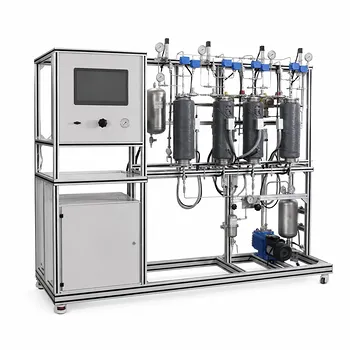
Lab-scale synthesis teaches you the steps, but pilot-scale operation teaches you the consequences. Fully instrumented glass batch reactors with jacketed temperature control and automated pH dosing give students a real-time window into how process variables govern complexation chemistry, transforming abstract theory into physical, measurable outcomes.

The Invisible Leverage of pH and Temperature

Rare-earth metal complexes are not simple salts—they assemble through delicate coordination equilibria where the ligand must deprotonate at the right moment and the metal center must resist hydrolysis. Even minor environmental swings redirect the entire reaction pathway.

Why a Narrow pH Window (7–8) Is Mandatory

The ligand dibenzoylmethane must lose a proton to coordinate europium efficiently. Below pH 7, insufficient deprotonation means too little reactive ligand; above pH 8, the metal ion tends to form insoluble hydroxides.

In a pilot plant, students watch the real-time pH trace climb or fall and then see the corresponding drop in fluorescence intensity when product samples are analyzed. The correlation becomes unforgettable.

Temperature’s Dual Personality: Gentle Dissolution, Controlled Reflux

Initial dissolution of reactants requires staying below 50°C—any hotter and you risk thermally degrading the ligand before it ever coordinates. Later, the reflux at 80–90°C drives the complexation to completion by providing the activation energy for bond formation without boiling off the solvent violently.

A jacketed reactor with precise heating/cooling ramps lets students enforce both regimes. Observing how a 10‑degree overshoot during dissolution permanently reduces the final emission intensity transforms a safety note into a visceral lesson in kinetics and product stability.

From Recipe to Reactor: How Pilot Plants Create Insight

Reading about the need for control is passive. Standing in front of a benchtop‑scale glass reactor, adjusting pump speeds, and seeing the reaction respond on a touchscreen builds a systems‑thinking mindset.

Real-Time pH Monitoring and Automated Dosing

Instead of manual drops of base, students program an automated dosing pump linked to a sterilizable pH sensor. They can design feedback loops: if pH drops below 7.2, a microcontroller opens the base valve. This introduces them to process control strategies used in every modern chemical plant, while also revealing how sensor lag or dead zones can cause oscillations—an early taste of real engineering trade‑offs.

Jacketed Temperature Control and Heat Transfer Awareness

Educational pilot plants force students to measure not just the reaction mixture temperature but also the jacket inlet and outlet temperatures. Performing an energy balance across the jacket lets them calculate the enthalpy change of the reaction in real time.

This bridges the gap between thermodynamic tables (Hess’s Law) and live, measurable heat evolution. They see that an exotherm during complexation must be removed efficiently, or the temperature will overshoot and break the very product they are trying to make.

Data Acquisition and Kinetic Modeling

Every parameter—pH, temperature, stirrer speed, dosing rate—is logged digitally. Students export this data to build kinetic models, comparing predicted versus actual yields.

They discover that temperature directly modifies the rate constant, and pH effectively controls reactant concentrations. The result is a deeper appreciation for why industrial reactors demand such rigorous control: selectivity and yield are not set‑and‑forget variables.

Understanding the Trade‑offs

No pilot plant perfectly mirrors an industrial facility, and highlighting these limitations is part of the education.

Sensor Drift and Calibration Realities

Automated pH probes can drift, especially at elevated temperatures or in organic‑heavy solvent mixtures. Students must learn to schedule calibrations, recognize faulty readings, and design manual override procedures. Far from being a nuisance, this teaches the criticality of measurement integrity—something textbooks often ignore.

Scaling Limitations vs. Educational Value

A 10‑liter glass reactor does not experience heat and mass transfer inhomogeneities the same way a 10,000‑liter stainless steel vessel does. Yet that very mismatch forces students to discuss dimensionless numbers (Reynolds, Nusselt) and scale‑up principles. The pilot plant becomes a launchpad for conversations about mixing, hotspots, and the non‑linearity of reacting systems.

Making the Right Choice for Your Learning Goal

Different students approach the pilot plant with different objectives. The equipment can serve each one if you focus on the right measurement.

  • If your primary focus is mastering process control: Concentrate on programming the dosing loop and analyzing pH‑over‑time stability. This builds automation and troubleshooting skills directly transferable to industry.
  • If your primary focus is understanding reaction kinetics and thermodynamics: Perform detailed energy balances across the jacket and use the logged data to fit an Arrhenius model. The real‑time temperature data reveals activation barriers far more concretely than a chalkboard derivation.
  • If your primary focus is safety and solvent handling: Pay attention to the reflux condenser, inert gas blankets, and emergency quench protocols. These pilot‑scale setups let you manage volatile solvents under controlled, supervised conditions.

Every successful rare‑earth complexation run in the pilot plant plants a seed of confidence: that the student can move from a gram‑scale beaker to a scalable, engineered process without losing the chemical intuition that makes synthesis an art.

Summary Table:

Control Parameter Target Range / Method Synthesis Impact Educational Value
pH Level pH 7–8 / Automated dosing pump Ensures ligand deprotonation; prevents metal hydrolysis Teaches process feedback loops, sensor lag, & control limits
Temperature Dissolution <50°C; Reflux 80–90°C Prevents thermal degradation; drives complexation to completion Illustrates heat transfer, reaction kinetics, & energy balances

Bring Industrial-Scale Process Learning to Your Lab

LABPARK provides state-of-the-art Educational and Vocational Unit Operations Pilot Plants in chemical engineering, bioprocess & biotech, and environmental & water treatment. Tailored for universities, research institutes, and enterprises, our fully-instrumented pilot plants bridge the gap between abstract theory and hands-on operational expertise.

Empower your students and researchers to master critical process controls safely. Contact LABPARK today to find the perfect pilot plant solution for your institution.

Related Products

People Also Ask

Related Products

Carbon Dioxide Hydrogen Methanol Synthesis Educational Unit Operations Pilot Plant

Carbon Dioxide Hydrogen Methanol Synthesis Educational Unit Operations Pilot Plant

Hands-on educational pilot plant for methanol synthesis from carbon dioxide and hydrogen. Enables practical study of high-pressure catalysis, unit operations, and process control. Features real-time data acquisition, safety systems, and customizable experiment modules for undergraduate and graduate chemical engineering laboratories.

Methanol Synthesis and Catalyst Performance Evaluation Educational Unit Operations Pilot Plant

Methanol Synthesis and Catalyst Performance Evaluation Educational Unit Operations Pilot Plant

Bench-scale methanol synthesis and catalyst evaluation educational pilot plant for chemical engineering labs to study catalytic kinetics, high-pressure operations, process control, and unit operations under realistic conditions with industrial safety features, precision gas delivery, data acquisition, and intelligent monitoring.

Ethyl Acetate Synthesis Unit Operations Pilot Plant for Practical Training

Ethyl Acetate Synthesis Unit Operations Pilot Plant for Practical Training

Modular and customizable pilot plant for ethyl acetate synthesis practical training. Integrates esterification reaction, liquid-liquid extraction, neutralization, and sieve-plate distillation unit operations. Bridging theory and real-world industrial processes. Designed for university chemical engineering labs

Carbon Dioxide Hydrogenation Methanol Synthesis Educational Unit Operations Pilot Plant

Carbon Dioxide Hydrogenation Methanol Synthesis Educational Unit Operations Pilot Plant

Pilot-scale educational system for carbon dioxide hydrogenation to methanol. Designed for unit operations teaching, it features a fixed-bed reactor, three-stage heating, dual mass flow controllers, and a 15.6-inch touchscreen with data acquisition. Perfect for chemical engineering and sustainable energy courses.

Aspirin API Synthesis Unit Operations Training Pilot Plant

Aspirin API Synthesis Unit Operations Training Pilot Plant

An integrated pilot plant for aspirin API synthesis training, featuring batch reaction, recrystallization, and packed distillation modules. Offers dual-control operation, transparent vessels, and public utility simulation for safe, hands-on chemical engineering unit operations education. Ideal for university labs.

Carbon Material Thermal Pretreatment Multiphase Separation Educational Pilot Plant

Carbon Material Thermal Pretreatment Multiphase Separation Educational Pilot Plant

Educational pilot plant for carbon material thermal pretreatment and multiphase separation. Features jacketed agitated reactor, separation column, and modern controls for hands-on unit operations training in heat transfer, fluid flow, and process safety with industrial-grade materials and wireless data acquisition.

Bench Scale Carbon Dioxide Capture Educational Unit Operations Pilot Plant

Bench Scale Carbon Dioxide Capture Educational Unit Operations Pilot Plant

This bench-scale educational pilot plant simulates industrial CO₂ separation using a multi-tower adsorption system for hands-on engineering training. Students achieve ≥90% CO₂ purity while studying pressure swing adsorption, desorption kinetics, and process control in gas purification experiments.

Natural Product Extraction Unit Operations Training Pilot Plant

Natural Product Extraction Unit Operations Training Pilot Plant

Integrated natural product extraction pilot plant for chemical engineering training bridges theory and industrial practice with modular extraction and evaporation/concentration units, hybrid touchscreen and manual control, realistic process simulation, and self-contained softened water and vacuum utilities.

Methane Cracking Educational Unit Operations Pilot Plant

Methane Cracking Educational Unit Operations Pilot Plant

This bench-scale methane cracking educational pilot plant provides hands-on catalytic conversion training with a 1000°C furnace, seven mass flow controllers, and real-time automation for safe, curriculum-aligned experiments. Designed for university teaching of unit operations and reaction engineering.

Polymerization Granulation and Pellet Processing Educational Unit Operations Pilot Plant

Polymerization Granulation and Pellet Processing Educational Unit Operations Pilot Plant

Integrated pilot plant for teaching polymer processing from polymerization to pelletizing. Includes 30L reactor, hydrolyzer, extruder-granulator, vibration dryer, crusher, and sieve. Atmospheric pressure operation for safety, corrosion-resistant SS, customizable for chemical and polymer engineering education. Ideal for university labs.

Multi Functional Membrane Crystallization Educational Unit Operations Pilot Plant

Multi Functional Membrane Crystallization Educational Unit Operations Pilot Plant

Integrated bench-scale membrane crystallization pilot plant for engineering education. Provides hands-on training in advanced separation technologies, combining membrane distillation crystallization and process intensification. Features variable scaling vessels, industrial-grade flow control, and interactive digital data acquisition. Customizable for university labs.

Multi-Reactor Educational Pilot Plant for Reaction Engineering Unit Operations

Multi-Reactor Educational Pilot Plant for Reaction Engineering Unit Operations

Integrated bench-scale educational pilot plant for chemical engineering teaching featuring fixed bed fluidized bed and stirred tank reactors with web-based digital twin controls and safety interlocks for hands-on unit operations and reaction engineering comparative studies in one compact system.

100L Continuous Loop Hydrogenation Educational Unit Operations Pilot Plant

100L Continuous Loop Hydrogenation Educational Unit Operations Pilot Plant

This 100L continuous loop hydrogenation pilot plant is designed for chemical engineering education, featuring 316 stainless steel construction, advanced gas-liquid mass transfer components, explosion-proof safety systems, and a 15.6-inch touchscreen with 5G connectivity, cloud data logging, bridging theory and industry.

Fixed-Bed Chemical Reaction and Gas Dust Tar Removal Unit Operations Pilot Plant

Fixed-Bed Chemical Reaction and Gas Dust Tar Removal Unit Operations Pilot Plant

Integrated educational pilot plant for studying catalytic gas-solid reactions and downstream gas purification. Features dual fixed-bed reactor, three-stage heating, and touchscreen control for hands-on engineering training. Ideal for chemical and environmental engineering curricula.

Multi-Functional Special Distillation Educational Pilot Plant

Multi-Functional Special Distillation Educational Pilot Plant

Versatile multi-functional special distillation pilot plant for chemical engineering education. Supports continuous, vacuum, azeotropic, reactive, extractive distillation. Transparent glass columns enable real-time visual observation of hydrodynamics and separation processes.

Residence Time Distribution and Reactor Flow Characteristics Determination Educational Pilot Plant

Residence Time Distribution and Reactor Flow Characteristics Determination Educational Pilot Plant

This versatile educational pilot plant is designed for comprehensive study of residence time distribution and reactor flow characteristics, featuring multiple CSTRs in series, a tubular reactor, variable recycle loop, and automated real-time data acquisition, perfect for hands-on chemical engineering education.

Ethylbenzene Dehydrogenation Educational Unit Operations Pilot Plant

Ethylbenzene Dehydrogenation Educational Unit Operations Pilot Plant

Ethylbenzene dehydrogenation educational pilot plant replicates industrial styrene production, offering hands-on experience with fixed-bed reactors, catalyst activation, regeneration, automated process control. Designed for university chemical engineering labs, it enables study of gas-solid catalysis, catalyst deactivation, steam regeneration, and safety interlocks.

Crude Benzene Hydrogenation Educational Unit Operations Pilot Plant

Crude Benzene Hydrogenation Educational Unit Operations Pilot Plant

Advanced pilot plant for higher education, enabling hands-on study of crude benzene hydrogenation and gas-liquid catalytic reactions. Triple-stage reactor system with precision flow and temperature control, AI-driven PID, remote monitoring, and comprehensive safety interlocks. Customizable for curriculum integration.

Electrolytic Hydrogen Production Educational Unit Operations Pilot Plant

Electrolytic Hydrogen Production Educational Unit Operations Pilot Plant

Bench-scale electrolytic hydrogen production pilot plant designed for university engineering labs. Provides hands-on training in water electrolysis, gas-liquid separation, and process safety. Fully customizable system with digital PID control, corrosion-resistant components, and hydrogen gas detector. Ideal for chemical engineering curricula.

High-Gravity Emulsification and Mass Transfer Educational Pilot Plant

High-Gravity Emulsification and Mass Transfer Educational Pilot Plant

This integrated educational pilot plant utilizes rotating packed bed technology to demonstrate high-gravity emulsification and mass transfer, providing engineering students with hands-on experience in process intensification and unit operations through a modular, customizable design with digital monitoring.


Leave Your Message