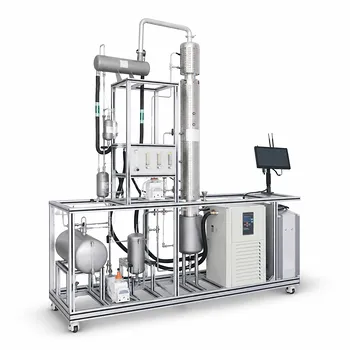
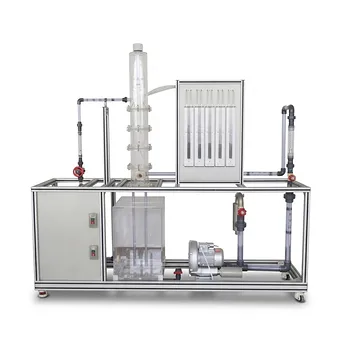
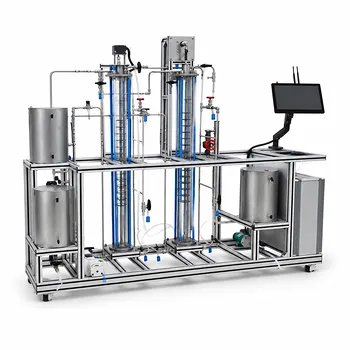
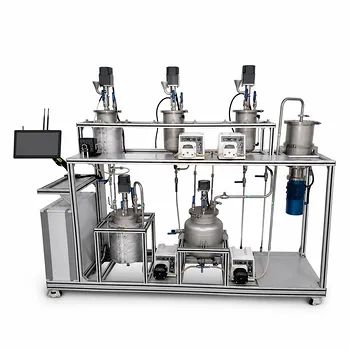
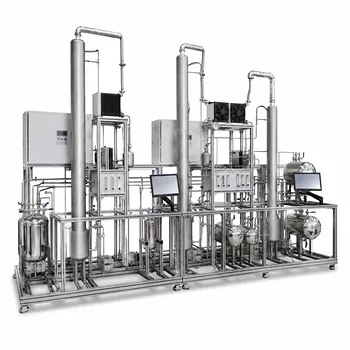
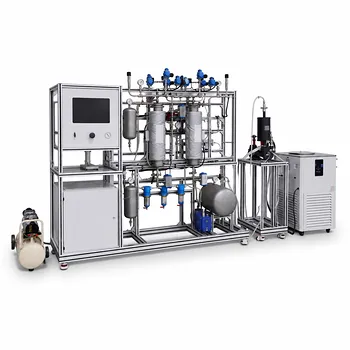
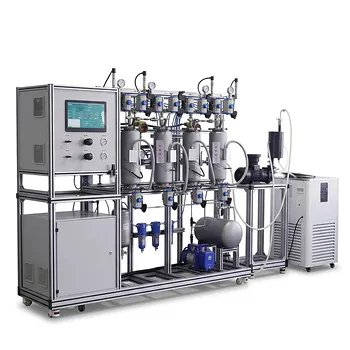
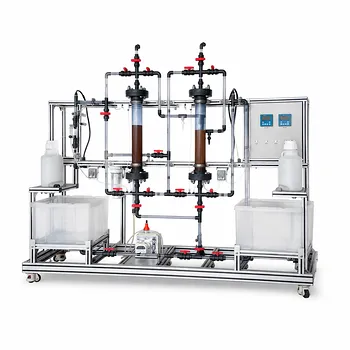
Pilot plants are the ultimate bridge between textbook theory and industrial reality. By allowing direct, hands-on experimentation with real distillation columns, they transform abstract concepts like tray efficiency and HETP into measurable, visual phenomena. Students can physically observe the bubbling action on a sieve plate, measure the pressure drop across a packed bed, and see how a change in reflux ratio immediately alters product purity—turning multicomponent distillation from a math problem into an engineering intuition.
The core insight: Educational pilot plants demystify multicomponent distillation by letting students directly experience the contrasting hydrodynamic and mass-transfer behaviors of plate and packed columns. This transforms theoretical differences—staged versus continuous contact—into a tangible understanding of efficiency, operability, and the crucial design trade-offs that no simulation alone can teach.
How Pilot Plants Turn Theory into Understanding
The primary reference highlights that running experiments allows students to collect real-time data and calculate Height Equivalent to a Theoretical Plate (HETP) for packed columns and plate efficiency for plate columns. But the educational value goes far deeper than just plugging numbers into the Fenske-Underwood-Gilliland shortcut methods.
The Power of Direct Physical Observation
A textbook describes a plate column as a series of discrete stages. In a pilot plant, students see the vapor bubbling through the liquid on each tray, physically creating a step change in concentration.
They can observe weeping, entrainment, or flooding—operational limits that formulas only hint at. This visceral memory cements the concept of stage-wise contact permanently.
For packed columns, they watch the liquid film trickle down the packing surface while vapor rises through the voids. They can directly diagnose channeling or poor liquid distribution, problems abstractly described in literature but instantly obvious when you see uneven wetting in a transparent column.
Measuring What Textbooks Can’t Capture
Students take temperature profiles along the column height and draw samples from each stage or bed section. This raw data brings the McCabe-Thiele and Ponchon-Savarit constructions to life.
They immediately feel the impact of a poorly chosen reflux ratio. Too low, and purity collapses; too high, and utility costs soar. A pilot plant makes cost-optimization tangible, not just a numerical exercise.
The supplementary references emphasize that pressure drop is dramatically different: as low as 0.01–0.27 kPa per theoretical stage for packed columns, versus 0.4–1.1 kPa for plate columns. Students measure this directly, instantly understanding why packed beds are preferred for vacuum distillation—a link that remains abstract on a chalkboard.
Contrasting Operational Behavior Under Real Conditions
The deep learning lies in comparing the columns when running the same separation. It reveals the fundamental trade-offs between the two technologies in a way that a table of pros and cons never can.
Hydrodynamic Stability and Ease of Operation
Plate columns hold a larger liquid inventory on each tray. This provides high operating elasticity and makes them remarkably forgiving of feed fluctuations or reflux changes.
Students learn this firsthand. A plate column stabilizes quickly after a disturbance; you can almost recklessly adjust the feed and still recover. A packed column, with its low liquid holdup, responds almost instantly, overshooting or crashing if you are not delicate.
This teaches a critical industrial lesson: plate columns are easier for novice operators, while packed columns demand precise control and consistent feed conditions. The pilot plant is the only place to safely experience these dynamics.
Separation Efficiency: Stages versus Continuous Gradient
With plate columns, students calculate plate efficiency by comparing actual concentration changes across a tray to the equilibrium prediction. They can physically count the trays and see the discrete jumps.
With packed columns, they calculate HETP by measuring the total height and using a mass-transfer model to back out the number of theoretical stages. The supplementary references note that packed columns can achieve over 10 theoretical stages per meter in industrial designs, far exceeding the typical less-than-2 stages per plate for tray columns.
Running both columns with the same mixture allows students to directly compare: the packed column may deliver the same separation in a much shorter height, but at the cost of liquid distribution sensitivity. This is the heart of the deep need—understanding not just what the differences are, but why they matter when designing or operating a plant.
Addressing Scale-Up and Real-World Constraints
The primary reference notes that pilot plants bridge the gap to industrial production. The supplementary references extend this to scale-up challenges—equipment size, operating hours, and automation levels.
From Lab Flexibility to Industrial Rigor
An educational pilot plant often runs batch distillation, with students changing operating procedures on the fly. This mimics the flexible, multipurpose plants used in fine chemicals, where columns might switch between plate and packed internals depending on the campaign.
Students learn that what works in a lab column may fail at scale. For instance, the excellent turndown ratio of a plate column (the ability to operate at a fraction of design capacity) becomes a critical economic parameter when a production plant must run at peak demand but idle at low rates.
They also confront practicalities: plate columns are easier to clean and inspect, a massive advantage when handling fouling mixtures or product changeovers. Packed columns, with their high efficiency, suffer if solids are present or if polymerization occurs—exactly the kind of constraint that drives industrial column selection.
Understanding the Trade-offs
Transparency about limitations is essential for true understanding. A pilot plant does not just showcase advantages; it forces students to confront the downsides.
When Plate Columns Become a Liability
- Pressure drop per theoretical stage is high, making them unsuitable for heat-sensitive products that need low-temperature vacuum operation. Students see the reboller temperature rise as column pressure increases—a direct lesson in thermal degradation risk.
- Liquid holdup can be a problem for expensive or toxic chemicals, as the inventory sitting on each tray represents financial and safety exposure. The pilot plant’s volume makes this tangible.
- At very low liquid loads, plate efficiency crashes because the liquid seal fails. Students can provoke this weeping condition and see separation collapse, learning the hard limit of operational range.
Where Packed Columns Fall Short
- Incomplete wetting at low liquid loads destroys transfer efficiency. The supplementary references are clear: packed columns suffer at turndown because the liquid no longer coats the packing evenly. Students see this as a sudden drop in HETP when the feed rate is cut.
- Channeling and wall effects plague small-diameter educational columns. A pilot plant with a glass wall makes these maldistribution problems starkly visible—yet another reason industrial packed columns demand sophisticated liquid distributors.
- Cleaning is a nightmare if polymerization or solids form on the packings. The structured geometry that makes them efficient traps debris, a practical headache that textbooks rarely mention but that pilot-scale mishaps burn into memory.
Making the Right Choice for Your Educational Goal
The optimal column for a student lab depends on what you want to teach. Pilot plants can be configured to emphasize different aspects, so align your equipment choice with the learning outcome.
- If your primary focus is ease of operation and visualizing stage-by-stage separation: A plate column pilot plant offers forgivable dynamics, visible tray action, and a direct link to the simplest mass-transfer design methods. It builds confidence before moving to more complex systems.
- If your primary focus is high-efficiency separation, vacuum distillation, or continuous mass-transfer fundamentals: A packed column pilot plant forces students to master liquid distribution, measure pressure drops in a physically compact system, and appreciate the nuances of interfacial area and surface renewal. The lessons are more challenging but deeper.
- If your curriculum spans both industrial reality and scale-up sensibilities: Run the same separation in both columns on the same pilot plant skid. The immediate A/B comparison—measuring HETP, pressure drop, turndown, and stability—creates an unforgettable benchmark that turns students into informed equipment specifiers.
True understanding lives in the hands-on friction between theory and reality—the pilot plant provides that friction safely and repeatably.
Summary Table:
| Feature | Plate Columns | Packed Columns |
|---|---|---|
| Contact Type | Stage-wise (discrete trays) | Continuous gradient (packing) |
| Key Metric | Plate Efficiency | HETP (Height Equivalent to a Theoretical Plate) |
| Pressure Drop | High (0.4 - 1.1 kPa/stage) | Low (0.01 - 0.27 kPa/stage) |
| Liquid Holdup | High (more forgiving, stable) | Low (fast response, sensitive) |
| Visual Phenomena | Bubbling, weeping, flooding | Liquid trickling, channeling |
Bring Industrial Reality to Your Chemical Engineering Labs
Equip your students and researchers with the practical skills they need to bridge the gap between textbook theory and industrial practice. LABPARK provides state-of-the-art Educational and Vocational Unit Operations Pilot Plants in chemical engineering, bioprocess & biotech, and environmental & water treatment.
Designed for universities, research institutes, and enterprises, our pilot plants deliver:
- Hands-on learning: Real-world comparison of plate and packed columns under dynamic operating conditions.
- Precise process control: Industrial-grade instrumentation for accurate data collection (HETP, pressure drops, and efficiency).
- Unmatched durability & safety: Safe, transparent, and robust systems tailored for academic and research environments.
Ready to elevate your engineering curriculum or research capabilities? Contact LABPARK today to discuss your custom pilot plant configuration!
Related Products
- Continuous Sieve-Plate Distillation Pilot Plant for Unit Operations Laboratory Education
- Multimodal Absorption and Desorption Pilot Plant for Unit Operations Training
- Absorption and Desorption Educational Unit Operations Pilot Plant
- Multi-Functional Special Distillation Educational Pilot Plant
- Dual-Mode Rectification Pilot Plant for Practical Training Unit Operations
People Also Ask
- How to select the right activity coefficient model (Wilson, NRTL, UNIQUAC) for distillation pilot plants?
- What are the primary reflux ratio control strategies? Master Distillation Unit Operations
- Why is vacuum operation capability an essential feature for a distillation unit operations pilot plant? Unlock Efficiency
- How does catalyst water concentration affect distillation pilot plant design? Key separation train choices.
- How can real-time carbon number prediction improve distillation pilot plants? Optimize control.