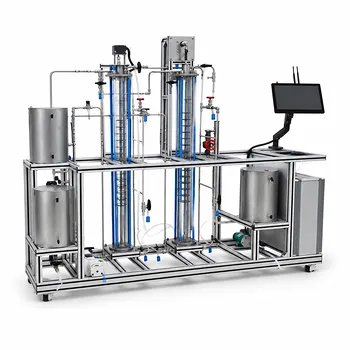
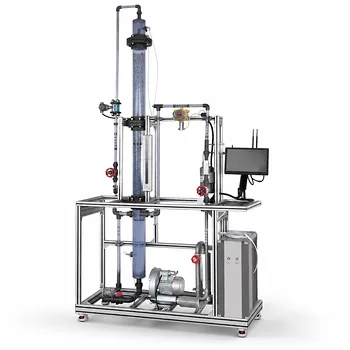
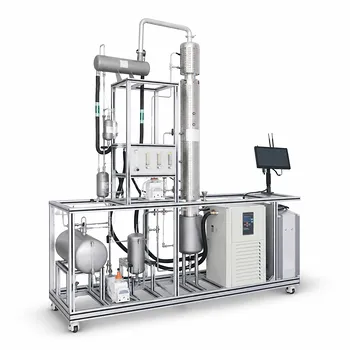
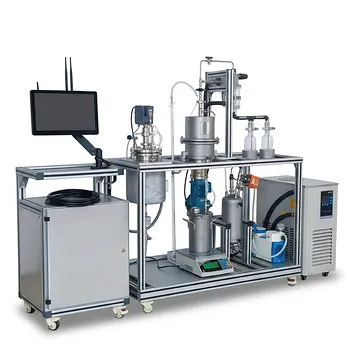
Pilot plants convert theoretical concepts of Dividing Wall Columns and Model Predictive Control into tangible, operational reality. By physically integrating a DWC into a pilot-scale unit, students and researchers directly observe how a single column shell performs multiple separations, dramatically reducing energy use and equipment footprint compared to conventional sequences. Coupling this hardware with advanced control strategies like MPC and RTO exposes them to the real-time dynamics of process optimization, revealing how manipulated variables interact under fluctuating feed conditions to maintain stability and efficiency.
The hands-on, iterative learning environment of a pilot plant bridges the gap between textbook equations and industrial practice. It transforms energy-saving distillation from a set of abstract principles into a visceral understanding of process integration, control, and the inevitable trade-offs engineers must navigate.
How Pilot Plants Unlock the Power of Dividing Wall Columns
A DWC is a masterpiece of process integration, but its internal operation is invisible in a simulation. Pilot plants provide the physical context needed to grasp its operation and benefits.
Demystifying the Thermal Separation Wall
Students can literally trace the liquid and vapor splits across trays in a modular pilot-scale DWC.
They witness firsthand how a single vertical wall inside the column creates three distinct separation zones, effectively replacing two separate conventional columns—and even a prefractionator—in one shell. This direct observation reinforces the concept that heat integration is achieved through internal energy coupling, not external piping.
Visualizing Energy and Capital Reduction
The primary reference correctly emphasizes the demonstration of reduced energy consumption and equipment footprint.
By operating a DWC pilot plant next to a conventional two-column sequence, users measure a 20-40% reduction in reboiler duty for the same separation. They measure condenser loads and steam consumption in real time, translating theoretical energy savings into measurable utility costs. The capital savings become equally concrete when they see how a single column replaces multiple vessels, foundations, and interconnecting pipework.
Understanding Operational Constraints and Degrees of Freedom
The real learning comes from what goes wrong.
A DWC loses a degree of freedom compared to a conventional sequence—the vapor split ratio is no longer independently controllable. Students encounter this limit when they try to adjust the internal vapor flow by manipulating the pressure profile. They learn that the pilot plant’s temperature sensors and pressure drops are their only window into that internal split, driving home the critical need for precise modeling and control.
Integrating Advanced Control to Tame Complexity
Adding MPC and RTO to the same pilot plant reveals how modern control strategies handle the DWC’s inherent interactions and operational constraints.
From Single-Loop PID to Multivariable Prediction
Students start with conventional PID loops controlling reflux, reboiler steam, and distillate rate.
They quickly discover that a DWC’s pressure and composition dynamics are highly coupled—changing one parameter ripples instantaneously across all product purities. Implementing Model Predictive Control on the pilot plant forces them to capture these interactions in a dynamic matrix. They then see how the controller predicts future behavior to preemptively move multiple valves, maintaining process stability even when disturbances hit.
Handling Feed Composition Disturbances in Real Time
The supplementary references highlight the importance of varying feed conditions.
The pilot plant becomes a dynamic classroom when researchers deliberately introduce step changes in feed composition or flow rate. With MPC active, they observe how the controller uses its internal model to anticipate the column’s response and adjust the liquid split, reflux, and reboiler duty simultaneously—before a product goes off-spec. This visceral demonstration of predictive capability cements the theory far better than any simulation.
Embedding Economic Logic with Real-Time Optimization
For deeper insight, RTO layers economic objectives on top of process control.
The pilot plant’s control system can be linked to RTO software that calculates the most profitable operating point subject to equipment limits. Students then watch as the RTO recalculates the optimal setpoints after a change in energy pricing or feed quality, and the MPC gently steers the process toward this new target. They grasp that advanced control is not just about quality, but about directly maximizing margin.
Learning Through Hands-On Parameter Manipulation
Practical experimentation with physical knobs and switches cements the mass and energy balance principles that underpin all energy-saving techniques.
The Reflux Ratio as a Direct Energy Lever
Students physically increase the reflux ratio by turning a valve or adjusting a pump speed.
They then record—not just calculate—the corresponding rise in reboiler steam flow and cooling water demand. This direct cause-and-effect relationship transforms the abstract concept of “operating cost” into a visible meter reading. They learn that reducing the reflux ratio saves energy but narrows the separation window, a trade-off they can see immediately in the product purity reading.
Feed Tray Location and Column Dynamics
The pilot plant’s modular design, as referenced in the supplementary material, allows users to move the feed tray location.
Students physically relocate the feed nozzle and see how the temperature profile shifts and the separation efficiency changes. They observe that an incorrect feed location forces the column to use more energy to achieve the same purity—a powerful lesson in optimal design that a textbook graph cannot replicate.
Understanding the Trade-offs
The Pilot-Scale Gap: Size Matters
A pilot-scale DWC often displays larger heat losses and wall effects relative to its industrial cousin.
Measurements of thermal efficiency may be skewed, and the internal vapor split can be more sensitive to ambient conditions. Students must learn to scale these results cautiously, recognizing that the principles transfer perfectly but the absolute numbers require extrapolation.
Model Accuracy vs. Controller Performance
An MPC is only as good as its embedded model, and a pilot plant will ruthlessly expose this.
When a student’s simplified model fails to predict an observed temperature profile, they must go back and update the identification data. This iterative loop teaches the sobering lesson that advanced control requires continuous maintenance and validation—it is not a “set and forget” technology.
DWC’s Inherently Narrow Operating Window
While energy-efficient, a DWC demands that the feed composition and product specifications remain relatively stable.
Pilot tests with a wide-boiling feed or extreme product purity requirements often reveal that the column’s internal split cannot be adjusted far enough. Students encounter the real constraint: a DWC is a high-performance tool for a specific job, not a universal fix for every separation.
Making Advanced Distillation Education Actionable
Based on the learning goals for your lab or research program, focus your pilot plant configuration as follows.
- If your primary focus is demonstrating energy efficiency: Prioritize a modular DWC configuration alongside a conventional two-column sequence for direct comparison, and integrate heat pump or multi-effect modules to show additional heat recovery.
- If your primary focus is mastering advanced process control: Ensure the pilot plant’s control system supports MPC and RTO, and design experiments that deliberately introduce feed disturbances to test controller robustness and model fidelity.
- If your primary focus is bridging fundamentals to industrial practice: Require students to manually optimize reflux ratios and feed locations before activating MPC, so they first internalize the physics before delegating control to an algorithm.
A well-designed pilot plant does not just teach how a DWC works; it teaches engineers to judge when and where to deploy it, and how to keep it performing optimally under real-world pressure.
Summary Table:
| Key Feature | Operational / Educational Value | Learning Outcome |
|---|---|---|
| Dividing Wall Column (DWC) | Single shell replacing multiple conventional columns | Direct observation of 20-40% energy savings & internal coupling |
| MPC & RTO Integration | Multivariable dynamic matrix control with economic optimization | Understanding process stability under real-time feed disturbances |
| Modular Configurations | Adjustable feed tray locations and manual reflux control | Hands-on experience with process degrees of freedom and physical limits |
Empower Your Students and Researchers with LABPARK Pilot Plants
Ready to transform abstract distillation and process control theories into hands-on mastery? LABPARK provides state-of-the-art Educational and Vocational Unit Operations Pilot Plants in chemical engineering, bioprocess & biotech, and environmental & water treatment.
Specifically designed for universities, research institutes, and enterprises, our systems enable users to safely operate, troubleshoot, and optimize advanced setups like Dividing Wall Columns (DWC) and Model Predictive Control (MPC).
Contact LABPARK today to find the perfect pilot plant solution for your lab or research facility!
Related Products
- Plate Column Hydrodynamics Tray Demonstration Educational Pilot Plant
- Absorption and Desorption Educational Unit Operations Pilot Plant
- Multi-Modal Distillation Unit Operations Training Pilot Plant
- Dual-Mode Rectification Pilot Plant for Practical Training Unit Operations
- Multimodal Absorption and Desorption Pilot Plant for Unit Operations Training
People Also Ask
- How to update chemometric calibration models in pilot plants? Best practices for process engineers.
- How does nuclear yield inefficiency translate to chemical engineering education? Optimize kinetics with pilot plants.
- How can educational pilot plants be used to teach process safety and risk assessment in chemical engineering curricula?
- Why Correct Sig Figs & Rounding Matter in Educational Pilot Plants: Ensure Data Accuracy
- Why Calculate Sieve Tray Pressure Drop? Optimize Distillation Pilot Plant Performance