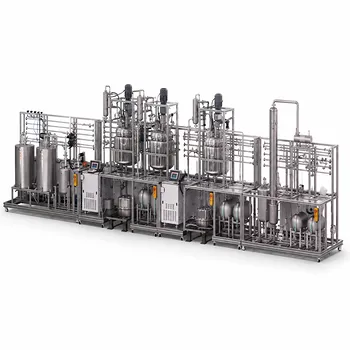
Nothing bridges the gap between abstract mass balance equations and industrial reality like a well-instrumented pilot plant.
A chemical engineering pilot plant that integrates a reactor, a separator, and a recycle loop allows you to directly observe, measure, and validate material balances with recycle and purge streams. By running a continuous reaction—such as gas-phase oxidation—and then recovering unreacted material while deliberately bleeding off a small purge, you can track how inert components accumulate, quantify conversion efficiency, and prove that mass is conserved at every step. The pilot plant transforms an algebraic exercise into a hands-on demonstration, showing exactly why a purge stream is essential to prevent the buildup of inert or unwanted byproducts that would otherwise kill reactor performance.
The core insight: A reactor-separator-recycle pilot plant physically manifests the recycle-purge balance. By measuring flow rates and compositions at the feed, reactor effluent, recycle, purge, and product streams, you can apply conservation of mass to each component, validate theoretical predictions, and see in real time how adjusting the purge ratio shifts the trade-off between raw material conservation and reaction efficiency.
How a Pilot Plant Materializes the Recycle–Purge Concept
The Physical Setup Enforces Mass Conservation
In a typical pilot configuration, a gaseous or liquid feed enters a continuous stirred-tank or tubular reactor. The effluent flows to a separator (a distillation column, condenser, or membrane unit) that isolates the desired product. The unreacted reactants, along with any inert gases or byproducts, are then routed back to the reactor inlet via a recycle line. A small fraction of that recycle loop is continuously bled off through a purge valve. At steady state, the mass entering the system must equal the mass leaving—a principle that is impossible to escape when you can physically measure every stream.
Measuring the Right Variables Makes Balances Tangible
Pilot plants are equipped with flow meters, thermocouples, pressure transducers, and inline analyzers (gas chromatographs or spectrometers). You directly measure:
- The fresh feed flow rate and composition.
- The combined reactor feed (fresh plus recycle) and its composition.
- The reactor outlet stream after reaction.
- The recycle flow rate before the purge split.
- The purge stream flow rate and composition.
- The final product stream. With these measurements, you can write component balances for each chemical species. For an inert like nitrogen, the accumulation equation becomes obvious: if you don't purge, the inert concentration in the loop rises until a steady-state bleed matches the inert entering with the fresh feed. Students can plot this rise by sampling the recycle line at different purge rates, turning a differential equation into a visible trend.
Purge Is the Key that Unlocks the Balance
In many reactions, the fresh feed contains a small amount of inert that does not participate in the reaction (e.g., N₂ in air-based oxidation). Without a purge, that inert would circulate endlessly, diluting the reactants and lowering the reaction rate. The purge stream provides a controlled exit path for these inerts. By varying the purge-to-recycle ratio on the pilot plant’s control panel, you demonstrate how the inert concentration responds dynamically—high purge rates remove inerts aggressively but also waste valuable reactants; low purge rates conserve raw materials but allow inert buildup that degrades reactor kinetics. The material balance equations (Input + Generation = Output + Consumption) let you calculate the exact purge fraction required to hold the inert concentration at a desired setpoint.
Connecting Theory to Measurable Performance Metrics
Calculating Overall and Single-Pass Conversion
A pilot plant with recycle directly illustrates the difference between the conversion across the reactor alone and the conversion benefit of recycling. Using the measured flow rates and compositions, you compute:
- Single-pass conversion = (Reactant into reactor – Reactant out of reactor) / Reactant into reactor
- Overall conversion = (Reactant into the process – Reactant leaving the process) / Reactant into the process
Because unreacted material is returned, the overall conversion is always higher than the single-pass conversion. Students can alter the reactor temperature or recycle flow and immediately see how both numbers shift, grounding abstract formulas in physical cause and effect.
Validating Separator Efficiency and Recycle Ratios
The separator’s performance is not perfect—some product may remain in the recycle loop, and some reactant may contaminate the product. By measuring compositions at the reactor outlet and the separator’s two exit streams, you can calculate the split of each component. That data then feeds directly into the material balance, revealing the actual recovery efficiency. The pilot plant makes it painfully clear that a “perfect” separation only exists in textbooks; real-world losses force you to adjust the purge size and recycle rate to maintain product purity.
Observing Inert Accumulation as a Real Phenomenon
In a purely theoretical class, the need for a purge is presented as a mathematical necessity. In a pilot plant, you can start with no purge, watch the concentration of, say, carbon dioxide or argon gradually climb on a real-time monitor, and then open the purge valve to see the level drop and stabilize. This visual, dynamic learning experience cements the concept that material balance with recycle is not just a set of equations—it is a continuous battle against unproductive dilution.
Understanding the Trade-offs in Recycle-Purge Operation
Raw Material Conservation vs. Reactor Performance
The decision to purge more or less is a classic process optimization problem. A higher purge rate wastes reactants, increasing raw material costs. A lower purge rate accumulates inerts, slowing reaction kinetics and potentially requiring a larger reactor or higher temperature to maintain throughput. The pilot plant allows operators to measure the economic and operational consequences of both extremes, helping trainees internalize why industrial plants often operate with a carefully calculated purge fraction of just a few percent.
Idealized Instrumentation vs. Real-World Noise
While pilot plants are excellent teaching tools, their sensors and sampling systems may introduce measurement lag or slight inaccuracies. When students attempt to close a total mass balance to within 1%, they often discover small discrepancies caused by heat loss, calibration drift, or gas solubility in liquids. This is a vital lesson in itself: real-world process data always has noise, and a perfect balance sheet requires understanding and accounting for measurement uncertainty.
Scale-Down Effects on Heat and Mass Transfer
Pilot plants are smaller than industrial units, so surface-to-volume ratios are larger. Heat loss to the environment and mass transfer limitations may be exaggerated compared to a full-scale plant. When demonstrating material balances, you must emphasize that while the conservation laws hold universally, the numerical values of conversions and purge requirements are scale-dependent. This prevents the dangerous assumption that a pilot plant’s optimal purge ratio can be directly plugged into a commercial design without further analysis.
Making the Right Choice for Your Learning or Research Goal
The way you configure and operate the pilot plant should align with the specific concept you want to reinforce.
- If your primary focus is teaching steady-state material balances: Set up a stable run with a fixed feed rate and purge fraction, and have students measure all streams to close a complete component balance. This builds confidence in the reliability of conservation laws.
- If your primary focus is demonstrating the dynamic effect of purge: Begin with zero purge, track the inert accumulation curve, then step the purge rate and observe how the system settles to a new steady-state concentration. This illustrates the time-dependent nature of recycle loops.
- If your primary focus is optimization and economic analysis: Run the plant at multiple purge fractions, calculate the reactant loss and reactor productivity for each, and determine the purge rate that minimizes the combined cost. This connects material balances to real-world decision-making.
- If your primary focus is validating separation performance: Isolate the separator and compare its actual partition coefficients with theoretical predictions. The data will highlight inefficiencies that alter the recycle composition and, consequently, the overall material balance.
A pilot plant with recycle and purge turns the textbook mantra “Input + Generation = Output + Consumption” into a living process. Once you’ve held the clipboard, adjusted the purge valve, and watched the GC trace shift in response, material balances are no longer abstract—they become a tool you trust.
Summary Table:
| Stream Type | Function in Pilot Plant | Key Measurement/Metric |
|---|---|---|
| Fresh Feed | Introduces raw materials & inerts | Flow rate & species composition |
| Recycle Loop | Returns unreacted material to reactor | Recycle ratio & single-pass conversion |
| Purge Stream | Bleeds off inert build-up to maintain rate | Purge-to-recycle ratio & inert conc. |
| Product Stream | Isolates desired chemical species | Overall conversion & separator efficiency |
Elevate Your Chemical Engineering Lab with LABPARK
Bridging the gap between textbook equations and industrial reality requires hands-on, high-precision equipment. LABPARK designs and manufactures premium Educational and Vocational Unit Operations Pilot Plants in chemical engineering, bioprocess & biotech, and environmental & water treatment.
Whether you are a university looking to enhance student engagement, a research institute validating scale-up models, or an enterprise training your operations staff, our custom pilot plants deliver the real-time data and reliability you need to master complex recycle-purge balances.
Ready to transform your laboratory training? Contact us today to discuss your custom pilot plant requirements and get a tailored solution for your institution.
Related Products
- Multi-Reactor Educational Pilot Plant for Reaction Engineering Unit Operations
- Tubular Reactor Flow Characteristics Determination Educational Unit Operations Pilot Plant
- Fixed-Bed Chemical Reaction and Gas Dust Tar Removal Unit Operations Pilot Plant
- 100L Continuous Loop Hydrogenation Educational Unit Operations Pilot Plant
- Multi Pump Fluid Transport Process Piping Unit Operations Training Pilot Plant
People Also Ask
- How do educational unit operations pilot plants address safety and waste management when scaling up?
- How do educational unit operations pilot plants bridge theory and design? Bridge the Engineering Gap
- Why Compare Predicted and Experimental Excess Enthalpy? Key to Accurate Pilot Plant Scale-up
- Why Use PTFE & Hastelloy in Chemical Pilot Plants? Prevent Corrosion & Ensure Safety
- How to study gasification in pilot plants? Compare exit gas composition & efficiency