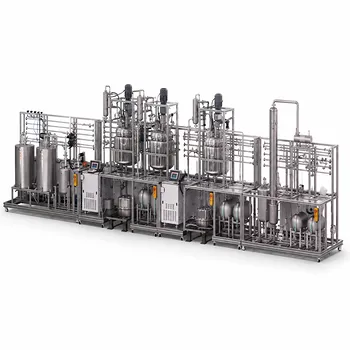
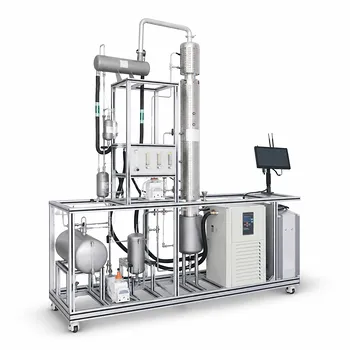
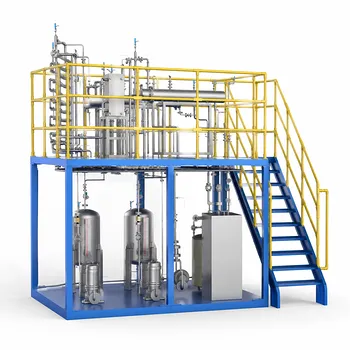
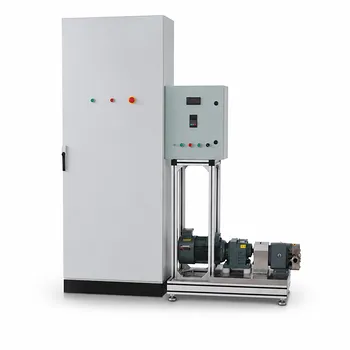
The most effective way to connect theory to practice. Unit operations pilot plants transform the abstract concepts of Critical Process Parameters (CPPs) and Critical Quality Attributes (CQAs) into tangible, observable phenomena. By physically adjusting variables like temperature, flow rate, or pressure, students can directly witness how each change impacts final product quality. This hands-on experimentation allows them to define the multidimensional design space where quality is assured, instantly bridging the gap between Quality by Design (QbD) theory and industrial process control.
The raw power of pilot‑scale experimentation lies in moving Quality by Design from a conceptual regulatory guideline to a lived experience. By directly manipulating variables and measuring outcomes, students internalize the multivariate, cause‑and‑effect relationship between process inputs and product quality—a lesson no lecture can deliver on its own.
Beyond the Textbook: Bridging the QbD Theory‑Practice Gap
Why Abstract Concepts Need Physical Anchors
QbD principles like design space and risk‑based control can feel vague when studied on paper. A pilot plant turns them into an intuitive, measurable reality.
When students see that a 5 °C rise in extraction temperature drastically alters the purity of a final API, the concept of a Critical Process Parameter ceases to be abstract. The causal link between input and output becomes unforgettable.
The Unit Operation as a Learning Module
Complex industrial processes are built from discrete unit operations—mixing, extraction, filtration, drying. Pilot plants isolate these steps, creating perfect teaching modules.
Each unit operation comes with its own set of CPPs and CQAs. In a filtration module, for instance, membrane type and pressure drop are the CPPs, while filtrate clarity and flow rate are the CQAs. This modularity lets learners master one relationship at a time before integrating the whole manufacturing train.
How Pilot Plants Teach the CPP‑CQA Relationship
The Core Loop: Manipulate, Measure, Model
The fundamental learning cycle is simple but powerful. A student varies a Critical Process Parameter—say, agitator speed in a granulator—and then measures the resulting change in a Critical Quality Attribute, such as particle size distribution.
By repeating this loop across multiple parameters and conditions, the learner builds a mental model of the process’s sensitivity. This model is the foundation of the QbD mindset.
Systematic Experimentation with Design of Experiments (DoE)
Rather than changing one variable at a time, pilot plants enable structured Design of Experiments (DoE). Students can execute a factorial design, varying agitation speed and liquid addition rate simultaneously, to uncover interaction effects on granule density.
This multivariate approach reveals that CPPs do not operate in isolation. A change in one parameter might amplify the effect of another—insights that are critical for defining a robust design space.
Risk Assessment and Variable Classification
Before running a single experiment, students learn to apply risk‑assessment tools on the pilot plant. They use Cause‑and‑Effect (C&E) matrices and Failure Mode and Effects Analysis (FMEA) to categorize variables as controllable (C), noise factors (N), or experimental variables (X).
This step teaches prioritization: not every variable is worth the same experimental effort. Students focus their limited pilot time on the few CPPs that pose the greatest risk to CQAs.
Building and Visualizing the Design Space
With DoE data in hand, students can map the multidimensional design space—the region where all CQAs simultaneously meet specifications. On a pilot‑scale bioreactor, for example, they might identify the operating envelope of temperature and feed rate that maximizes yield while keeping impurity levels acceptable.
They can then physically run the process at the edges of this space. Watching a process drift from “well within spec” to “borderline failure” cements the meaning of control limits far more effectively than any graph.
Linking Upstream Variability to Downstream Quality
In industry, raw materials are never constant. Pilot plants let students simulate this reality by deliberately altering feedstock properties—changing particle size, moisture content, or purity—at the first unit operation.
They then trace the consequences through each successive downstream step. This end‑to‑end exercise shows that final CQAs are not just a function of immediate process settings, but of the entire manufacturing history, teaching a science‑ and risk‑based approach to raw material acceptance criteria.
Understanding the Trade‑offs and Limitations
Scale‑Down Can Mask Real‑World Complexity
A pilot plant is not a perfect replica of a production‑scale unit. Differences in surface‑to‑volume ratios, mixing dynamics, and heat transfer can hide issues that only emerge at full scale. Students must learn that a design space validated on the pilot plant requires a deliberate scale‑up strategy.
Resource Intensity Limits Exploration
Pilot experiments consume materials, energy, and instructor time. Safety protocols and chemical costs often restrict the number of runs. This constraint is actually a powerful teaching moment—it forces students to choose parsimonious experimental designs and to think critically about which data points are truly essential.
The Danger of Confirmation Bias
When students see a visual trend linking a CPP to a CQA, they may leap to a causal conclusion without proper statistical rigor. A well‑designed pilot‑plant curriculum must deliberately include runs that challenge assumptions and teach the disciplined analysis of residuals and confidence intervals.
Making the Right Choice for Your Educational Goal
How you deploy a unit operations pilot plant will depend on the core competency you want to build. Align the experiments with your learning objective.
- If your primary focus is teaching basic cause‑and‑effect: Start with single‑factor experiments on robust unit ops like filtration or simple mixing. Keep the visual link between CPP and CQA immediate and unambiguous.
- If your primary focus is instilling an industrial‑quality mindset: Incorporate raw material variability, sequential unit operations, and formal risk‑assessment methodologies like FMEA. Have students define an end‑to‑end control strategy, not just isolated parameters.
- If your primary focus is statistical competence and DoE mastery: Design a structured project that culminates in a response surface model. Let students plan a fractional factorial experiment, execute it on the pilot plant, and then use the model to predict and verify an optimal setpoint within the design space.
- If your primary focus is troubleshooting and scale‑up thinking: Introduce deliberate deviations outside the intended design space and let the process fail—observe powder degradation, yield loss, or out‑of‑spec dissolution. Then challenge students to diagnose the root cause and propose a corrective action that brings the process back into control.
Ultimately, the unit operations pilot plant is not just equipment—it is a pedagogical engine that forges the intuitive, risk‑based thinking essential for the next generation of chemical engineers.
Summary Table:
| Learning Objective | Key Focus & Methodology | Target Educational Outcome |
|---|---|---|
| Basic Cause & Effect | Single-factor experiments (e.g., filtration) | Grasp immediate, visual CPP-CQA links |
| Industrial Quality Mindset | Risk-assessment (FMEA) & feed variability | Design comprehensive, end-to-end control strategies |
| DoE & Statistical Mastery | Factorial design & response surface modeling | Map and verify multidimensional design spaces |
| Troubleshooting & Scale-up | Inducing out-of-spec deviations & failures | Diagnose root causes and propose corrective actions |
Bridge the Gap Between QbD Theory and Practice with LABPARK
Looking to equip your students and researchers with the practical skills needed to master Critical Process Parameters (CPPs) and Critical Quality Attributes (CQAs)?
LABPARK designs and manufactures high-quality Educational and Vocational Unit Operations Pilot Plants tailored for universities, research institutes, and enterprises. Our pilot-scale systems cover key areas including:
- Chemical Engineering (distillation, extraction, drying, and reaction engineering)
- Bioprocess & Biotech (bioreactors, fermentation, and downstream processing)
- Environmental & Water Treatment (membrane filtration, aeration, and purification)
Give your learners a physical anchor for abstract Quality by Design (QbD) concepts. Contact LABPARK today to discuss your curriculum needs or request a customized equipment quotation!
Related Products
- Carbon Dioxide Hydrogen Methanol Synthesis Educational Unit Operations Pilot Plant
- Multi Pump Fluid Transport Process Piping Unit Operations Training Pilot Plant
- Multi-Reactor Educational Pilot Plant for Reaction Engineering Unit Operations
- Ethyl Acetate Synthesis Unit Operations Pilot Plant for Practical Training
- Multi-Modal Distillation Unit Operations Training Pilot Plant
People Also Ask
- How do temp & pressure affect methanol synthesis pilot plants? Optimize equilibrium and catalyst performance.
- Why is a purge system necessary when operating a gas recirculation loop in a methanol synthesis pilot plant? (Guide)
- Why do modern methanol pilot plants operate at lower pressures? Catalyst & Feed Requirements Explained
- What are the operational requirements for catalyst activation? Safe Methanol Pilot Plant Operation
- Why is the chemical plant startup schedule crucial? De-risk scale-up with pilot plants.