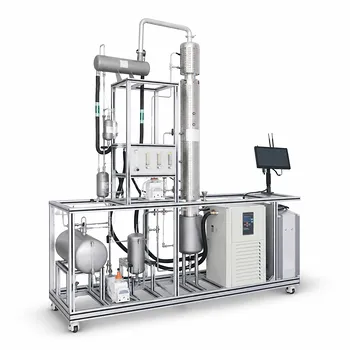
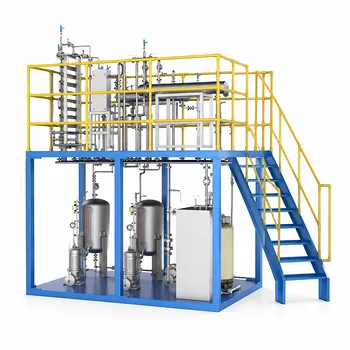
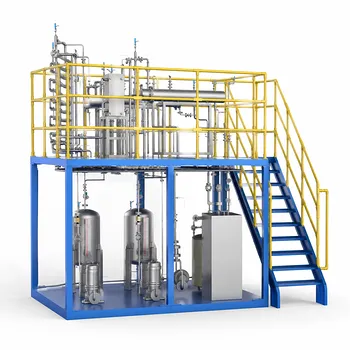
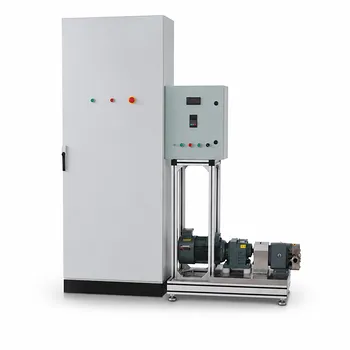
The key isn't scaling the reaction to the vessel, but scaling the vessel's internal geometry to the reaction. Unit operations pilot plants solve the mass and heat transport mismatch by abandoning the single-vessel paradigm. They function as a configurable "multi-scale toolbox," where researchers directly match the critical length scale of the reactor hardware—micro, milli, or meso—to the specific time scale of the reaction's kinetics and transport demands.
The core challenge of scale-up is not making reactors bigger, but managing the physics of smaller internal pathways. A pilot plant equipped with interchangeable technologies—from micro-channel mixers to spinning-disk reactors—allows you to manipulate the surface-area-to-volume ratio and residence time distribution independently. This gives you direct experimental control over the heat and mass transfer coefficients that degrade in traditional batch scale-up.
Deconstructing the Physics of Failure in Scale-Up
The disconnect between lab success and pilot failure usually stems from one broken assumption: that mixing and heat transfer are instantaneous. At a larger scale, they are not. A multi-scale pilot plant lets you intentionally break this assumption to map the boundary where a reaction becomes transport-limited.
Why a Bigger Beaker Fails to Scale
When you increase the length scale of a vessel, the surface-area-to-volume ratio collapses. The rate at which you can add or remove heat is proportional to the vessel's surface area, but the mass that holds that heat is proportional to the volume. This creates a thermal bottleneck.
Transport processes like mixing don't scale linearly either. The time required to achieve homogeneity by diffusion alone increases with the square of the diffusion path length. What was a millisecond event in a beaker becomes a multi-second delay in a pilot reactor, during which unwanted side reactions can dominate.
How Internal Geometry Overrides Vessel Size
A multi-scale pilot plant bypasses this problem by shrinking the critical transport dimension while maintaining industrial throughput. Instead of a large stirred tank, you can select a meso-scale plug flow reactor with millimeter-wide channels. The heat transfer distance is now the radius of that channel, not the radius of a large vessel, while the high surface area of many parallel channels provides the necessary heat exchange capacity.
For ultra-fast reactions demanding sub-millisecond mixing, a microfluidic mixing tee or a spinning-disk reactor becomes the tool of choice. These technologies apply intense shear in a highly confined volume, achieving mixing times that rival the chemical reaction time itself, thereby restoring kinetic control.
Matching the Tool to the Kinetic Demand
The true power of a unit ops pilot plant lies in its ability to be reconfigured. You don't design a process around a pump and a tank; you select the pump and the reactor type that give the chemistry exactly what it needs.
Understanding the Multi-Scale Toolbox
The "toolbox" approach means having a range of reactor internals with different characteristic dimensions, known as "internal hydraulic diameters." This allows for head-to-head experimental comparisons.
- For mixing-limited reactions: A standard tee-junction mixer can be swapped for a micro-structured lamellar mixer. Students can immediately observe a jump in product yield, conclusively proving that the reaction was previously limited not by kinetics, but by the physical rate of molecular encounter.
- For heat transfer-limited reactions: A large-volume continuous stirred-tank reactor (CSTR) can be replaced by a compact heat exchanger reactor. The approach to isothermal operation is measured empirically. This makes the abstract concept of a UA calculation (overall heat transfer coefficient times heat transfer area) a tangible, measurable design parameter.
Mapping the Kinetic Regime Empirically
A pilot plant's job is to provide the empirical truth that models can't predict. By deliberately operating the same chemistry in a poorly-mixed CSTR and a near-ideal plug flow reactor, you map how the residence time distribution changes product distribution.
Advanced units with integrated analytical sensors make this powerful. You can measure a fast reaction's selectivity in real-time as you change the mixer's internal diameter, directly establishing the "kinetic time scale" that any successful industrial design must beat.
The Critical Step: From Unit Operation to Closed-Loop Process
A reactor is just one unit. The deep need is to understand how it integrates into a sustainable, stable process over time, which a closed-loop pilot plant reveals.
Detecting the Slow Killers of Yield
Lab-scale runs lasting minutes use pure chemicals and fresh catalyst. A continuous pilot plant operating for weeks reveals the hidden but fatal problems. You can observe the slow accumulation of inactive forms of the catalyst due to coking or observe the buildup of trace byproducts in a recycle stream that can poison the main reaction. These effects are invisible in a short lab test but will define the economic viability of a commercial plant.
Uncovering the "Process Signature"
Achieving identical product quality across scales requires more than matching a single number like conversion. You must replicate the entire process signature—the multivariate trajectory of a material through a time-temperature-mixing history.
A sensor-rich pilot plant generates the high-dimensional data required to model this. By using latent variable methods on historical runs, you can mathematically define the operating envelope that guarantees product quality. This transforms scale-up from an art of guesswork into a data-driven science.
Understanding the Trade-offs
A multi-scale toolbox is powerful, but it does not eliminate constraints; it shifts them to different areas that must be managed.
- Pressure Drop vs. Performance: The high shear and small channels that deliver excellent heat and mass transfer come at a steep cost: a significantly higher pressure drop. The pumping energy requirement can become a major operational cost and a safety concern for viscous or fouling-prone mixtures.
- Sensitivity to Fouling: Micro- and meso-scale channels, by their nature, are more susceptible to blockages from solids or polymerization. A pilot plant designed for a fast, clean reaction may fail instantly if an unexpected precipitate forms—an issue a large, forgiving, stirred tank might handle.
- Data Complexity Overload: A toolbox with multiple reactors and online sensors generates immense multivariate data. Without a clear experimental design, it's easy to drown in noise, identifying spurious correlations between dozens of parameters instead of the true causal relationship between mixing time and selectivity.
- The "Tiny Flow" Trap: The most elegant micro-reactor is useless for an industrial process if it can't be scaled out to meet production targets. This "scale-out by numbering-up" creates its own challenge in ensuring uniform flow distribution across thousands of parallel channels, a problem the pilot plant must anticipate.
How to Apply This to Your Project
The right configuration depends entirely on the physics of the reaction you're scaling. Use the pilot plant's flexibility to ask these specific questions.
- If your primary focus is a mixing-limited, fast competitive reaction: Start by rapidly screening a series of mixers with decreasing internal hydraulic diameters, using yield of the desired product as your sole go/no-go metric. This directly quantifies the mixing time you need.
- If your primary focus is a highly exothermic or thermally sensitive reaction: Select the reactor technology by directly measuring a steady-state temperature profile, not by calculating the UA. A compact heat exchanger reactor that maintains a near-isothermal profile at your target throughput is the correct choice, even if it's more complex.
- If your primary focus is bridging theory and industrial reality: Use the pilot plant not as a mini-factory, but as a model validation engine. Run identical chemistry in a non-ideal CSTR and an ideal plug flow reactor, then use the resulting data to build a combined kinetic-transport model that can predict performance at any scale.
A unit operations pilot plant is not a destination but a decision-making instrument. Its true value is in providing the physical evidence to select and size the one reactor technology that precisely meets the kinetic demands of your specific chemistry.
Summary Table:
| Reactor Type | Characteristic Dimension | Key Transport Benefit | Best Application |
|---|---|---|---|
| Micro-Scale (e.g., Mixing Tee, Spinning-Disk) | Sub-millimeter channels | Intense shear, sub-millisecond mixing times | Fast, mixing-limited, competitive reactions |
| Meso-Scale (e.g., Plug Flow Reactor) | Millimeter-wide channels | High surface-area-to-volume ratio, short heat path | Exothermic, heat transfer-limited reactions |
| Macro-Scale (e.g., Traditional CSTR) | Large vessel diameter | Large volume, longer residence times | Slow, kinetic-controlled, fouling-prone reactions |
Bridge the Gap Between Theory and Industrial Scale-Up with LABPARK
To master complex transport phenomena, your researchers and students need hands-on access to modular, real-world hardware. LABPARK designs and delivers premium Educational and Vocational Unit Operations Pilot Plants in chemical engineering, bioprocess & biotech, and environmental & water treatment.
Tailored specifically for universities, research institutes, and enterprises, our pilot plants empower you to:
- Configurably match reactor geometry to chemical kinetics.
- Experimentally analyze heat transfer coefficients and residence time distributions.
- Train the next generation of engineers on industry-grade instrumentation.
Take control of your scale-up research and curriculum. Contact LABPARK today to discuss your custom pilot plant configuration!
Related Products
- Carbon Dioxide Hydrogen Methanol Synthesis Educational Unit Operations Pilot Plant
- Multi Pump Fluid Transport Process Piping Unit Operations Training Pilot Plant
- Multi-Reactor Educational Pilot Plant for Reaction Engineering Unit Operations
- Ethyl Acetate Synthesis Unit Operations Pilot Plant for Practical Training
- Multi-Modal Distillation Unit Operations Training Pilot Plant
People Also Ask
- How do temp & pressure affect methanol synthesis pilot plants? Optimize equilibrium and catalyst performance.
- Why is a purge system necessary when operating a gas recirculation loop in a methanol synthesis pilot plant? (Guide)
- Why do modern methanol pilot plants operate at lower pressures? Catalyst & Feed Requirements Explained
- What are the operational requirements for catalyst activation? Safe Methanol Pilot Plant Operation
- Why is the chemical plant startup schedule crucial? De-risk scale-up with pilot plants.