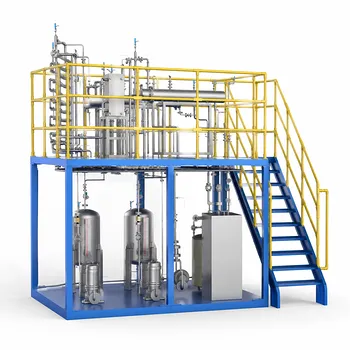
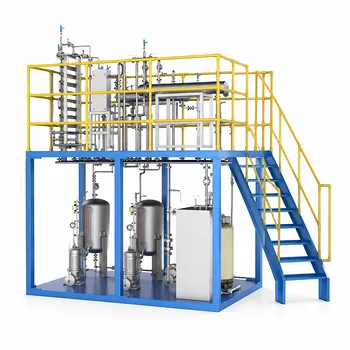
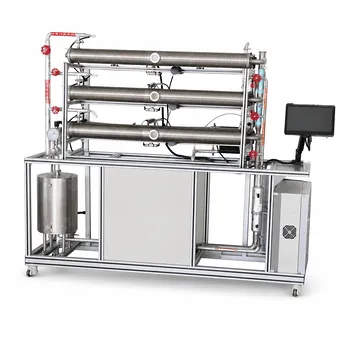
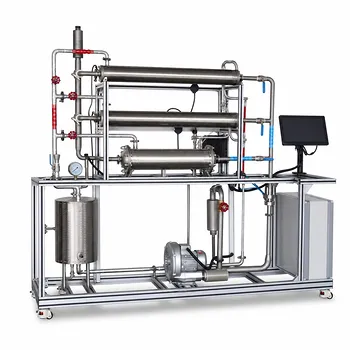
You can transform a unit operations pilot plant into a modern laboratory-scale replica of the 19th-century checkerbrick concept. By configuring a pilot-scale thermal storage bed with automated flow-reversal valves and precision temperature sensors, chemical engineering students actively measure heat recovery rates, thermal efficiency, and the influence of cycle time—directly mirroring the regenerative energy-saving principle that powered open-hearth steelmaking. This hands-on approach converts a textbook description into tangible data, cementing the fundamentals of high-temperature heat conservation.
The open-hearth furnace’s checkerbrick system conserved fuel by using a brick matrix to store heat from exhaust gases and then preheat incoming cold gas through periodic flow reversal. Students can recreate this same physics in a unit operations pilot plant equipped with a packed thermal storage bed and automated directional valves, learning to quantify heat transfer effectiveness and optimize thermal cycling — a skill essential for energy-efficient process design.
The Regenerative Checkerbrick Principle: From Steelmaking to the Heat Transfer Lab
How Open-Hearth Furnaces Saved Fuel with Bricks
The open-hearth process relies on a regenerative checkerbrick structure: hot combustion exhaust gases flow through one side of a brick arrangement, heating the bricks to a high temperature. At a set interval, the gas flow direction is reversed. Now the incoming cold air (and often fuel) passes across those same hot bricks, absorbing the stored heat before entering the melting chamber. This cyclic heat storage and release dramatically reduces fuel consumption while maintaining the extreme temperatures needed for steelmaking.
The Core Lessons: Thermal Storage and Dynamic Recovery
The educational value for a chemical engineering student lies in three interconnected concepts. First, the capacitive thermal storage in a solid matrix. Second, the dynamic transient heat exchange — the exchanger’s performance changes continuously during a cycle. Third, the system-level fuel savings achieved by recovering energy that would otherwise be lost. A pilot plant allows these abstract ideas to be measured, plotted, and tuned.
Setting Up a Regenerative Heat Recovery Pilot Plant
Essential Components: Thermal Storage Bed, Reversing Valves, and Sensors
To mimic the checkerbrick system, a unit operations pilot plant needs three core elements:
- A thermal storage unit, typically a packed bed of ceramic beads or metal spheres chosen for their heat capacity and surface area.
- Automated flow-reversal valves that route hot and cold gas streams alternately through the bed.
- Instrumentation: thermocouples at multiple axial positions, flow meters, and a data acquisition system for real-time temperature logging.
These components, often found on modular heat transfer pilot plants, allow the bed to experience the same heating-purging-cooling cycle as the historical brick checkers.
Operational Variables That Drive Thermal Performance
Students manipulate cycle time (the interval between flow reversals), hot gas inlet temperature, and cold gas flow rate. By changing these parameters, they observe how the bed’s thermal profile evolves. The resulting experimental data reveal the balance between heat storage capacity and convective transfer rates — the same trade-off faced by furnace engineers in the steel industry.
What Students Can Measure and Learn
Calculating Thermal Efficiency and Heat Recovery Rate
With inlet and outlet temperatures logged during each half-cycle, students perform an energy balance across the bed. They compare the energy gained by the incoming cold stream to the energy lost by the hot exhaust, computing thermal efficiency as: [ \text{Efficiency} = \frac{\text{energy recovered by cold gas}}{\text{energy available in hot exhaust}} ] This directly demonstrates the fuel savings potential and verifies that 100% recovery is impossible due to thermal losses to the environment and the bed’s imperfect heat retention.
Characterizing Heat Transfer Coefficients in Cyclic Operation
Unlike a steady-state recuperator, a regenerative bed operates in a transient mode. Students calculate an effective heat transfer coefficient using the temperature difference between the gas and the solid bed as a function of time. This hands-on analysis connects the empirical Nusselt number correlations taught in transport phenomena to a real, cycling device.
Evaluating the Impact of Cycle Time on Performance
Short cycle times may not allow the bed to fully charge or discharge, reducing thermal efficiency. Long cycle times can cause the outlet gas temperature to drop excessively during the later part of a blow period. By systematically varying the switching frequency, students generate characteristic efficiency versus cycle duration curves, discovering the optimal that maximizes heat recovery for a given bed geometry and flow rate.
Understanding the Trade-offs and Limitations of Pilot-Scale Simulation
Idealizations vs. Industrial Reality
A laboratory-scale thermal storage bed differs from a true open-hearth checker brickwork in important ways. Heat losses to the surroundings are proportionally larger in a small pilot plant unless insulation is carefully designed. Industrial checkerbricks experience extreme temperature swings (often exceeding 1000°C); a typical undergraduate pilot bed handles lower temperatures, which alters radiative heat transfer contributions. Students must critically compare their computed efficiencies with published plant data to grasp the effect of scale on thermal behavior.
Common Measurement Pitfalls and How to Avoid Them
The most frequent errors occur when thermocouple placement does not capture the proper gas mixing temperature at the bed exit. Students should install multiple sensors and allow for adequate sensor response time. Another pitfall is neglecting the thermal mass of the bed containment vessel in the energy balance, which can artificially inflate apparent heat recovery. Finally, rapid flow reversal can create pressure surges; the experimental procedure must include steady-state initial conditions and clear repeatability checks to yield meaningful results.
Making the Right Choice for Your Experiment
- If your primary focus is understanding energy conservation fundamentals: Use the pilot plant’s regenerative bed to measure the temperature rise of the cold stream and calculate fuel savings percentages directly, reinforcing the first law of thermodynamics.
- If your primary focus is dynamic process control: Configure the automated reversal valves to test different cycle strategies and observe the transient temperature profiles, then model the bed with a dynamic simulation to compare predicted and measured responses.
- If your primary focus is comparing regenerative and recuperative heat recovery: Operate the same pilot plant in a single-pass, non-recycling mode (bypassing the flow reversal) and contrast the temperature exit profiles and overall heat recovery with the cyclic operation to highlight when transient storage offers an advantage.
- If your primary focus is scaling up to industrial energy audits: Extend the exercise by applying the measured efficiency data to a pinch analysis of a mock plant, showing how waste heat from one unit operation (like a reactor) could preheat feeds using a regenerator — directly linking the lab to whole-plant energy optimization.
A unit operations pilot plant gives you the power to command the flow direction and watch in real time how a column of hot bricks — or ceramic beads — can hold and return energy. Master that cycle, and you hold the key to designing furnaces, reactors, and kilns that do more with less fuel.
Summary Table:
| Component/Parameter | Description | Key Educational Value |
|---|---|---|
| Thermal Storage Bed | Packed bed of ceramic beads/spheres | Demonstrates capacitive thermal storage and transient heat exchange |
| Reversing Valves | Automated flow-reversal controls | Simulates cyclic regenerative phases like industrial checkerbricks |
| Cycle Time | Adjustable switching intervals | Explores trade-offs between heat retention and heat transfer rates |
| Instrumentation | Axial thermocouples & flow meters | Enables calculation of efficiency and transient heat transfer coefficients |
Elevate Chemical Engineering Training with LABPARK
Bring complex thermodynamic principles to life in your lab. LABPARK provides premium Educational and Vocational Unit Operations Pilot Plants in chemical engineering, bioprocess & biotech, and environmental & water treatment for universities, research institutes, and enterprises.
Empower your students and researchers to master heat recovery, process control, and real-world industrial scale-up. Contact us today to find the perfect pilot plant solution for your lab!
Related Products
- Comprehensive Multi-Modal Heat Transfer Unit Operations Pilot Plant for Engineering Training
- Dual Mode Heat Transfer Pilot Plant for Unit Operations Training
- Three-Tube Heat Transfer Educational Pilot Plant for Unit Operations Training
- Comprehensive Heat Transfer Coefficient Determination Educational Unit Operations Pilot Plant
- Carbon Dioxide Absorption and Desorption Educational Pilot Plant for Carbon Capture Studies
People Also Ask
- When is ε-NTU preferred over LMTD in pilot plants? Predict heat exchanger performance without iteration.
- Why is emissivity critical in heat transfer pilot plants? Bridge the Gap Between Theory & Industrial Design
- What engineering trade-offs must students analyze in a heat transfer pilot plant? Balance performance & cost.
- How to Verify Air-Side Heat Transfer Coefficient with a Pilot Plant? Practical Lab Guide
- How to configure heat transfer pilot plants for pinch analysis? Teach energy recovery.