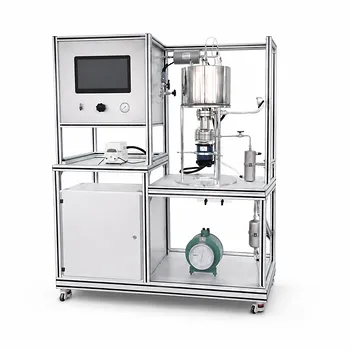
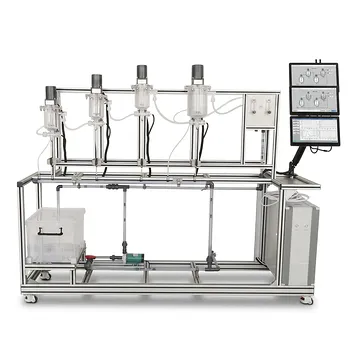
The experimental comparison hinges on running the same liquid-phase reaction in both a batch reactor and a CSTR pilot plant under tight isothermal control, then measuring how much time or volume each configuration demands to hit a target conversion. By holding temperature constant, students isolate the effect of flow pattern—transient concentration decay in the batch versus steady-state uniform mixing in the CSTR—and can directly verify the design equations that make the CSTR inherently thirstier for volume when the reaction order is positive.
The core insight is that a CSTR operates at the exit concentration, so every reacting element sees the slowest possible rate; a batch reactor progresses through a spectrum of high to low concentrations, averaging a much higher rate. This “dilution penalty” can be quantified experimentally by comparing the batch reaction time to the CSTR space time needed for identical conversion, revealing why a single CSTR often demands a substantially larger liquid holdup than a batch vessel performing the same chemistry.
Designing the Isothermal Comparison Experiment
Selecting a Reaction and Mastering Temperature Control
A robust isothermal comparison demands a well-characterized liquid-phase reaction—such as a simple alkaline hydrolysis or esterification—with known positive-order kinetics. Using a pilot plant with jacket or coil temperature control, students must first demonstrate that both reactors can hold a set temperature within ±0.5 °C throughout the entire run, because even a small thermal drift will distort rate constants and undermine the comparison.
Running the Batch Reactor: Capturing the Concentration–Time Story
A batch pilot plant is charged with a known initial concentration of the limiting reactant, and samples are withdrawn at timed intervals for concentration analysis. By plotting conversion or concentration against time, students can fit the data to the integrated rate law—for example, (t = -\frac{1}{k}\ln(1-X_{Af})) for a first-order reaction—to extract the reaction time needed for any desired conversion. The batch experiment directly delivers the kinetic rate constant (k) under the exact mixing intensity and temperature used later in the CSTR, eliminating discrepancies between literature values and local hydrodynamics.
Operating the CSTR: Finding Steady State and Interpreting Space Time
With the same feed concentration and isothermal setpoint, the CSTR pilot plant is started and allowed to reach steady state. Students measure the inlet and outlet reactant concentrations, then calculate conversion (X_A) and space time (\tau = V_R / Q_0). For a first-order reaction, the design equation (\tau_{CSTR} = \frac{X_A}{k(1-X_A)}) can be compared directly with the experimental (\tau); alternatively, students can adjust the feed flow rate to match the batch’s target conversion, then read the required volume directly from the level in the pilot plant. Multiple steady-state points at different flow rates build a curve of conversion versus space time that vividly contrasts with the batch’s time-conversion profile.
Interpreting the Performance Gap
Why the CSTR Needs More Volume (the Dilution Penalty)
In a perfectly mixed CSTR, the incoming feed is instantaneously diluted to the final exit concentration, so the entire reactor sees the slowest reaction rate of the whole process. A batch reactor, by contrast, starts at the high inlet concentration and only approaches the final exit concentration at the very end; its average rate is much higher. This is why, for positive-order kinetics, achieving 90 % conversion in a CSTR typically requires a significantly larger volume than a batch reactor that can reach the same conversion in far less liquid holdup once auxiliary time is excluded.
Verifying Design Equations with Experimental Data
Pilot plants allow students to transition from abstract integration to tangible measurement. After determining (k) from the batch reactor, they can predict the CSTR space time for a given conversion and then experimentally verify it by measuring outlet concentrations at steady state. The agreement—or the small deviation caused by deviations from ideal mixing—teaches the power and the limits of ideal reactor models, a lesson that no simulation alone can deliver.
Extending the Comparison to a CSTR Cascade
If the pilot plant allows multiple stirred tanks to be connected in series, students can further demonstrate that adding stages pushes overall performance closer to the batch/plug-flow ideal. By measuring conversions after each vessel, they see the concentration profile stepping down more gradually, reducing the total volume required to meet the final target. This progression from a single CSTR → multiple CSTRs → plug-flow behavior is one of the most instructive experiments a reactor engineering course can offer.
Understanding the Trade-offs and Hidden Pitfalls
Isothermal Control Is Harder Than It Looks
Even with active cooling, a CSTR running an exothermic reaction can develop localized hot spots or struggle to reject the continuous heat generation, making strict isothermal operation demanding. Students must confirm that the temperature measured at the vessel exit (and ideally at intermediate points) remains constant; otherwise, the “isothermal” comparison is contaminated by temperature-dependent kinetics, and the observed volume penalty may be exaggerated or masked.
The Ghost of Auxiliary Time
The batch reactor’s elegant time-conversion calculation ignores filling, heating, emptying, and cleaning—all of which erode real-world productivity. When these auxiliary times are added in, a batch system may lose its volumetric advantage over a CSTR, especially for fast reactions. A mature pilot plant exercise can extend the comparison by measuring total cycle time, not just reaction time, giving students a preview of the economic trade-offs that govern industrial reactor selection.
Mixing Effects That Masquerade as Kinetic Differences
If an apparently slow CSTR run is actually suffering from poor micromixing near the feed zone, students might misattribute the performance drop to the dilution penalty. The primary reference implicitly assumes ideal mixing; pilot plants make that assumption testable. By deliberately varying agitator speed while holding flow rate constant, students can confirm whether the reaction is kinetically controlled or if transport limitations are distorting the data.
Making the Right Choice for Your Educational Goal
The optimal experimental sequence depends on what you most need your students to learn. Use the pilot plant capabilities to target the specific takeaway.
- If your primary focus is teaching reaction kinetics fundamentals: Start with the batch reactor to extract the intrinsic rate constant and validate the integrated rate law; the CSTR becomes a verification tool, not the main event.
- If your primary focus is comparing reactor volumes for process design: Run both reactors to a common conversion and directly calculate the liquid holdup required, emphasizing the dilution penalty and the impact of auxiliary time on real batch productivity.
- If your primary focus is demonstrating continuous processing and RTD: Center the exercise on the CSTR, using tracer tests and multiple steady states to explore residence time distribution, while using the batch reactor only as a kinetic benchmark.
- If your primary focus is bridging theory and industrial practice: Combine both experiments with a CSTR cascade to show students that the large volume penalty of a single stirred tank can be dramatically reduced by staging, a principle they will see repeatedly in plant design.
The pilot plant doesn’t just prove equations—it turns “the CSTR needs a bigger tank” into a number students have measured with their own hands, building the intuition that separates a textbook engineer from a trusted decision-maker.
Summary Table:
| Feature | Batch Reactor | CSTR (Continuous Stirred Tank) |
|---|---|---|
| Concentration Profile | Declines over time (transient) | Constant at exit concentration (steady-state) |
| Reaction Rate | High average rate | Slowest rate (diluated exit concentration) |
| Key Metric | Reaction time ($t$) | Space time ($\tau$) |
| Volume Required | Smaller liquid holdup | Larger volume for identical conversion |
Bridge the Gap Between Reactor Theory and Hands-On Practice
Ready to elevate your chemical engineering curriculum or research capabilities? LABPARK provides state-of-the-art Educational and Vocational Unit Operations Pilot Plants in chemical engineering, bioprocess & biotech, and environmental & water treatment.
Specifically engineered for universities, research institutes, and enterprises, our pilot plants enable students and researchers to physically measure, compare, and master reactor performance.
Contact LABPARK today to discover how our customizable pilot plant solutions can transform your lab training and research outcomes!
Related Products
- Fixed-Bed Chemical Reaction and Gas Dust Tar Removal Unit Operations Pilot Plant
- Multi-Reactor Educational Pilot Plant for Reaction Engineering Unit Operations
- Fixed Bed Gas Solid Catalytic Reaction Educational Pilot Plant
- 100L Continuous Loop Hydrogenation Educational Unit Operations Pilot Plant
- Internal Circulation Gradient Free Catalytic Reaction Educational Pilot Plant
People Also Ask
- When to transition from PID to adaptive control in pilot plants? Key process indicators.
- How do deviations in estimating latent heat impact pilot plant thermal systems? Avoid hardware mis-sizing.
- Why Compare Predicted and Experimental Excess Enthalpy? Key to Accurate Pilot Plant Scale-up
- How to study gasification in pilot plants? Compare exit gas composition & efficiency
- Why Use PTFE & Hastelloy in Chemical Pilot Plants? Prevent Corrosion & Ensure Safety