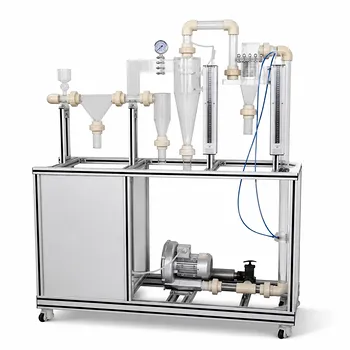
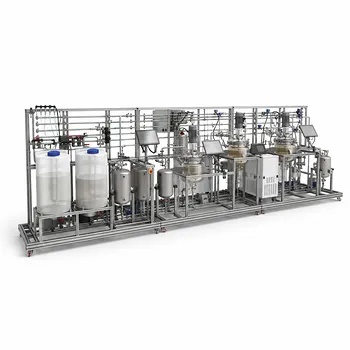
Optimization in pilot plants isn't just about getting the “right answer”—it’s about teaching students to think critically about trade-offs in real, constrained systems. Chemical engineering instructors can integrate Sequential Quadratic Programming (SQP) by framing pilot‑plant exercises as constrained, non‑linear optimization problems. Students first build a simulation model of a single unit operation—such as a distillation column or heat exchanger—using fundamental balances. They then apply SQP to solve for optimal operating parameters (like reflux ratio, feed temperature, or flow rate) that maximize product purity or minimize energy consumption, and finally validate the predictions on the physical pilot plant. This sequence transforms SQP from an abstract algorithm into a practical tool for process improvement.
Teaching SQP with unit operations pilot plants accomplishes two goals at once: it demonstrates the power of gradient‑based optimization for low‑variable, highly non‑linear problems, and it forces students to confront the real‑world gaps that can exist between simulated optima and actual process behaviour.
Why SQP Fits the Educational Pilot‑Plant Challenge
The Nature of Pilot‑Plant Optimization Problems
Unit‑operation pilot plants—whether a fractionation column, a heat‑exchanger network, or a continuous stirred‑tank reactor—present students with small, focused design spaces. Typical exercises involve fewer than 50 decision variables, yet the underlying physics (phase equilibrium, reaction kinetics, heat transfer coefficients) are highly non‑linear. These conditions are precisely where Sequential Quadratic Programming excels.
SQP’s Speed and Educational Practicality
SQP converges faster than Successive Linear Programming (SLP) for gradient‑based, low‑variable problems. In a teaching lab, faster convergence means less time waiting for a solver and more time discussing why the optimum landed where it did. Instructors can therefore dedicate class sessions to sensitivity analysis and constraint interpretation rather than to numerical troubleshooting.
Designing an SQP‑Based Learning Module
Building the Simulation Foundation
Before optimization comes a trustworthy model. Students must express the unit operation through mass and energy balances, thermodynamic models, and kinetic rate laws. Many educational pilot plants are integrated with simulation software—such as MMSP programs for multistage separation—that can be used to build a digital twin. The model captures the same adjustable parameters the students will later turn on the physical rig: flow rates, temperature set‑points, reflux ratios, or space velocity.
Formulating an Optimization Objective
The instructor guides students to translate a practical goal into a mathematical objective: minimise reboiler duty while meeting distillate purity specs, or maximise ethylbenzene selectivity without exceeding a hot‑spot temperature. Constraints naturally arise from equipment limits, safety boundaries, and product quality requirements. This step teaches the critical skill of converting a process‑engineering desire into a solvable optimisation problem.
Implementing SQP in the Classroom
Depending on the course’s technical depth, students can call an SQP solver from MATLAB’s fmincon, Python’s SciPy, or a built‑in routine in Aspen Plus. The instructor can briefly walk through the conceptual loop: a quadratic subproblem approximates the Lagrangian, a line‑search steers toward a better point, and the Hessian is updated via BFGS. Students then run the solver, adjusting starting guesses to see how convergence changes.
Connecting Simulation Back to the Physical Pilot Plant
Validation and Model Refinement
Optimisation only has value if it holds in reality. Students take the SQP‑found setpoints and implement them on the actual pilot‑scale column, reactor, or heat‑exchanger network. They measure actual purity, conversion, or utility consumption and compare against the simulation’s predictions. Discrepancies caused by fouling, heat loss, or non‑ideal mixing become tangible—bridging the gap that pure simulation often oversimplifies.
Iterative Optimization as a Learning Loop
The process doesn’t end with one run. When predicted and measured performance diverge, students adjust key model parameters (e.g., overall heat transfer coefficients or tray efficiencies) and re‑run SQP. This cycle mirrors industrial practice and teaches students that a model is never perfect—it is refined through data. The SQP algorithm becomes a feedback partner rather than a one‑off calculator.
Understanding the Trade‑offs and Limitations
When SQP Is Not the Ideal Choice
SQP requires smooth, continuous objective and constraint functions. If a problem involves discrete decisions (e.g., tray numbers or pipe sizes) or lacks reliable gradient information, SQP may fail or deliver a sub‑optimal result. Used in an educational setting, this limitation is itself a valuable lesson: students should discuss when a derivative‑free method or a mixed‑integer formulation would be more appropriate.
Common Pitfalls in Teaching Optimisation with Pilot Plants
Over‑emphasising the numerical solution while skipping the physical validation can leave students with a false sense of confidence. The instructor must also prepare for convergence failures; SQP is sensitive to poor initial guesses. Teaching how to use process knowledge to generate a feasible starting point is just as important as explaining the algorithm’s mathematics.
Making the Right Choice for Your Course Goals
- If your primary focus is teaching optimisation theory: Use SQP to solve a simulated distillation column or heat‑exchanger problem, emphasising the algorithm’s quadratic subproblem, line‑search, and Hessian update process.
- If your primary focus is bridging simulation and physical reality: Have students optimise a heat‑exchanger network (e.g., a pinch‑analysis problem) with SQP on a model, then physically implement the network on a modular pilot plant and compare thermal efficiency.
- If your primary focus is reactor engineering: Frame the optimisation around maximising conversion or selectivity in a CSTR or plug‑flow reactor pilot unit, using SQP to set feed rates and temperature while students verify performance with online analytical sensors.
- If your primary focus is process economics: Let students minimise total annualised cost—trading capital expenses (e.g., column size) against operating costs (steam and cooling water)—using SQP to handle the non‑linear cost functions.
Seen as a whole, SQP transforms the unit operations pilot plant from a simple demonstration rig into a dynamic testbed where students learn that the best design is not the one that merely works, but the one that is deliberately, quantifiably optimal.
Summary Table:
| Focus Area | SQP Application in Pilot Plants | Learning Outcome |
|---|---|---|
| Optimization Theory | Solve simulated distillation or heat-exchanger models | Grasp quadratic subproblems, line-searches, & Hessian updates |
| Simulation vs. Reality | Run SQP-found setpoints on physical rigs; compare results | Understand system non-idealities, heat losses, and fouling |
| Reactor Engineering | Maximize CSTR/PFR conversion while constrained by temp | Verify real-time chemical selectivity using online sensors |
| Process Economics | Minimize total annualized costs (CAPEX vs. OPEX) | Balance thermodynamic limitations with business economics |
Empower Your Students with Industry-Grade Labs
Take your chemical engineering curriculum to the next level by bridging the gap between simulation theory and physical validation. LABPARK provides state-of-the-art Educational and Vocational Unit Operations Pilot Plants in chemical engineering, bioprocess & biotech, and environmental & water treatment.
Specially designed for universities, research institutes, and enterprises, our pilot plants act as the perfect digital-twin platforms for teaching optimization algorithms like SQP.
Contact us today to discuss how our custom pilot plant solutions can enhance your teaching and research laboratory!
Related Products
- Natural Product Extraction Unit Operations Training Pilot Plant
- Gas-Solid Heterogeneous Separation Demonstration Educational Unit Operations Pilot Plant
- Bio-fermentation Ethanol Production Practical Training Unit Operations Pilot Plant
- Dual-Mode Rectification Pilot Plant for Practical Training Unit Operations
- Methanol Synthesis and Catalyst Performance Evaluation Educational Unit Operations Pilot Plant
People Also Ask
- How to Demo Solubility Sensitivity in SFE Pilot Plants? Practical Thermodynamics
- How do pilot plants differentiate physical vs chemical extraction? Enhance Chemical Engineering Training
- How are HTU and NTU applied to determine extraction column height? Guide to Pilot Plant Scaling
- How can Hotelling's T² & Q statistics detect pilot plant abnormalities? Optimize Safety
- Why use split-plot designs in pilot plants instead of CRD? Optimize process parameters effectively.