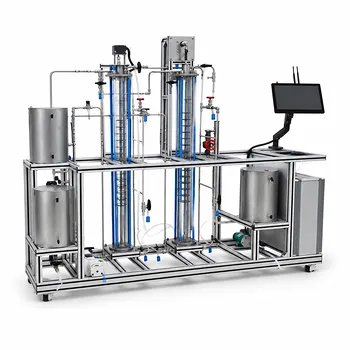
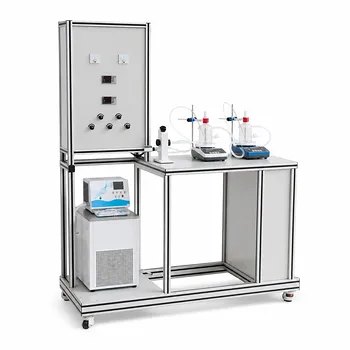
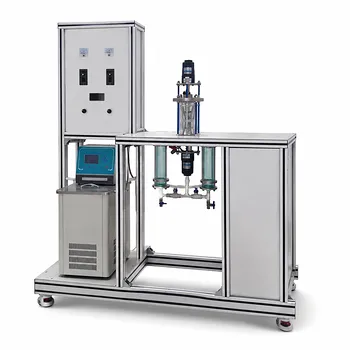
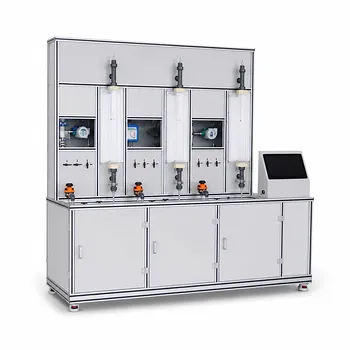
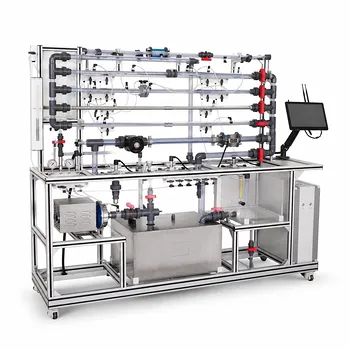
The fundamental difference a student grasps is one of physical state versus chemical identity. Educational pilot plants demonstrate that for a homogeneous catalyst, the post-reaction separation is a thermal distillation challenge, whereas for a biphasic system, it becomes a simple, gravity-driven physical decanting operation. The entire process flow diagram is reconfigured to leverage this core distinction, replacing an energy-intensive stabilization column with a simple phase separator.
To understand the difference, you must trace the catalyst's fate. In a homogeneous process, the catalyst is a dissolved molecule that stays with the high-boiling products, demanding distillation that risks its thermal death. A biphasic process confines the catalyst to an immiscible phase, allowing a pilot plant to demonstrate that a simple liquid-liquid decanter can achieve instantaneous, gentle recovery, cutting both energy costs and catalyst degradation.
Decoding the Homogeneous Process in a Pilot Plant
The educational goal for a homogeneous catalytic system is to demonstrate the engineering challenge of retaining a heat-sensitive molecular catalyst that is intimately mixed with the product. The pilot plant uses a sequence of thermal separations to solve this.
The Configuration: From Reactor to Distillation Train
A typical setup starts with a continuous stirred-tank reactor (CSTR) where the liquid-phase reaction occurs. The effluent from the reactor is a single, homogenous liquid solution containing the unreacted feed, the desired product, by-products, and the dissolved, high-value rhodium-based catalyst. A gas-liquid separator first removes any gaseous co-products. The liquid then moves to a stabilizer column, a critical teaching point. This column gently strips remaining light ends, but its primary industrial function is to prevent violent decomposition of the dissolved catalyst, a phenomenon that can occur at elevated temperatures. Final product purification requires one or more distillation columns, which separate the volatile products from the non-volatile catalyst-laden heavies that are recycled back to the reactor.
Teaching Thermal Sensitivity Through Configuration
This setup visually highlights a core limitation: the catalyst's thermal fragility. Educational pilot runs can show that distillation temperatures, often exceeding 420 K, can cause irreversible catalyst decomposition and loss of precious metal. The stabilizer column becomes a living lesson in process constraints, showing students that the separation scheme is a direct concession to the catalyst's stability limits, balancing recovery against irreversible destruction.
Demonstrating the Biphasic Alternative
The biphasic pilot plant configuration teaches that a clever choice in catalyst chemistry can fundamentally simplify the entire separation problem, moving it from a thermal process to a physical one.
The Liquid-Liquid Decanter: A Physical Switch
The reactor effluent now contains two immiscible phases. The water-soluble catalyst, bound to polar ligands like sulfonated triphenylphosphine, resides in the aqueous phase. The organic products form a separate layer. The pilot plant demonstrates the elegant solution: the stream is sent directly to a liquid-liquid phase separator (decanter) . Students can physically observe the gravity-driven separation, opening valves from the top of the decanter to draw off the lighter product phase, and from the bottom, the heavier catalyst-containing aqueous phase, which is then pumped directly back to the reactor as a recycle loop.
Observing the Physics of Separation
This configuration allows for direct visual study of critical transport phenomena not visible in a distillation column. Students can observe how droplet coalescence and settling rates are affected by a low-density difference and interfacial tension between the two phases. The pilot plant becomes a tool to study how axial mixing, or backmixing, and even emulsification can impair separation efficiency. By running the decanter at different throughputs, one can measure the workshop's direct impact on catalyst recovery and recycle rates, bridging the gap between molecular chemistry and process-scale fluid dynamics.
Understanding the Trade-Offs
A truly objective lesson from these pilot plants is that neither system is universally superior. The choice involves inherent engineering compromises.
The Mass Transfer Penalty in Biphasic Systems
The decanter’s operational simplicity masks a chemical challenge. The biphasic reaction is not a simple phase separation; it is a reaction governed by interphase mass transfer. Because the organic reactants have limited solubility in the aqueous catalyst phase, the overall reaction rate can be orders of magnitude slower than in a homogeneous system. A pilot plant can demonstrate this by showing that to achieve a similar conversion, a biphasic CSTR may need a much larger volume or more intense mixing to maximize interfacial area, compared to its homogeneous counterpart.
The Ligand Stability Problem
While the catalyst avoids thermal degradation, it faces chemical attrition in the aqueous loop. The water-soluble phosphine ligands are themselves sensitive to oxidation and can slowly hydrolyze at process temperatures. An educational pilot running for extended periods can demonstrate a gradual drop in catalyst activity over time, not because the metal is lost in the decanter, but because the stabilizing ligand is degrading chemically within the recycle loop. This teaches the critical lesson that process development is about managing the weak point in every system.
Making the Right Choice for Your Educational Goal
Whether your pilot plant focuses on homogeneous or biphasic separation depends entirely on the core concept you intend to teach. The equipment should be tailored to the demonstration's objective.
- If your primary focus is teaching thermal degradation and distillation sequencing: Configure the pilot plant for a homogeneous process. A CSTR followed by a stabilizer and distillation column shows the direct engineering response to a catalyst’s heat-sensitivity limits.
- If your primary focus is teaching phase equilibrium and fluid dynamics: The biphasic system with its decanter is superior. It allows for visual study of interfacial tension, coalescence, backmixing, and the direct physical recovery of a catalyst at ambient temperature.
- If your primary focus is integration with azeotropic challenges: Module the biphasic setup for a reaction like ethyl acetate synthesis, where the decanter is integrated with a fractional distillation column. This teaches the elegant combined removal of a reaction by-product (water) to shift equilibrium, while simultaneously recycling the catalyst.
The genius of the pilot plant is its ability to externalize the otherwise invisible molecular destiny of a catalyst, turning it into a visible engineering choice between a distillation column and a decanter.
Summary Table:
| Feature | Homogeneous Process | Biphasic Process |
|---|---|---|
| Primary Separation | Thermal Distillation | Gravity Decanting (Physical) |
| Main Equipment | CSTR, Stabilizer, Distillation Columns | CSTR, Liquid-Liquid Decanter |
| Catalyst Degradation Risk | High (Thermal limits) | Low (Chemical ligand degradation) |
| Key Challenge | High energy cost, thermal sensitivity | Interphase mass transfer resistance |
Bring Hands-On Chemical Engineering Concepts to Life
Are you looking to upgrade your training laboratory with industry-grade equipment? LABPARK provides state-of-the-art Educational and Vocational Unit Operations Pilot Plants in chemical engineering, bioprocess & biotech, and environmental & water treatment.
Designed specifically for universities, research institutes, and enterprises, our pilot plants turn complex thermodynamic and fluid dynamics theories into visible, hands-on learning experiences.
Contact us today to discuss your curriculum requirements and get a customized solution!
Related Products
- Fluidized Bed Gas Solid Catalytic Reaction Educational Pilot Plant
- Comprehensive Liquid-Liquid Extraction Pilot Plant for Engineering Education
- Fixed Bed Gas Solid Catalytic Reaction Educational Pilot Plant
- Ternary Liquid-Liquid Equilibrium Educational Pilot Plant
- Micro-Scale Gas-Solid Catalytic Reaction Educational Pilot Plant
People Also Ask
- Why is the bed height-to-diameter ratio (L/dt) critical? Fluidized bed pilot plant selection guide.
- How is the minimum fluidization velocity (U_mf) determined and utilized? A Unit Operations Guide
- How does the Mears criterion evaluate transport resistance? Key Guide to Intrinsic Kinetics
- How do reactor pilot plants safely study gas-solid reactions? Master kinetics with thermal & flow control.
- How do pilot plants demonstrate fluidized-bed reactor advantages over fixed-bed? Find Out Now