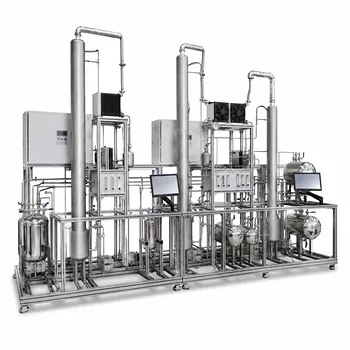
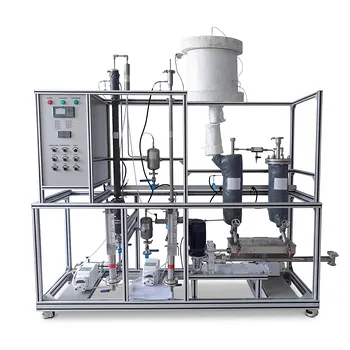
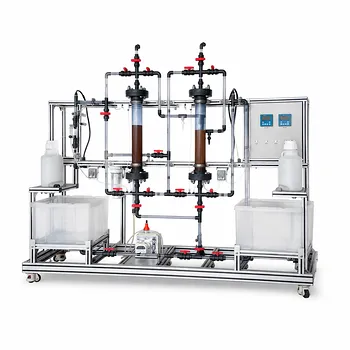
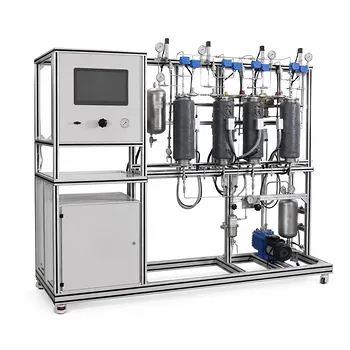
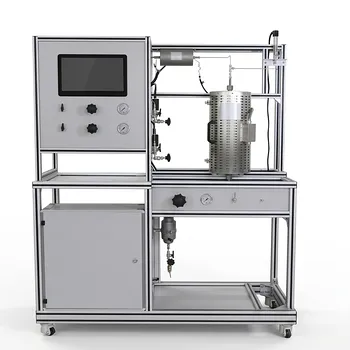
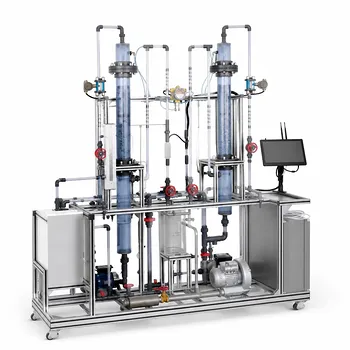
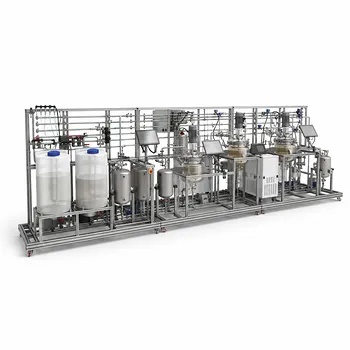
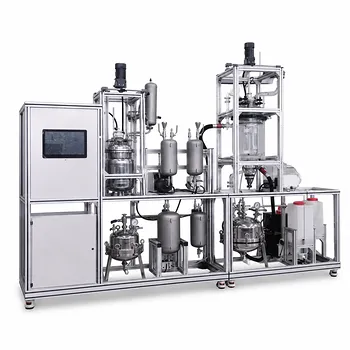
The purification of cinnamic acid in a chemical engineering education pilot plant is primarily demonstrated through a steam distillation unit operation. This setup specifically targets the removal of volatile, unreacted benzaldehyde from the high-boiling-point reaction mixture. By manipulating thermodynamics and phase behavior at a pilot scale, students move beyond simple lab glassware to understand industrial-level thermal separation.
While lab synthesis focuses on the reaction mechanism, pilot plant education focuses on the separation logic. The deep need is to grasp how volatility differences are scaled into a controllable, continuous engineering process—a steam distillation unit provides the clearest window into the vapor-liquid equilibrium and mass transfer principles governing this specific purification.
Bridging the Gap from Beaker to Unit Operation
In a small-scale organic chemistry lab, purifying cinnamic acid from a Perkin reaction often involves a simple workup. You might add a base, extract, and rely on a rotary evaporator.
However, a unit operations pilot plant designed for this synthesis forces a more rigorous engineering approach. It replicates the thermal separation challenge at a scale where energy efficiency and phase contact matter.
The Chemistry Creates the Separation Challenge
The classic synthesis involves condensing benzaldehyde with acetic anhydride at a high temperature, typically between 150–180 °C. The primary reference correctly identifies this high-temperature zone as the reaction’s completion point.
The resulting mixture is not just the desired cinnamic acid salt. It contains a significant quantity of unreacted benzaldehyde. This impurity must be removed because its boiling point is high enough (179 °C) that simple evaporation at room temperature is impractical and wasteful of a valuable starting material.
Why Steam Distillation is the Engineered Solution
Benzaldehyde is volatile and immiscible with water. Cinnamic acid, once acidified, is a solid with a much higher boiling point.
This difference is perfectly suited for steam distillation. The pilot plant unit introduces live steam directly into the hot, alkaline reaction mixture. The steam reduces the effective vapor pressure required to volatilize the benzaldehyde, stripping it out at a temperature well below its normal boiling point.
The Pilot Plant as a Data-Rich Teaching Tool
The value of the pilot plant is not just in achieving separation. It’s in making the invisible physical phenomena visible through instrumentation.
Students operate a miniature version of an industrial still, learning to control and measure variables that are theoretical concepts in a textbook.
Visualizing Vapor-Liquid Equilibrium
The core thermodynamic principle at play is vapor-liquid equilibrium (VLE) for a partially miscible system. The pilot unit allows students to directly observe the distillate forming two phases, an organic layer (benzaldehyde) and an aqueous layer.
By measuring the temperature at the still head and comparing it to the steam input, they experience how the system's boiling point remains constant as long as two liquid phases co-exist. This transforms an abstract phase diagram into a tangible process outcome.
Quantifying Steam Consumption and Efficiency
An industrial-scale process must be economically viable. The pilot plant configuration, as noted in the primary reference, is ideal for a steam consumption control study.
Students can meter the steam flow rate and measure the volume of benzaldehyde recovered over time. They learn to optimize the steam-to-organic ratio, finding the point where additional steam yields diminishing returns in product recovery, directly linking operational cost to separation efficiency.
Understanding the Trade-offs
A steam distillation pilot plant is instructive, but it is not a universal or flawlessly efficient solution. Its educational value is sharpened by exploring its limitations.
The process is inherently energy-intensive. Generating the steam and then condensing the vapor mixture in a downstream condenser requires significant utility loads. For a high-value product like cinnamic acid, this may be acceptable, but an objective analysis requires students to calculate this energy balance. Furthermore, the pilot-scale operation highlights emulsion handling challenges. The interface between the condensed water and benzaldehyde layers can be cloudy, and students must decide on strategies like adding salt or increasing settling time, which introduces a trade-off between separation speed and purity in the recovered benzaldehyde.
How to Apply This to Your Curriculum or Project
Your selection of a pilot plant configuration should be driven by the core learning objective. A steam distillation unit is not a standalone device; it is a module within a broader chemical engineering education flow.
- If your primary focus is demonstrating thermal separation of high-boiling organics: The steam distillation pilot plant is your direct answer, allowing a precise study of vapor-pressure reduction and two-phase distillate handling.
- If your primary focus is a full synthetic process scale-up: Integrate the steam distillation unit with an upstream stirred-tank reactor and a downstream crystallization unit to show the complete chain from synthesis to final solid product purification.
By moving purification into a pilot-scale context, you don't just clean up a reaction product—you validate the physical and economic logic of the entire downstream processing sequence.
Summary Table:
| Parameter / Step | Separation Mechanism | Educational Value |
|---|---|---|
| Benzaldehyde Removal | Steam distillation (stripping volatile organic below boiling point) | Practical observation of Vapor-Liquid Equilibrium (VLE) |
| Process Optimization | Metering steam flow vs. benzaldehyde recovery rate | Quantitative study of steam consumption and efficiency |
| Phase Separation | Condensation and gravity settling of immiscible layers | Troubleshooting of emulsions and interface boundaries |
Bring Industrial-Scale Learning to Your Lab
Looking to enhance your curriculum or research with hands-on unit operations? LABPARK provides premium Educational and Vocational Unit Operations Pilot Plants in chemical engineering, bioprocess & biotech, and environmental & water treatment.
We empower universities, research institutes, and enterprises to bridge the gap between theory and industrial practice with robust, data-rich pilot systems designed for deep experiential learning.
Contact LABPARK today to find the ideal pilot plant configuration for your laboratory!
Related Products
- Electrolyte Distillation Purification and Formulation Educational Pilot Plant
- Fixed-Bed Chemical Reaction and Gas Dust Tar Removal Unit Operations Pilot Plant
- Green Anhydrous Ethanol Purification Extractive Distillation Unit Operations Training Pilot Plant
- Steam Methane Reforming Hydrogen Production and Purification Educational Pilot Plant
- Methane Cracking Educational Unit Operations Pilot Plant
People Also Ask
- Why does simple distillation yield higher efficiency than flash distillation? Key thermodynamic differences.
- How to Integrate Spectroscopy in Distillation Pilot Plants for Advanced Process Control
- Why is the acentric factor important in pilot plants? Fluid property prediction.
- How to Verify Distillation Boundary Lines & Composition Regions with Pilot Plants
- How does double temperature difference control improve distillation pilot plants? Stabilize purity.