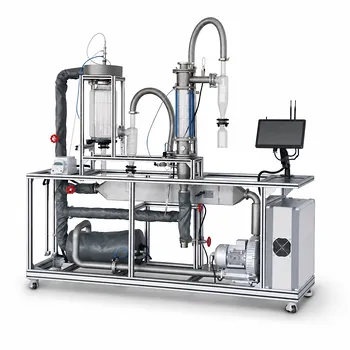
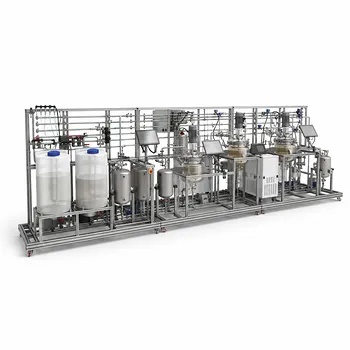
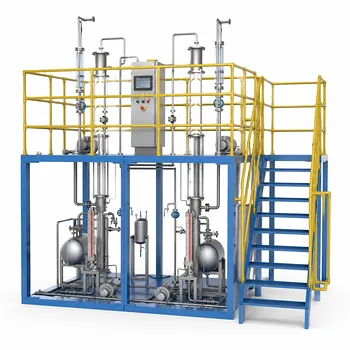
It’s not about watching one dial; it’s about seeing the whole symphony. Bioprocess unit operations pilot plants—integrating bioreactors, tangential flow filtration, and media preparation systems—generate the dense, multi-variable batch data needed to teach real-time multivariate statistical process monitoring (RT-MSPM). Trainees use historical runs to build Principal Component Analysis (PCA) and Partial Least Squares (PLS) models, then practice live monitoring with Squared Prediction Error (SPE) and Hotelling’s T² charts, followed by contribution plots to pinpoint root causes of deviations, directly preparing them for advanced process control in commercial manufacturing.
Pilot plants transform real-time multivariate statistical process monitoring (RT-MSPM) from an abstract data science exercise into a visceral, hands-on skill. By experiencing true process variability and troubleshooting live deviations on scaled-down equipment, engineers learn to detect, diagnose, and correct faults with the same tools used in regulated biopharma environments.
From Theory to Practice: The Unique Value of a Pilot Plant
A textbook can explain the math behind PCA, but only a living, breathing process can teach the intuition. Pilot plants provide the missing link: real-time, noisy, and causally complex data that force trainees to apply MSPM in context.
Generating Realistic, Multi-Variable Data
Unlike simulated data, a pilot plant streams hundreds of correlated process signals—pH, dissolved oxygen, flow rates, temperatures, and spectroscopic readings—from inline sensors and PAT tools. Trainees learn to aggregate this flood of information into a unified data matrix that reflects true process dynamics.
Building the Multivariate Models
Using historical runs from the pilot plant, learners define a “normal operating region” by fitting PCA models for dimensionality reduction or PLS models that link process variables to quality outcomes. Placing model-building in the pilot plant environment teaches immediate lessons about data pre-processing, outlier handling, and the importance of representative training sets.
Real-Time Monitoring with Control Charts
With a validated model loaded, the pilot plant’s live data feed can be monitored through Squared Prediction Error (SPE) and Hotelling’s T² charts. Trainees see alarms trigger as the process drifts—a pump speed change, a cooling jacket malfunction—and practice the critical decision of when a deviation is significant enough to act on.
Diagnosing Faults with Contribution Plots
An SPE alarm only says “something is wrong.” Troubleshooting requires knowing which variable broke the pattern. Pilot plants let instructors inject deliberate faults—say, a temperature mismatch in a perfusion loop—so learners can apply variable contribution plots to instantly isolate the aberrant sensor or process step. This skill transfers directly to fast, root-cause diagnosis in cGMP manufacturing.
From Monitoring to Corrective Action
The loop closes when a trainee uses contribution plot insights to adjust a PID setpoint, tweak a feed rate, or initiate a deviation investigation. Practicing this monitor-diagnose-correct cycle under realistic time pressure builds the operational reflexes that prevent batch losses at commercial scale.
Bridging to Advanced Process Control and QbD
RT-MSPM training on a pilot plant doesn’t stop at fault detection. It becomes the foundation for Quality by Design (QbD) and continuous process verification.
Linking Process Data to Quality Attributes
By extending PLS models with product-quality measurements (e.g., from offline titer samples or PAT analyzers), trainees learn to predict endpoint quality in real time. This demonstrates how multivariate monitoring reduces reliance on end-product testing and supports the regulatory justification for real-time release.
Forging the Design Space Mindset
Pilot plants allow students to execute Design of Experiments (DOE) alongside MSPM. They see how the normal operating region defined by a PCA model corresponds to a robust, multidimensional design space, reinforcing the interplay between process understanding, risk assessment, and control strategy.
Understanding the Trade-offs and Common Pitfalls
Despite its power, pilot-plant-based RT-MSPM training has limitations that must be acknowledged to avoid creating false confidence.
The Risk of a Sterile Learning Environment
A clean, well-maintained pilot plant rarely shows the raw material variability and equipment aging that plague commercial facilities. Models built in an overly pristine setting can fail to generalize. Effective training must deliberately introduce realistic disturbances—batch-to-batch variation in media lots, sensor drift, or fouling.
The Hidden Cost of Model Maintenance
Building a reliable PCA or PLS model requires a thorough set of historical runs, which can take weeks of pilot-plant time. Trainees must also learn that MSPM models are living artifacts—they need periodic refitting as the process evolves, new raw materials are introduced, or equipment is recalibrated.
Avoiding Analysis Paralysis
When every variable is monitored, every minor alarm can become deafening. Piloting teaches the human side of MSPM: tuning alarm thresholds, balancing sensitivity against false-alarm fatigue, and developing the judgment to distinguish a statistically significant deviation from a practically meaningful one.
How to Design an Effective RT-MSPM Training Program
The greatest educational value emerges when the pilot plant curriculum matches the learner’s real-world goal.
- If your primary focus is operational readiness for commercial manufacturing: Design runs that simulate common production faults (e.g., air filter blockages, temperature excursion) and require trainees to respond using only SPE and T² trends and contribution plots—mirroring the time pressure of a manufacturing control room.
- If your goal is to embed Quality by Design (QbD) principles: Combine MSPM workshops with DOE-driven pilot runs; have students build PLS models linking process parameters to critical quality attributes and then demonstrate how continuous monitoring verifies the design space.
- If you are developing troubleshooting experts: Introduce multi-layered faults (a sensor fault that masks a process drift) and force learners to correlate real-time spectral data from FTNIR or Raman probes with classical process signals before relying on contribution plots.
- If sustainability and efficiency matter to your curriculum: Use the pilot plant’s mass-balance and energy data as additional monitored variables, showing how MSPM can detect yield losses or excessive resource consumption well before they become cost overruns.
Hands-on RT-MSPM training on a bioprocess pilot plant doesn’t just teach a software tool; it forges the diagnostic intuition and process vigilance that safeguard product quality and patient safety at scale.
Summary Table:
| Training Step | Core Activity | Methods & Tools | Practical Value |
|---|---|---|---|
| 1. Data Generation | Aggregating multi-variable signals | Inline sensors & PAT tools | Real-world noise & causality |
| 2. Model Building | Defining normal operating regions | PCA & PLS modeling | Data cleaning & pre-processing |
| 3. Live Monitoring | Tracking deviations in real-time | SPE & Hotelling's T² charts | Distinguishing noise from faults |
| 4. Fault Diagnosis | Pinpointing root causes of drift | Variable contribution plots | Rapid troubleshooting & recovery |
Elevate Your Bioprocess Training with LABPARK
To effectively teach advanced control methods like RT-MSPM, students and engineers need hands-on experience with realistic process variability. LABPARK offers specialized Educational and Vocational Unit Operations Pilot Plants in chemical engineering, bioprocess & biotech, and environmental & water treatment, designed specifically for universities, research institutes, and enterprises.
Our pilot plants provide the dense, real-time data streams and control systems required to transition from theoretical model-building to practical troubleshooting.
Contact LABPARK today to find the perfect pilot plant solution for your facility!
Related Products
- Bio-fermentation Ethanol Production Practical Training Unit Operations Pilot Plant
- Multimodal Absorption and Desorption Pilot Plant for Unit Operations Training
- Natural Product Extraction Unit Operations Training Pilot Plant
- Multi Pump Fluid Transport Process Piping Unit Operations Training Pilot Plant
- Dual-Mode Rectification Pilot Plant for Practical Training Unit Operations
People Also Ask
- Why Use PTFE & Hastelloy in Chemical Pilot Plants? Prevent Corrosion & Ensure Safety
- Why Compare Predicted and Experimental Excess Enthalpy? Key to Accurate Pilot Plant Scale-up
- Why is the chemical plant startup schedule crucial? De-risk scale-up with pilot plants.
- When to transition from PID to adaptive control in pilot plants? Key process indicators.
- Why must batch and fed-batch fermentation pilot plants be designed to accommodate changing rheological conditions?