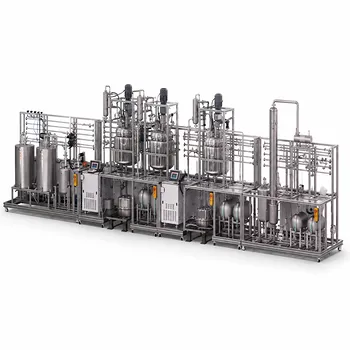
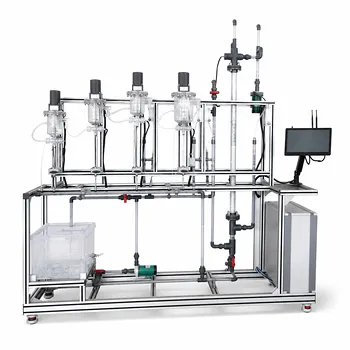
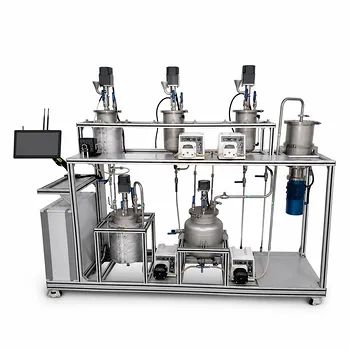
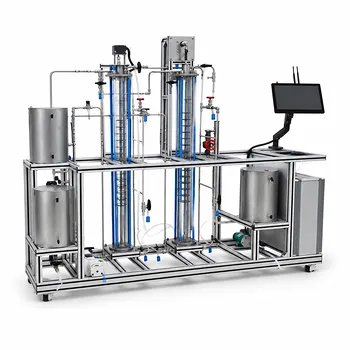
The primary goal is hands-on process integration insight. A synthesis loop pilot plant trains students by letting them physically reconfigure the sequence of gas compression, condensation, and recycling steps, directly measuring the resulting shifts in energy consumption, product purity, and catalyst protection. Instead of theoretical exercises, students manipulate real valves and setpoints to see why a compressor placed before a condenser creates a radically different cost and purity profile than a compressor placed after.
The deepest learning comes from confronting the unavoidable trade-off between the energy cost of compressing uncondensed recycle gas and the capital cost of additional condensation stages. A synthesis loop pilot plant makes these abstract design dilemmas tangible, forcing students to balance efficiency, purity, and equipment protection in real time.
The Educational Value of a Physical Synthesis Loop
From Block Diagrams to Dynamic Systems
Abstract flow sheets rarely convey the cascading consequences of equipment placement. A synthesis loop pilot plant transforms static symbols into dynamic reality.
Students turn valves to redirect gas flow, instantly altering the sequence of unit operations. They can place a condenser upstream of the reactor to scrub out poisons, or downstream to maximize product recovery, watching how each choice reshapes the entire system's behavior.
Building Intuition Through Direct Manipulation
The plant’s instrumentation turns hidden energy penalties into visible data. Students can run the loop with the recycle compressor pulling uncondensed, product-laden gas and then run it again with a condenser directly upstream.
The difference in compressor power draw becomes a concrete lesson. This visceral experience cements the principle that a compressor’s volumetric efficiency and energy demand are tied directly to the composition and state of the gas entering it.
Key Unit Operations and Their Interdependence
The Reactor as a Sensitivity Anchor
Every loop configuration revolves around the reactor's tolerance. The primary reference highlights a critical scenario: feed gas impurities that poison the catalyst.
Students learn that when a catalyst is fragile, product separation must occur before the reactor. The pilot plant becomes a test bed for scrubbing strategies, showing how a cold trap or knock-out condenser can safeguard the catalyst bed, even if it increases upstream compression costs.
The Compressor’s Position Drives Economics
Where you place the recycle compressor is the central economic lever. If it compresses gas that still contains a significant fraction of uncondensed product, students observe a direct spike in energy consumption per kilogram of pure product.
They experimentally validate that compressing a leaner gas stream—achieved by condensing first—reduces the mass flow and energy demand on the compressor. The numerical data they collect answers the question: Is the extra capital cost of a larger or colder condenser justified by the operational savings in compression?
Condensation as a Multifunctional Tool
In the pilot plant, the condenser is not just for product recovery. Students configure it as a purification gatekeeper.
By varying the condensation temperature and pressure, they watch how different impurity components drop out. They learn that a single condensing step can simultaneously recover liquid product, protect downstream catalysts, and prevent accumulation of inerts in the recycle loop—a triple function that is difficult to appreciate without physical operation.
Quantifying Real-World Process Design Trade-offs
Visualizing Energy Penalties in Recycle Loops
The primary reference explicitly directs students to analyze “the energy penalties associated with compressing recycled gas containing uncondensed product versus compressing it after separation.”
With a synthesis loop pilot plant, this becomes a controlled experiment. Students keep all other variables constant and toggle the sequence. They log compressor rpm, power consumption, and downstream purity. The resulting spreadsheet makes the trade-off curve manifest, transforming a textbook paragraph into an unforgettable, career-long reference point.
The Addition of Condensing Stages vs. Compression Costs
One of the most powerful exercises is the systematic addition of intermediate condensing stages. Students install a second chilled condenser between the reactor outlet and the recycle compressor.
They will see product recovery increase and recycle purity rise, but at the cost of added pressure drop and cooling duty. They can then plot the marginal gain in product recovery against the total system energy input. This directly mirrors the front-end engineering decisions they will later make in industry.
Common Pitfalls and Misconceptions
Assuming More Separation Is Always Better
Students quickly discover that pushing condensation temperatures lower can freeze components or cause hydrate formation, plugging lines. The pilot plant shows them that separation is bounded by physical and safety constraints, not just theoretical purity targets.
Ignoring the Accumulation of Inerts
A physical loop teaches a brutal lesson: without a purge stream, light inerts concentrate relentlessly. Students watch recycle gas composition shift over time, lowering reactor efficiency and increasing compression costs. They learn why every real synthesis loop must balance recycle purity against the loss of valuable reactant in the purge.
Overlooking Dynamic Stability
Switching from a cold-separation-first to a compressor-first configuration alters the entire loop’s transient response. Students experience control challenges—temperature fluctuation in the reactor, surging in the compressor—that no steady-state simulation ever predicted. This drives home the importance of dynamic controllability in process integration.
Making the Right Choice for Your Educational Goal
The final lesson of a synthesis loop pilot plant is that the "correct" arrangement depends entirely on the specific constraints of the chemistry and economics.
- If your primary focus is protecting a poison-sensitive catalyst: Place the condenser and any absorption stages before the reactor, even at the cost of higher upstream compression, to scrub impurities completely.
- If your primary focus is minimizing energy consumption per ton of product: Locate the condensing train to deliver the leanest possible gas to the compressor suction, accepting the additional capital cost and complexity of a more elaborate separation section.
- If your primary focus is teaching dynamic controllability and system integration: Task students with creating start-up and shut-down procedures for both configurations, comparing compressor surge margins and separation stability across the sequence.
A well-designed synthesis loop pilot plant doesn't just teach unit operations; it forges a systems-thinking mindset that elevates a student’s ability to design and troubleshoot truly integrated chemical processes.
Summary Table:
| Configuration Focus | Key Educational Objective | Process Trade-offs |
|---|---|---|
| Catalyst Protection | Prevent poisoning via pre-reactor separation | Increases upstream compression costs |
| Energy Optimization | Minimize compression costs via post-separation recycle | Requires larger/colder condensation stages |
| Dynamic Controllability | Understand system transients and startup/shutdown | Balancing purge losses vs. inert accumulation |
Bring Hands-On Process Integration to Your Chemical Engineering Lab
Looking to equip your students with real-world engineering intuition? LABPARK provides premium Educational and Vocational Unit Operations Pilot Plants in chemical engineering, bioprocess & biotech, and environmental & water treatment for universities, research institutes, and enterprises.
Our pilot plants allow students to physically reconfigure unit operations—such as gas compression, separation, and recycling loops—to bridge the gap between static flowsheets and dynamic system performance.
- Enhance Curriculum Value: Deliver concrete experimental data on energy penalties, separation efficiencies, and dynamic stability.
- Industrial-Grade Design: Prepare future engineers with industry-standard control systems and safety features.
Ready to elevate your engineering department's training capabilities? Contact us today to discuss custom pilot plant solutions tailored to your educational goals!
Related Products
- Methanol Synthesis and Catalyst Performance Evaluation Educational Unit Operations Pilot Plant
- Ethyl Acetate Synthesis Unit Operations Pilot Plant for Practical Training
- Carbon Dioxide Hydrogen Methanol Synthesis Educational Unit Operations Pilot Plant
- Aspirin API Synthesis Unit Operations Training Pilot Plant
- 100L Continuous Loop Hydrogenation Educational Unit Operations Pilot Plant
People Also Ask
- Why is a purge system necessary when operating a gas recirculation loop in a methanol synthesis pilot plant? (Guide)
- How do temp & pressure affect methanol synthesis pilot plants? Optimize equilibrium and catalyst performance.
- Why do modern methanol pilot plants operate at lower pressures? Catalyst & Feed Requirements Explained
- What are the operational requirements for catalyst activation? Safe Methanol Pilot Plant Operation
- Why Compare Predicted and Experimental Excess Enthalpy? Key to Accurate Pilot Plant Scale-up