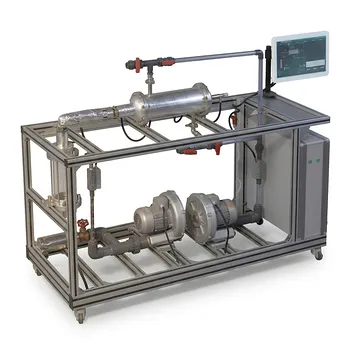
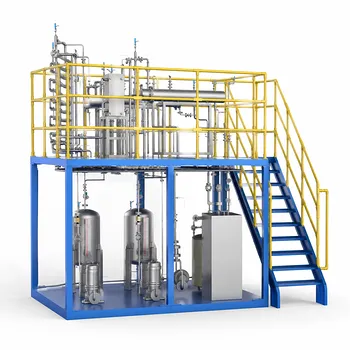
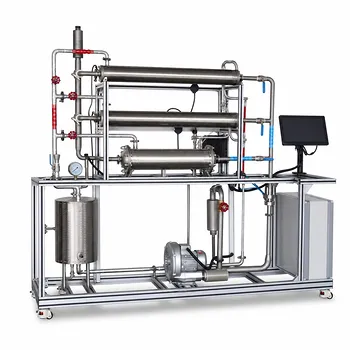
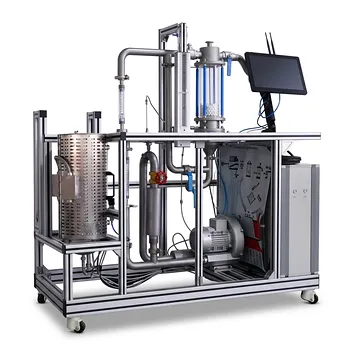
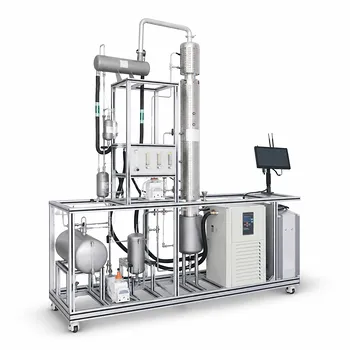
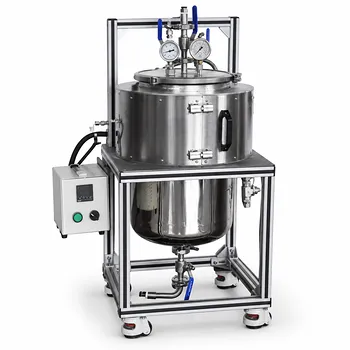
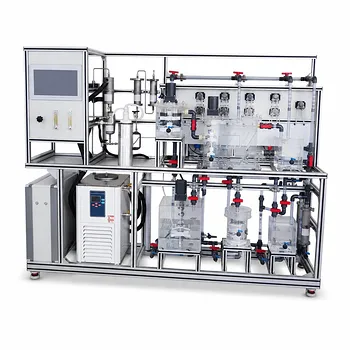
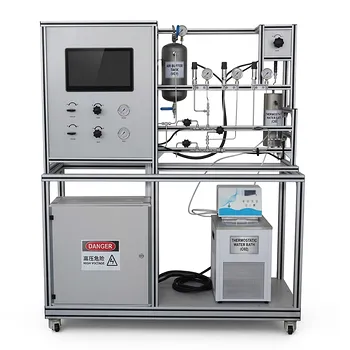
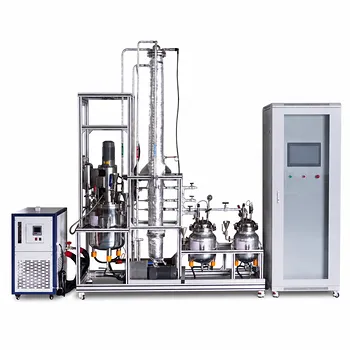
A plate heat exchanger pilot unit demonstrates process retrofitting and capacity expansion by physically allowing students to add heat transfer plates to the frame—a direct, hands-on replication of how real plants upgrade capacity. Students calculate the required new area for an increased flow rate, disassemble and rebuild the plate pack, then run before-and-after experiments to see how a larger heat transfer area maintains target outlet temperatures without changing utility fluid conditions. This turns an abstract design concept into a tangible engineering lesson.
The core insight is that plate heat exchangers are inherently modular, enabling capacity upgrades by simply adding plates. For students, the act of dismantling, re-configuring, and validating the system transforms capacity expansion from a textbook formula into a concrete exercise in retrofit engineering—bridging the gap between theoretical design and real-world operational adjustments.
The Plate Heat Exchanger as a Modular Teaching Tool
Simulating a Common Industrial Scenario
Industrial processes often face increased throughput demands. A pilot unit lets students mirror this challenge by raising the process fluid flow rate by, for example, 50%.
They must hold inlet temperatures constant, creating the same constraints a real plant engineer would encounter. The immediate question becomes: how do we keep meeting the design outlet temperature without changing the utility stream?
Students calculate the additional heat transfer area needed using the standard heat exchanger design equation. This step directly connects the experimental goal with core chemical engineering theory.
Hands-On Retrofitting: Adding Plates to the Frame
The physical action is the lesson’s centerpiece. After the calculation, students dismantle the plate pack and add more plates to the existing frame.
They then reassemble and pressure-test the unit. By running the modified system under the new, higher flow rate, they observe the result: outlet temperatures return to target because the increased area compensates for the higher duty.
This immediate cause-and-effect demonstration is impossible with a purely theoretical exercise. It ingrains the concept of modular scalability and the direct relationship between area, duty, and flow.
Bridging Theory and Reality with Experimental Data
Before and after the retrofit, students collect real-time data: flow rates, all inlet and outlet temperatures. They calculate the actual heat duty, Log Mean Temperature Difference (LMTD), and overall heat transfer coefficient ($U A$) from both configurations.
This hands-on validation mirrors the pilot plant learning approach seen in other unit operations, where empirical data closes the gap between idealized design models and real-life performance. Students can compare their pre-modification predictions with actual post-modification results.
This comparison naturally highlights the impact of real-world factors. For instance, they can discuss how fouling or flow maldistribution might cause the experimental overall heat transfer coefficient to deviate from the theoretical value, even after the area increase.
Understanding the Trade-offs of Plate Addition
Pressure Drop and Hydraulic Considerations
Adding plates changes the flow geometry. A thinner plate gap or simply more plates can significantly increase the pressure drop across the exchanger.
Students must measure the pressure drop before and after the retrofit. This teaches them that capacity expansion isn't free—you trade off pumping energy costs and must ensure the existing pump can handle the new hydraulic load.
A purely theoretical paper exercise might ignore this crucial real-world constraint. The pilot unit forces students to confront and quantify the penalty.
Practical Limitations of Frame and Gasket Integrity
A heat exchanger frame has a maximum design plate count. Students will encounter this physical limit on the unit, learning that retrofitting has a ceiling.
They also learn about gasket performance. Repeatedly opening and closing the plate pack teaches the importance of gasket condition and correct plate alignment, which directly impacts the unit’s ability to avoid leaks and maintain design pressure.
This introduces the non-idealities of maintenance and asset integrity into the capacity expansion discussion. It’s a lesson no simulation can fully convey.
Contrasting with Other Exchanger Designs
This modular retrofit capability is a distinct advantage of plate heat exchangers. A shell-and-tube exchanger facing a similar duty increase is not so easily upgraded.
In a shell-and-tube design, increasing capacity typically requires an iterative, often impractical, redesign—altering tube passes, shell type, or building a larger unit. Students operating another pilot unit can observe that adjusting from a 2-pass to a 4-pass configuration to improve velocity and heat transfer is a much different, less straightforward retrofit than simply adding plates.
This contrast solidifies the plate heat exchanger’s role as the ideal teaching platform specifically for modular, in-field capacity expansion.
Making the Right Choice for Your Educational Goal
How you structure the lab depends on the core lesson you want students to retain. The same pilot unit can serve multiple deep learning outcomes.
- If your primary focus is demonstrating scale-up principles: Emphasize the pre-modification calculation of required area. Force students to strictly follow the design algorithm, then use the post-modification run purely to validate their formula. This reinforces theoretical fundamentals.
- If your primary focus is teaching retrofitting economics: Make students evaluate the cost. Create a scenario where they must decide between adding plates (capital cost, pressure drop penalty) versus increasing utility flow or temperature (operating cost). The pilot data becomes evidence for their engineering recommendation.
- If your primary focus is bridging theory and practice: Focus heavily on the discrepancy between the predicted $U A$ and the experimentally measured $U A$. Require a detailed error analysis that accounts for real-world phenomena like fouling, measurement accuracy, and bypass streams.
A plate heat exchanger pilot unit does far more than just heat fluid; it externalizes the entire engineering lifecycle of modular design, physical upgrade, and real-world validation. The student who has unbolted a frame and added a plate to meet a higher load carries an understanding that no lecture alone can provide.
Summary Table:
| Educational Concept | Hands-On Activity | Key Learning Outcome |
|---|---|---|
| Capacity Expansion | Adding plates to the heat exchanger frame | Validates design calculations by meeting target duty at higher flows |
| Hydraulic Trade-offs | Measuring pressure drop before and after retrofit | Demonstrates pump limits and energy penalties of added plates |
| Asset Integrity | Disassembling, aligning, and sealing the plate pack | Teaches maintenance, leak prevention, and physical frame limits |
Elevate Process Engineering Education with LABPARK
Bridge the gap between chemical engineering theory and industrial practice. LABPARK provides state-of-the-art Educational and Vocational Unit Operations Pilot Plants in chemical engineering, bioprocess & biotech, and environmental & water treatment.
Our modular systems empower universities, research institutes, and enterprises to deliver impactful, hands-on training in retrofitting, scale-up, and system validation.
Ready to transform your laboratory training? Contact us today to discover how our customizable pilot plants can benefit your curriculum!
Related Products
- Three-Tube Heat Transfer Educational Pilot Plant for Unit Operations Training
- Shell and Tube Heat Exchanger Heat Transfer Coefficient Determination Educational Pilot Plant
- Comprehensive Multi-Modal Heat Transfer Unit Operations Pilot Plant for Engineering Training
- Dual Mode Heat Transfer Pilot Plant for Unit Operations Training
- Comprehensive Heat Transfer Coefficient Determination Educational Unit Operations Pilot Plant
People Also Ask
- When is ε-NTU preferred over LMTD in pilot plants? Predict heat exchanger performance without iteration.
- How does transitioning to a multi-shell heat exchanger affect required area? Optimize pilot plant design.
- How can a heat transfer pilot plant demonstrate waste heat recovery? Learn to optimize industrial thermal systems.
- What engineering trade-offs must students analyze in a heat transfer pilot plant? Balance performance & cost.
- How does cascade control achieve superior disturbance rejection in heat transfer pilot plants?