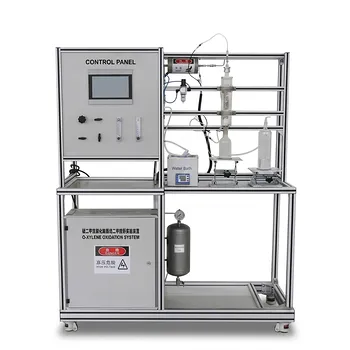
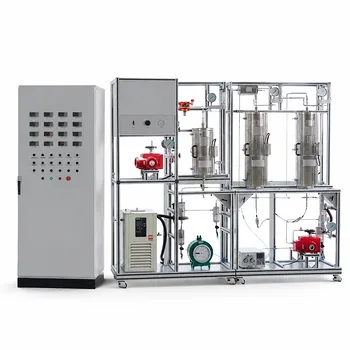
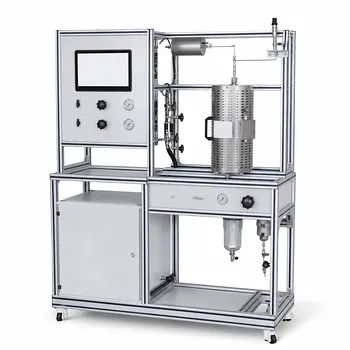
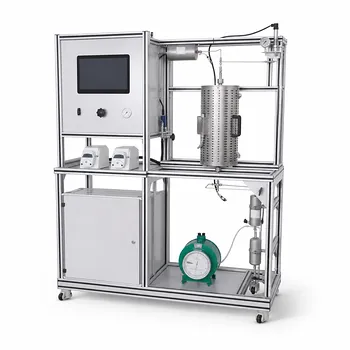
Pilot plant reactors are the definitive tool for transforming abstract vessel design codes into tangible economic and safety boundaries. By deliberately operating a reactor up to the failure points predicted by theory, engineers and students can directly observe the correlation between a construction alloy’s temperature ceiling, the cost of that metallurgy, and the physical limits of reaction kinetics. This transforms a mathematical optimization problem into an observable reality.
Chemical reactor design is a race between chemistry and physics. Higher temperatures accelerate reactions and shrink equipment size, but the metallurgy of the reactor vessel imposes a hard, non-negotiable thermal ceiling. A pilot plant demonstrates that true economic optimization isn't about running as hot as possible—it's about precisely calculating the point where the operational benefit of an extra degree of heat is outweighed by the exponential cost and safety risk of the premium alloy required to contain it.
Making Invisible Constraints Visible
A theoretical model on paper can show you the math behind a temperature limit, but it cannot replicate the physical weight of a high-alloy flange or the failure mode of a standard steel coupon. A pilot plant grounds the optimization equation in physical truth.
The "Thermal Ceiling" and Vessel Code Compliance
The primary reference correctly identifies that higher temperatures reduce residence time and reactor size. In a pilot plant, you can experimentally verify this by ramping up the jacket temperature and observing the accelerated depletion of reactants via an online gas chromatograph. However, the vessel’s data plate imposes an absolute boundary and can be cross-referenced with alloy limits defined in the primary reference ($T_A, T_B, T_C$). This mechanical limit is governed by the ASME Boiler and Pressure Vessel Code restrictions detailed in the supplementary references (such as the 482°C cutoff for standard carbon steel).
Visualizing the Strength-Temperature Cliff
The supplementary references explain that low-carbon steel loses over 50% of its tensile strength when heated from ambient to 500°C. A pilot plant equipped with a data acquisition system can map this degradation in real-time. By operating at high temperatures, the pilot plant demonstrates why the maximum allowable stress used in wall thickness calculations plummets as temperature rises, directly linking the kinetic advantage of heat to the structural risk of rupture.
Understanding the Trade-offs: Alloy Grade vs. Capital Investment
The critical learning objective here is mastering the discontinuous nature of design variables. You cannot simply pick a temperature; you must pick an alloy class that survives that temperature, which introduces a massive step-change in capital asset cost.
The MINLP Problem in Physical Form
The primary reference introduces Mixed-Integer Non-Linear Programming (MINLP) to handle alloy choice as a discrete variable. A pilot plant lab can physically stage this mathematical problem. A student can be tasked with achieving a target conversion rate first using a mock "standard steel" limit ($T_{max} = 400°C$), then a "high-alloy" limit ($T_{max} = 650°C$).
They must then calculate the reactor volume saved by the faster kinetics against the fabrication cost multiplier of the exotic alloy. The pilot plant proves that a reactor is not a universal vessel but a highly specialized economic compromise.
The Creep Failure Mode
Beyond immediate rupture, high-temperature operations introduce creep deformation. As noted in the supplementary references, alloys like Inconel 600 are rated for sustained load at heat, whereas cheaper materials will slowly sag. A pilot plant demonstrating long-duration holds at critical temperatures shows why an optimal economic design must factor in the alloy’s creep rupture life, not just its immediate tensile strength.
Selectivity and the Equilibrium Trap
The supplementary references highlight the van 't Hoff equation and Arrhenius-based selectivity. A pilot plant can demonstrate that the "optimal" temperature for speed is often suboptimal for yield. For an exothermic reaction, pushing the temperature to the material's maximum limit may accelerate the kinetics but crush the equilibrium constant ($K_p$), yielding mostly reactants or unwanted byproducts. This proves that the material constraint and thermodynamic optimization must be solved simultaneously.
How to Apply This to Your Educational or Scale-up Project
Optimization of pressure vessel design is not about finding a single perfect number; it is about mapping a feasible region bounded by chemistry and physical metallurgy. A pilot plant should be used to stress-test these boundaries.
- If your primary focus is capital cost minimization: Use the pilot plant to identify the lowest possible temperature that meets your production targets. A 20°C safety margin below the carbon steel failure point is far cheaper than a 100°C margin into high-alloy territory.
- If your primary focus is reaction selectivity and product purity: Do not default to the maximum alloy limit. Use the pilot plant’s PID-controlled jacket to profile a lower temperature path that maximizes the yield of the desired product via activation energy differences, even if it means accepting a slightly larger reactor volume.
- If your primary focus is safety and long-term structural integrity: Calibrate your pilot data against the ASME code derating curves. Validate that your operating window stays far clear of the creep regime for your chosen material, treating the alloy's maximum allowable working pressure at temperature as a hard constraint in your process flow diagram.
Ultimately, a chemical reactor pilot plant translates the abstract cost factors of pressure vessel design into a critical thinking framework for balancing molecular speed against mechanical strength.
Summary Table:
| Key Constraint | Impact on Vessel Design | Pilot Plant Demonstration |
|---|---|---|
| Thermal Ceiling | Tensile strength drops at high temps; requires strict ASME code compliance. | Map real-time strength degradation and monitor temperature boundaries. |
| Metallurgy Cost | Premium alloys (e.g., Inconel) drastically increase CAPEX. | Compare reactor volume savings against premium material costs. |
| Creep & Yield | Sustained heat causes deformation and can lower exothermic reaction yield. | Run long-duration holds and optimize PID profiles for yield vs. speed. |
Bridge Theory and Practice with LABPARK Pilot Plants
Are you looking to equip your students, researchers, or engineers with hands-on experience in reactor design and process optimization?
LABPARK designs and manufactures high-performance Educational and Vocational Unit Operations Pilot Plants across chemical engineering, bioprocess & biotech, and environmental & water treatment. Tailored for universities, research institutes, and enterprises, our pilot plants allow users to safely test material limits, analyze reaction kinetics, and master pressure vessel design constraints in real-world scenarios.
Contact LABPARK today to discover how our custom pilot plant solutions can elevate your educational curriculum or industrial scale-up research!
Related Products
- Fixed-Bed Chemical Reaction and Gas Dust Tar Removal Unit Operations Pilot Plant
- Fixed Bed Gas Solid Catalytic Reaction Educational Pilot Plant
- Multi-Reactor Educational Pilot Plant for Reaction Engineering Unit Operations
- Residence Time Distribution and Reactor Flow Characteristics Determination Educational Pilot Plant
- Tubular Reactor Flow Characteristics Determination Educational Unit Operations Pilot Plant
People Also Ask
- When to transition from PID to adaptive control in pilot plants? Key process indicators.
- How do deviations in estimating latent heat impact pilot plant thermal systems? Avoid hardware mis-sizing.
- Why Compare Predicted and Experimental Excess Enthalpy? Key to Accurate Pilot Plant Scale-up
- How to study gasification in pilot plants? Compare exit gas composition & efficiency
- Why Use PTFE & Hastelloy in Chemical Pilot Plants? Prevent Corrosion & Ensure Safety