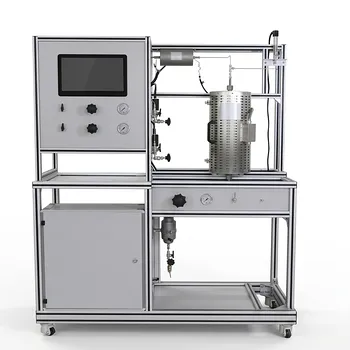
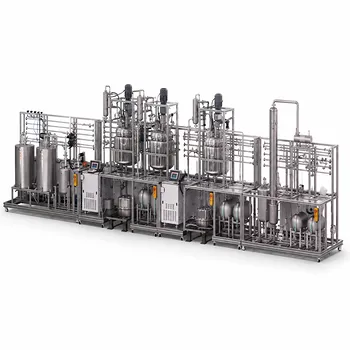
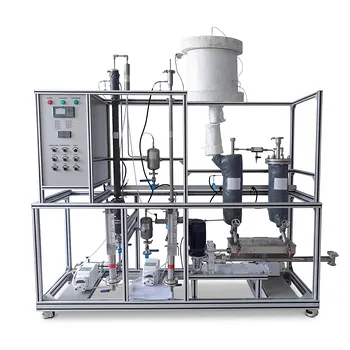
Mastering the balance between speed and yield in an exothermic, equilibrium-limited reaction is a fundamental chemical engineering challenge. A pilot plant with multiple reactors in series, like those used for MTBE synthesis, makes this balance tangible. By precisely manipulating feed temperatures, inter-stage cooling, and cold recycle streams, operators gain direct, real-time insight into how temperature dictates both reaction rate and equilibrium conversion—and how intelligent heat removal can maximize overall yield.
The multi-reactor pilot plant transforms abstract thermodynamics into a practical demonstration: as temperature rises, the reaction speeds up but the equilibrium shifts unfavorably toward reactants. Inter-stage cooling and cold recycle strategically remove heat, maintaining high initial rates while protecting thermodynamic conversion in later stages. This hands-on platform teaches the critical trade-off between kinetics and thermodynamics that underpins industrial reactor design.
The MTBE Reaction: A Classic Case of Kinetic-Thermodynamic Tension
The Exothermic, Reversible Nature of MTBE Synthesis
MTBE is produced from methanol and isobutene in a reaction that is both exothermic (ΔrH = -37.5 kJ/mol) and equilibrium-limited.
Higher temperatures increase the reaction rate constant, but they also decrease the equilibrium constant—shifting the equilibrium back toward the reactants.
This conflict creates the core instructional problem: how do you drive a reaction forward when the very heat it releases works against your final yield?
Why a Single Reactor Falls Short
In a single adiabatic fixed-bed reactor, the temperature rise caused by the reaction’s own heat release quickly pushes the system into a region of poor equilibrium conversion.
You either sacrifice per-pass yield (by letting the bed run hot) or accept a painfully slow rate (by keeping it too cool).
Neither option reflects good industrial practice.
The Multi-Reactor Advantage
A pilot plant equipped with several fixed-bed reactors in series, each with independent temperature control and inter-stage cooling, decouples these opposing demands.
Now the first reactor can operate at a temperature that gives a high reaction rate, while the subsequent stages can be held at progressively lower temperatures to “lock in” a high overall conversion.
This configuration is the physical embodiment of the kinetic-thermodynamic compromise every chemical engineer must learn.
Demonstrating Temperature-Dependent Equilibrium
Adjusting Feed Temperature to Map the Equilibrium Limit
Operators set each reactor stage to a different steady-state temperature—typically from 320 K to 360 K for MTBE synthesis—and measure the outlet isobutene concentration.
Results show clearly that lower temperatures give higher equilibrium conversion, but the reaction rate becomes so slow that practical production is impossible.
Plotting conversion against temperature directly reveals the equilibrium curve and forces students to confront the rate–yield trade-off.
Verifying van’t Hoff with Live Plant Data
Using the pilot plant’s online analyzers, students can calculate the equilibrium constant Kp at each temperature from the partial pressures of the products and unreacted feedstock.
Plotting ln(Kp) versus 1/T yields a straight line whose slope equates to -ΔH°/R.
This simple experiment verifies the reaction enthalpy experimentally, connecting the Le Chatelier principle from textbooks to real, measurable chemical behavior.
Observing the Optimum Temperature Trajectory
In a multi-bed system, there exists a theoretical optimum temperature profile—a curve that keeps the reaction rate as high as possible at every point in the conversion path.
By dynamically adjusting inter-stage coolers to keep each bed close to its own Topt, the pilot plant demonstrates how to maximize space-time yield.
Students see that blindly cooling after the first reactor is good, but cooling to exactly the temperature the kinetics demand is even better.
Managing Heat in Exothermic Multi-Reactor Systems
Inter-Stage Cooling: The Practical Tool for Equilibrium Control
After the first reactor’s exotherm raises its temperature, a shell-and-tube or plate heat exchanger strips away the unwanted heat before the stream enters the second reactor.
This cooling is not just about safety—it resets the thermodynamic driving force, allowing the second bed to achieve significant additional conversion without pushing the equilibrium backward.
The operator directly observes that a heated stream entering a cooler reactor immediately shows a jump in conversion, proving that heat removal can act as a chemical “shift lever.”
Cold Recycle: Reinforcing the Temperature Strategy
In many pilot plants, a portion of the cooled reactor effluent is recycled and mixed with the fresh feed.
This cold recycle stream dilutes the reactants and absorbs part of the reaction heat, limiting the temperature rise across the first catalyst bed.
By adjusting the recycle ratio, students can see how the peak temperature in the first reactor falls and overall conversion rises—a tangible demonstration of a core industrial practice used in processes like ammonia and methanol synthesis.
Temperature Sensors and Real-Time Control
The pilot plant is instrumented with multiple thermocouples along the height of each fixed bed.
These sensors reveal hot spots, temperature gradients, and the immediate effect of a change in cooling duty or recycle flow.
Monitoring this data in real time teaches operators how to detect incipient runaway conditions and how to maintain the thermal envelope required for catalyst stability.
Understanding the Trade-offs
Kinetics versus Thermodynamics: No Free Lunch
A hotter first reactor gives a spectacular initial rate but leaves equilibrium conversion on the table.
Inter-stage cooling recovers that conversion, but at the cost of additional equipment and energy.
The pilot plant quantifies this trade-off—students can compare overall yield, productivity, and utility consumption for different temperature strategies and see that the “best” design is always a compromise.
Thermal Runaway and Catalyst Deactivation
Without adequate heat removal, the exotherm can accelerate the rate further, leading to a positive feedback loop known as thermal runaway.
The pilot plant’s sensors and safety interlocks let you safely watch how a failure in cooling leads to a rapid temperature spike and how that spike damages catalyst activity.
This experience is invaluable for learning to design reliable relief systems and to set safe operating windows.
Data Integrity and the Path to Scale-Up
Accurate temperature, pressure, and composition data collected under controlled conditions form the basis for kinetic modeling.
By fitting reaction rate equations to the pilot plant data, researchers can predict the performance of full-scale reactors with confidence.
The pilot plant thus teaches not just thermodynamics, but the discipline of generating clean, defensible data for engineering decisions.
Making the Right Choice for Your Educational or Research Goal
- If your primary focus is student learning and concept visualization: Let learners vary the feed temperature to each reactor, calculate Kp at steady state, and verify the van’t Hoff relationship. This turns an abstract equation into a memorable hands-on experiment.
- If your primary focus is reaction kinetic research: Use the multi-reactor setup to collect high-quality data across a wide temperature range, with and without inter-stage cooling. Build rate equations and validate them by predicting the experimental conversion profiles.
- If your primary focus is process safety and industrial scale-up: Operate the plant to deliberately test the effects of cooling failures and hot spot formation. Use the resulting data to design safe operating limits, quench systems, and control strategies for full-scale implementation.
Every run in a multi-reactor pilot plant is a lesson in the delicate dance between heat, speed, and yield—a dance that defines the success or failure of countless real-world exothermic processes.
Summary Table:
| Strategy / Feature | Operational Action | Thermodynamic & Kinetic Impact |
|---|---|---|
| Multi-Stage Reactors | Series configuration with separate temperature zones | High initial reaction rates followed by high equilibrium conversion |
| Inter-Stage Cooling | Heat exchangers remove heat between stages | Resets thermodynamic driving force, shifting equilibrium to products |
| Cold Recycle | Blends cooled effluent back into the feed stream | Dilutes reactants and controls peak temperature to prevent runaways |
Bring Industrial Reactor Design to Life with LABPARK
Bridge the gap between thermodynamic theory and practical engineering. LABPARK provides premium Educational and Vocational Unit Operations Pilot Plants in chemical engineering, bioprocess & biotech, and environmental & water treatment designed for universities, research institutes, and enterprises.
Whether you are training the next generation of engineers or scaling up catalytic processes, our multi-reactor systems offer the precise control and real-time data integration you need.
Ready to upgrade your lab's capabilities? Contact our engineering experts today to discuss your custom pilot plant requirements!
Related Products
- Fixed Bed Gas Solid Catalytic Reaction Educational Pilot Plant
- Multi Pump Fluid Transport Process Piping Unit Operations Training Pilot Plant
- Carbon Dioxide Hydrogen Methanol Synthesis Educational Unit Operations Pilot Plant
- Ethyl Acetate Synthesis Unit Operations Pilot Plant for Practical Training
- Natural Product Extraction Unit Operations Training Pilot Plant
People Also Ask
- How do reactor pilot plants safely study gas-solid reactions? Master kinetics with thermal & flow control.
- How does the Mears criterion evaluate transport resistance? Key Guide to Intrinsic Kinetics
- Why is a multibed configuration necessary for exothermic reactions? Optimize your pilot plant trajectory.
- Fluidized vs. Fixed Bed Reactors: Comparing Heat & Complexity in Pilot Plants
- How is the friction factor determined for fixed-bed pilot plants? Select the best pressure drop correlation.