Phase state is the master key to reactor classification, dividing all reaction systems into just two fundamental categories: homogeneous (single-phase) and heterogeneous (multiphase). For homogeneous gas or liquid reactions, tubular, stirred tank, or tower reactors are the standard choices in pilot plants. Heterogeneous systems—covering gas-solid, gas-liquid, liquid-liquid, and gas-liquid-solid combinations—require purpose-built configurations like fixed bed, fluidized bed, bubble column, slurry, or trickle bed reactors to engineer sufficient interfacial contact. In educational and vocational pilot plants, this classification directly determines reactor geometry, operating conditions, and the learning outcomes students can achieve.
The phase state of a reaction is not merely a label—it dictates the reactor’s geometry, mixing mechanism, and the entire transport-phenomena curriculum a pilot plant can deliver. Homogeneous reactions allow simpler, lower-temperature pilot setups, while heterogeneous reactions demand more complex designs that unlock training on multiphase mass transfer and industrial-scale constraints.
Classifying Reactors by Phase State
Reactor classification begins with the number of phases present in the reaction mixture. This single factor defines the interfacial contact challenge and, therefore, the necessary reactor architecture.
The Homogeneous–Heterogeneous Divide
Homogeneous systems contain only one phase—either gas or liquid—so all molecules are intrinsically miscible. Mass transfer resistance is minimal, and the reaction rate is controlled primarily by intrinsic kinetics and heat transfer.
Heterogeneous systems involve two or more distinct phases. Because the phases do not intermix at the molecular level, the reactor must actively create and maintain interfacial area for mass transport. The specific phase pairing then pinpoints the reactor type needed.
Phase-Pair Specific Classification
Gas-solid reactions rely on contact between a gas stream and solid catalyst particles or solid reactants. Fixed bed, moving bed, and fluidized bed reactors are the dominant solutions.
Gas-liquid reactions demand high gas-liquid interfacial area. Bubble columns, packed towers, plate columns, and stirred tanks each achieve this through different flow and agitation strategies.
Liquid-liquid reactions are often handled by stirred tanks or static mixers, where intense shear promotes droplet dispersion.
Three-phase (gas-liquid-solid) reactions combine all previous challenges. Trickle beds, where liquid trickles downward over a packed solid catalyst in the presence of a gas phase, and slurry reactors, with suspended fine catalyst particles, are the workhorse designs.
Typical Pilot Plant Reactors for Homogeneous Systems
When the reaction mixture is single-phase, simplicity and controllability make certain reactor types especially attractive for pilot plants.
Tubular (Plug Flow) Reactors
These are the go-to for homogeneous gas-phase reactions and many liquid-phase conversions. The narrow tube induces plug flow, minimizing backmixing and giving a well-defined residence time distribution. Educational pilot plants use them to teach fundamentals of conversion, selectivity, and heat exchange along the flow direction.
Stirred Tank Reactors
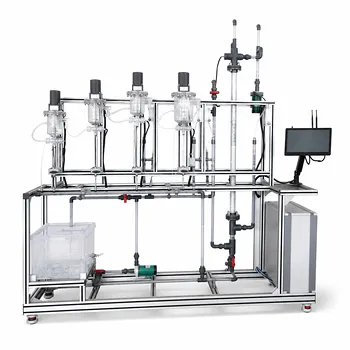
For liquid-phase homogeneous reactions, a stirred tank offers unmatched flexibility. It provides uniform composition and temperature, enabling straightforward kinetic studies under perfectly mixed conditions. The simple design also makes it one of the safest and most common choices for vocational training.
Tower Reactors
When gravity-driven flow is sufficient, tower reactors serve as an alternative to tubular arrangements. They are less common in small-scale education but can demonstrate continuous operation principles for homogeneous liquid systems with longer residence times.
Typical Pilot Plant Reactors for Heterogeneous Systems
Heterogeneous systems dominate industrial catalysis and advanced unit operations. Pilot plants that incorporate them expose learners to the real-world complexity of multiphase transport.
Fixed Bed Reactors for Gas-Solid Contact
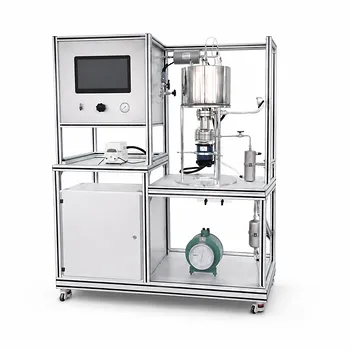
The fixed bed is the standard for heterogeneous catalytic processes like ammonia synthesis. Gas flows over a stationary bed of solid catalyst particles. Pilot plants with fixed beds allow students to study pressure drop, axial temperature profiles, and catalyst deactivation—all essential industrial phenomena.
Fluidized Bed Reactors
When heat transfer or catalyst handling becomes critical, the fluidized bed excels. Gas lifts solid particles, creating a fluid-like behavior that ensures near-isothermal conditions. In a pilot plant, this reactor type illustrates the delicate balance between gas velocity, particle size, and bed stability.
Bubble Columns and Stirred Tanks for Gas-Liquid Contact
Bubble columns introduce gas through a liquid pool via a sparger, making them ideal for illustrating interfacial area generation without moving parts. Adding a mechanical stirrer transforms it into a stirred tank reactor for gas-liquid systems, useful when higher mass transfer rates are needed.
Trickle Beds and Slurry Reactors for Three-Phase Systems
Trickle beds co-contact gas and liquid with a fixed solid catalyst bed, mirroring commercial hydrotreating units. Slurry reactors suspend fine catalyst particles in the liquid, providing exceptionally high mass transfer area. Both are critical for training on three-phase hydrodynamics and mass transfer limitations.
Understanding the Trade-offs in Reactor Selection
Even at pilot scale, no reactor type is universally superior. The phase state creates inherent tensions between operational simplicity, safety, and learning depth.
Mild Conditions vs. Industrial Realism
Homogeneous systems generally operate at much lower temperatures (350–505 K) than heterogeneous ones (530–775 K). This means homogeneous pilot plants can use less expensive materials, simpler utility systems, and lower pressure ratings, enhancing laboratory safety and reducing operating costs. The trade-off is that students miss experiencing high-temperature materials constraints and safety relief system design.
Mass Transfer Complexity vs. Kinetics Clarity
Heterogeneous reactors introduce mass transfer resistances that can mask true kinetics. While this is invaluable for teaching transport phenomena, it complicates data analysis for beginners. Homogeneous systems offer cleaner kinetic data, making them better for foundational learning before advancing to multiphase complexity.
Reactor Flexibility vs. Dedicated Design
A stirred tank can be adapted for liquid homogeneous, gas-liquid, or even slurry reactions, offering experimental flexibility in a multi-purpose pilot plant. In contrast, a trickle bed is highly specialized. Educational programs must decide whether to invest in a set of dedicated heterogeneous reactors or a few flexible platforms that can be reconfigured.
Making the Right Choice for Your Pilot Plant Goals
The best reactor selection aligns with the learning objectives, available infrastructure, and safety requirements of your educational or research environment.
- If your primary focus is fundamental kinetics and reactor modeling: Start with a tubular or stirred tank reactor for homogeneous systems. The clean data and lower utility demands allow students to master residence time distribution, conversion, and selectivity without multiphase complications.
- If your primary focus is industrial catalysis and process scale-up: Integrate a fixed bed and a bubble column or trickle bed reactor. These expose learners to pressure drop, catalyst effectiveness factors, and gas-liquid mass transfer coefficients—the very parameters scaled up in industry.
- If your primary focus is versatility on a limited budget: Choose a stirred tank that can be operated with different internals (spargers, catalyst baskets) and a small tubular reactor. This combination covers homogeneous and several heterogeneous modes with minimal infrastructure.
- If your primary focus is safety training and low-risk operation: Emphasize homogeneous liquid-phase reactors, which operate at the mildest conditions and allow students to learn emergency procedures in a low-hazard context before handling high-temperature heterogeneous systems.
Understanding reactor classification by phase state transforms pilot plant design from a catalog exercise into a deliberate, educational strategy—ensuring every piece of hardware serves a clear developmental purpose.
Summary Table:
| Reactor Class | Phase State | Common Pilot Plant Types | Key Training Focus |
|---|---|---|---|
| Homogeneous | Single-phase (Gas or Liquid) | Tubular (PFR), Stirred Tank (CSTR) | Kinetics, conversion, heat exchange, RTD |
| Heterogeneous | Multiphase (Gas-Solid, G-L, G-L-S) | Fixed Bed, Fluidized Bed, Bubble Column, Trickle Bed | Mass transfer, pressure drop, catalyst dynamics |
Optimize Your Chemical Engineering Lab with LABPARK
Choosing the right reactor configuration is critical to achieving your training and research goals. LABPARK provides state-of-the-art Educational and Vocational Unit Operations Pilot Plants in chemical engineering, bioprocess & biotech, and environmental & water treatment.
Whether you are a university developing transport phenomena curricula, a research institute studying advanced catalysis, or an enterprise scaling up processes, our systems offer the safety, flexibility, and industrial realism you need.
Contact our technical experts today to design the ideal pilot plant setup for your facility!
Related Products
- Fixed-Bed Chemical Reaction and Gas Dust Tar Removal Unit Operations Pilot Plant
- Fluidized Bed Gas Solid Catalytic Reaction Educational Pilot Plant
- 100L Continuous Loop Hydrogenation Educational Unit Operations Pilot Plant
- Fixed Bed Gas Solid Catalytic Reaction Educational Pilot Plant
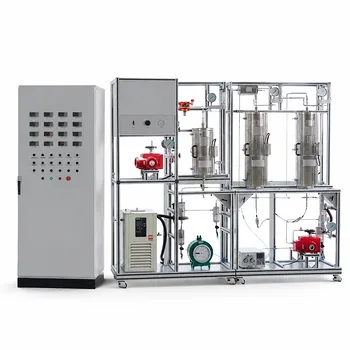
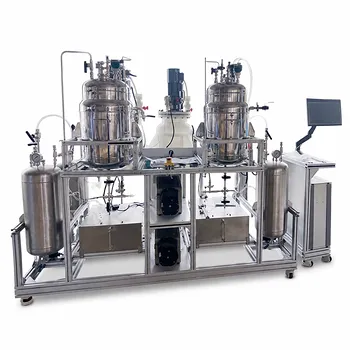
- Multi-Reactor Educational Pilot Plant for Reaction Engineering Unit Operations
People Also Ask
- When to transition from PID to adaptive control in pilot plants? Key process indicators.
- How do deviations in estimating latent heat impact pilot plant thermal systems? Avoid hardware mis-sizing.
- Why Compare Predicted and Experimental Excess Enthalpy? Key to Accurate Pilot Plant Scale-up
- Why Use PTFE & Hastelloy in Chemical Pilot Plants? Prevent Corrosion & Ensure Safety
- How to study gasification in pilot plants? Compare exit gas composition & efficiency