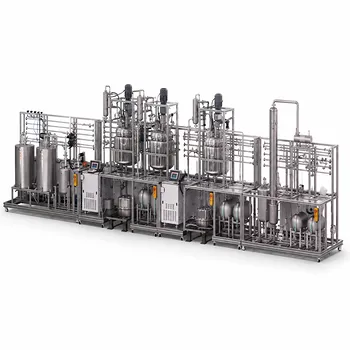
The financial orchestration of a pilot plant hinges on milestone-based contracts that tie payment releases directly to project progress. Under the standard approach, an Engineering, Procurement, and Construction (EPC) contractor manages all equipment procurement—from pressure vessels to instrumentation—and receives payments only upon reaching predefined stages: detailed design completion, groundbreaking, mechanical completion, and successful performance testing. This structure aligns incentives and provides the owner with clear risk gates throughout design and construction.
While the milestone framework keeps procurement and spending in lockstep, its success depends on two often-underestimated factors: design fees that can consume up to 30% of the plant's total bare-module cost (disproportionately high for pilot scales), and contingency reserves that must be embedded early to shield against price volatility in materials and technical uncertainty. Ignoring these creates a brittle payment plan.
The EPC Milestone Payment Framework
The core of any pilot plant procurement and payment strategy is the milestone-based contract with an EPC firm. This approach transforms an opaque capital outflow into a series of verifiable checkpoints.
Defining the Key Milestones
A typical unit operations pilot plant payment schedule breaks the project into four to six major gates. The completion of detailed design—which includes process flow diagrams, piping and instrumentation diagrams (P&IDs), and equipment datasheets—typically triggers the first substantial payment.
The next milestone is often groundbreaking or initiation of site work and fabrication. This signals the transition from engineering to physical execution. Then comes mechanical completion, when all equipment is installed, piped, and wired, but not yet operating as an integrated process. The final and largest payment is almost always tied to successful performance testing, where the plant runs at specified throughput and product purity, proving it meets contractual guarantees.
Why Milestones Matter for Pilot Plants
Pilot plants, unlike commercial-scale facilities, carry high technical novelty. A milestone structure forces the EPC contractor to demonstrate progress against objective, measurable criteria before receiving funds.
This protects the owner from paying for incomplete work while giving the contractor clear cash flow targets. It also creates natural pauses for technical reviews, reducing the risk of a mis-designed unit operation being integrated into the final system.
How Procurement Integrates with Payment Schedules
Procurement is not a separate activity; it is interwoven with the milestone payments. The EPC contractor acts as the central procurement hub, but the timing of their supplier commitments must mirror the payment schedule.
The Contractor’s Role as a Single Point of Responsibility
Under this model, the EPC contractor assumes full responsibility for sourcing all individual process components—heat exchangers, distillation columns, reactors, control valves—and ensuring they meet the design specifications. The owner does not manage a dozen supplier relationships. Instead, the contract makes the EPC firm accountable for integration, meaning any supplier error or delay becomes their problem to solve, typically at their own cost, until the next milestone is reached.
Linking Procurement to Milestones
Long-lead items, such as custom pressure vessels or exotic-alloy heat exchangers, must be ordered long before the “mechanical completion” milestone. To fund this, contracts often include advanced procurement payments that are released upon detailed design approval, even though physical installation is months away.
These payments are a risk-sharing tool. They give the contractor working capital to place supplier orders without financing the entire procurement chain themselves. In return, the owner gains visibility: the EPC firm must provide supplier acknowledgments and delivery schedules as a condition for releasing that funding.
The Hidden Costs That Shape the Payment Structure
A naïve milestone plan that simply divides the contract value into equal portions fails for pilot plants. Two cost categories demand a front-loaded and heavily buffered schedule.
The Disproportionate Burden of Design Fees
For educational or highly customized unit operations pilot plants, engineering and design costs are not a minor fraction. They can reach 30% of the combined ISBL and OSBL investment, compared to just 10% for a large industrial plant. This is because every piping run, instrument location, and modular skid arrangement must be engineered from scratch, often without the scale to amortize that effort.
Consequently, the first payment milestones—those tied to design deliverables—must reflect this reality. A structure that releases only 10% of the total project value at detailed design completion would starve the project of needed capital, forcing the contractor to cut corners or delay procurement. A healthy plan allocates up to 25-35% of total payments to early engineering milestones.
The Critical Role of Contingency Reserves
No pilot plant budget or payment schedule is complete without a contingency reserve. The supplementary analysis recommends at least 10%, rising to 50% for projects with high technical uncertainty or custom designs.
What does this mean for payment structure? You cannot simply add contingency as a lump sum at the end. Effective structures embed contingency within each milestone payment, as an owner-controlled fund released against formal change orders. This keeps the base milestone payments realistic while providing a buffer against material price spikes (like stainless steel or catalyst costs) and unforeseen installation labor. Without it, the project stalls at the first deviation, leading to acrimonious negotiations.
Understanding the Trade-offs
Milestone-based procurement and payment systems are powerful but not without friction. Recognizing these pitfalls is essential to building a durable contract.
Cash Flow Imbalance for the Contractor
If the milestones are too back-loaded, the EPC firm carries a heavy negative cash flow, especially during procurement of long-lead items. This can lead to pacing work to whatever the cash allows, delaying the schedule. Advance procurement payments help, but they must be calibrated to avoid the owner over-paying for goods not yet delivered.
Disputes Over Milestone Achievement
Vague milestone definitions like “mechanical completion” can become flashpoints. A contractor may claim completion while punch-list items remain, and the owner may disagree. The remedy is a clear, jointly signed checklist for each milestone gate, referencing specific documents, test certificates, and walk-down confirmations.
The Risk of Inadequate Contingency
Under-budgeting contingency and then rigidly holding milestone payments to the original plan creates a slow-motion failure. When an inevitable change arises—a valve needs an exotic trim material due to corrosive by-products—there is no financial mechanism to resolve it. The project enters a standoff. A payment structure must anticipate variability, not just hope it doesn't occur.
Making the Right Choice for Your Goal
How you structure procurement and payments should directly reflect your primary project priority.
- If your primary focus is budget certainty: Front-load payments only for the detailed design milestone (up to 30%), and then tie all subsequent payments to physical progress verifications. Embed a large, owner-controlled contingency (at least 20%) to absorb cost shocks without renegotiating the contract.
- If your primary focus is technical performance: Make the final performance testing milestone a substantial portion of the contract value (25-35%). This ensures the contractor’s financial incentive remains aligned with delivering a system that hits yield, purity, and operability targets, not just completing installation.
- If your primary focus is schedule: Use aggressive advance procurement payments immediately after design approval, paired with a shared savings clause that rewards the contractor for early mechanical completion. This injects cash into the supply chain exactly when it speeds up long-lead item deliveries.
The most robust payment plan is never a templated division of the contract price—it is a deliberate reflection of the pilot plant’s unique design intensity, technical risk, and the strategic leverage you want to hold over the final performance outcome.
Summary Table:
| Milestone / Phase | Typical Payment Allocation | Key Deliverables & Focus |
|---|---|---|
| Detailed Design | 25% - 35% | P&IDs, equipment datasheets, custom design approval |
| Groundbreaking / Fabrication | 15% - 25% | Site preparation, ordering long-lead process components |
| Mechanical Completion | 20% - 30% | Equipment installed, piped, and wired (not yet operational) |
| Performance Testing | 20% - 35% | System integration, throughput, and purity verification |
| Contingency Reserve | 10% - 50% (of total budget) | Owner-controlled buffer for price volatility and design changes |
Partner with LABPARK for Seamless Pilot Plant Execution
Designing and budgeting a pilot plant requires precise financial planning and engineering expertise. LABPARK provides premium Educational and Vocational Unit Operations Pilot Plants tailored for universities, research institutes, and enterprises across key sectors:
- Chemical Engineering
- Bioprocess & Biotech
- Environmental & Water Treatment
We align with your procurement structures and milestone requirements to deliver reliable, high-performance systems. Contact our engineering experts today to discuss your project specifications!
Related Products
- Multi Pump Fluid Transport Process Piping Unit Operations Training Pilot Plant
- Natural Product Extraction Unit Operations Training Pilot Plant
- Carbon Dioxide Hydrogen Methanol Synthesis Educational Unit Operations Pilot Plant
- Multi-Modal Distillation Unit Operations Training Pilot Plant
- Ethyl Acetate Synthesis Unit Operations Pilot Plant for Practical Training
People Also Ask
- Why distinguish Newtonian & non-Newtonian fluids in pilot plants? Prevent design errors.
- Why is the chemical plant startup schedule crucial? De-risk scale-up with pilot plants.
- When to transition from PID to adaptive control in pilot plants? Key process indicators.
- How do deviations in estimating latent heat impact pilot plant thermal systems? Avoid hardware mis-sizing.
- Why Compare Predicted and Experimental Excess Enthalpy? Key to Accurate Pilot Plant Scale-up