In short: standard equations of state cannot provide reliable quantitative predictions for dissolved hydrocarbon solubility in water.
While these thermodynamic models excel at calculating the water content present in gas and hydrocarbon liquid phases—a critical input for dew‑point control and hydrate prevention—their accuracy collapses when applied to the inverse problem. For environmental water treatment pilot plants, predicting the concentration of gaseous or liquid hydrocarbons dissolved in the water phase yields results that are, at best, qualitative. Precise process design and treatment optimization therefore demand pilot‑scale empirical testing to supplement any theoretical calculation.
The core challenge is that water’s strong polarity and hydrogen‑bonding network break the assumptions that make cubic equations of state successful for non‑polar mixtures. In a water treatment pilot plant, expecting a standard Peng‑Robinson or SRK model to accurately predict the solubility of benzene or methane in water without extensive experimental tuning is unrealistic—those models deliver approximate trends, not design‑grade numbers.
The Asymmetry Every Environmental Engineer Faces
The relationship between water and hydrocarbons in a process stream is not symmetrical. An equation of state that calculates how much water vapor dissolves in a hydrocarbon gas stream with < 2 % error will often fail by an order of magnitude when asked the opposite question: “How much hydrocarbon dissolves in the water?”
Equations of state are built for non‑polar, van der Waals‑type interactions.
Cubic models like Peng‑Robinson and SRK were originally developed for refinery and gas‑processing streams dominated by hydrocarbons. Their mixing rules and pure‑component parameters capture the weak, London‑dispersion forces that govern non‑polar molecule behavior beautifully.
Water is the ultimate outlier.
Once a polar substance such as water becomes the bulk phase, the situation reverses. Now you are trying to insert a non‑polar hydrocarbon solute into a liquid that is structured by a strong, three‑dimensional hydrogen‑bond network. That network cannot be approximated by the simple “a” and “b” parameters of a cubic equation without massive, empirically‑tuned corrections.
Why Equations of State Fall Short for Hydrocarbon‑in‑Water Solubility
The Polar Nature of Water Defies Simple Mixing Rules
Standard mixing rules assume that molecules interact in a pairwise fashion that can be averaged. Water’s hydrogen bonding is a directional, many‑body effect that cannot be represented by a single adjustable binary parameter. This is why even a model like SRK, which works reliably for the oil phase, struggles to give anything more than a qualitative solubility trend when water is the dominant component.
Binary Interaction Parameters – A Moving Target
To coax an equation of state into a better fit, you can tweak the binary interaction parameter ((k_{ij})) using experimental data. The problem is that this parameter is highly sensitive and temperature‑dependent. A 10 % change in (k_{ij}) can swing the predicted solubility by more than an order of magnitude in the dilute region. For environmental pilot plants operating across a range of seasonal water temperatures, a single fixed parameter quickly becomes useless unless re‑regressed for each condition.
The Critical Region and Three‑Phase Encounters
Near the water‑rich critical region, classical cubic equations of state break down thermodynamically. Additionally, many treatment systems operate near three‑phase boundaries (water‑hydrocarbon‑gas or hydrate‑forming conditions). Standard EOS implementations often fail to converge or predict azeotropic‑like behaviors that do not exist, giving a false sense of security about how much hydrocarbon will remain dissolved after treatment.
The Indispensable Role of the Pilot Plant in Environmental Treatment
Generating the Data That No Equation Can Predict
The only way to know how much benzene, toluene, or dissolved methane remains in treated water is to measure it. A pilot‑scale air stripper, dissolved‑air flotation unit, or liquid‑liquid extraction column can be fed with the actual process water. Sampling the water phase and analyzing it for dissolved hydrocarbons provides direct solubility data under realistic pressure, temperature, and composition conditions.
Calibrating Models with Real‑World Measurements
Once empirical solubility data exists, you can reverse‑engineer your thermodynamic model. Regressing binary interaction parameters from pilot‑plant measurements turns a qualitative EOS into a quantitative tool for scale‑up. This tuned model can then be used to explore “what‑if” scenarios—changes in temperature, pressure, or solvent‑to‑feed ratio—with much greater confidence, because it is anchored in physical reality.
Understanding the Trade‑offs
Speed vs. Fidelity – When a Qualitative Answer Suffices
In an early scoping study, running a quick Peng‑Robinson simulation with default water‑hydrocarbon binaries may be “good enough” to flag that dissolved methane will be a problem. The trade‑off is that the reported concentration may be an order of magnitude off. If the goal is simply to identify which hydrocarbons will partition into water, a qualitative EOS run saves time and money. For anything requiring a material balance or regulatory permit, it is a dangerous shortcut.
The Cost of Over‑Reliance on Uncalibrated Simulations
The biggest mistake is to treat an unvalidated EOS prediction as a process guarantee. Environmental compliance limits are often in the parts‑per‑billion range—far below the accuracy envelope of a generic cubic equation. Skipping the pilot plant and scaling a separation unit based solely on a predictive model means accepting a risk that can lead to failed effluent targets, costly retrofits, or even regulatory penalties.
The BWRS Trap
Modified Benedict‑Webb‑Rubin formulations are often marketed as more comprehensive. However, for water‑containing systems, BWRS still requires separate, dedicated water‑property correlations that are external to the equation of state itself. Using BWRS to predict hydrocarbon solubility in water without those correlations and without pilot‑plant regression simply replaces one inaccurate assumption with another.
Making the Right Choice for Your Environmental Pilot Plant
The question is not whether equations of state can be used, but how they should be used. Your approach must match the project’s risk profile and required accuracy.
- If your primary focus is conceptual screening or pre‑study scoping: Use an equation of state with default interaction parameters to obtain order‑of‑magnitude solubility trends. Clearly label the results as approximate and qualitatively identify the worst‑case dissolved hydrocarbons.
- If your primary focus is process design, optimization, or permit‑level reporting: Run the pilot plant first. Generate direct solubility data for your specific water chemistry, then fit the binary parameters of your chosen EOS. The resulting tuned model becomes your reliable design basis.
- If your primary focus is education or demonstrating thermodynamic fundamentals: Pair the pilot plant with EOS software. Have students compare the raw, un‑tuned predictions with their own experimental data. This contrast teaches the limitations of simplifying assumptions far more powerfully than any textbook.
In environmental water treatment, the equation of state is a useful map, but the pilot plant provides the trusted compass.
Summary Table:
| Feature | Equations of State (EOS) | Pilot Plant Testing |
|---|---|---|
| Accuracy | Qualitative (high error margins) | Quantitative (highly accurate) |
| Polarity Handling | Struggles with hydrogen bonding | Captures real-world polar interactions |
| Best Use Case | Initial screening & conceptual scoping | Process design, scaling & validation |
Bridge the gap between thermodynamic theory and real-world results with LABPARK.
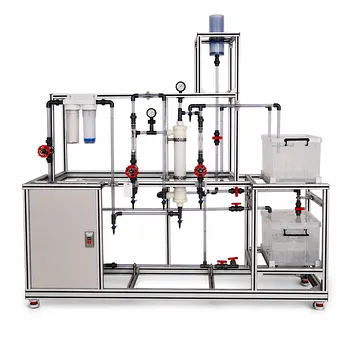
We provide state-of-the-art Educational and Vocational Unit Operations Pilot Plants in chemical engineering, bioprocess & biotech, and environmental & water treatment. Designed for universities, research institutes, and enterprises, our pilot plants deliver the precise empirical data you need to validate models and scale up operations with confidence.
Contact us today to find the perfect pilot plant for your lab!
Related Products
- Electrochemical Water Treatment Educational Unit Operations Pilot Plant
- Electrolytic Hydrogen Production Educational Unit Operations Pilot Plant
- Dual-Mode Rectification Pilot Plant for Practical Training Unit Operations
- Ion Exchange Water Purification Educational Pilot Plant for Engineering Unit Operations
- 100L Continuous Loop Hydrogenation Educational Unit Operations Pilot Plant
People Also Ask
- What design features do educational electrochemical pilot plants utilize to manage gas liberation and water loss?
- How can unit operations pilot plants show lead-acid concentration vs state of charge? Real-time monitoring guide.
- How do educational electrochemical pilot plants scale up electrolysis? Master industrial engineering.
- How to Estimate Sulfate in Water Treatment Pilot Plant Deposits: Gravimetric Guide
- How can foaming be managed during steam generation experiments in water treatment unit operations pilot plants? Tips