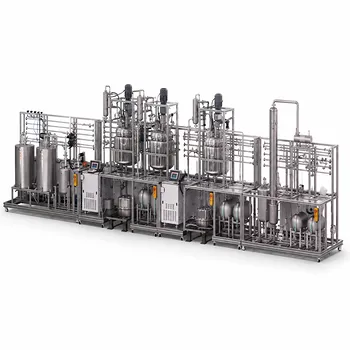
Chemical engineering pilot plants combat corrosion by integrating three core systems: test loops for exposing metal coupons, water treatment units that neutralize aggressive species, and stress-relief fabrication techniques. These operational and design features turn the abstract electrochemical theory of metal degradation into tangible, measurable, and controllable experiments. They allow engineers to observe how manipulating pH, dissolved oxygen, and mechanical strain directly dictates the rate of anodic metal dissolution.
The central insight is that industrial corrosion is an electrochemical disease with specific environmental triggers. A well-designed pilot plant doesn't just show students what corrodes; it isolates each driving force—acid attack, oxygen absorption, or residual stress—and demonstrates exactly how process control neutralizes it, mirroring the logic used to protect billion-dollar production facilities.
The Electrochemical Battlefield: Simulating Real-World Corrosion Mechanisms
Corrosion in neutral or basic, aerated water follows the oxygen absorption mechanism: iron oxidizes at anodic sites ($\text{Fe} \rightarrow \text{Fe}^{2+} + 2\text{e}^-$) while oxygen reduces at cathodic sites on the same metal surface. In acidic environments, the hydrogen evolution mechanism takes over, with protons directly consuming the electrons and generating hydrogen gas. Pilot plants are designed to recreate both scenarios on demand.
Exposing Truth with Metal Coupons and Test Loops
To study these dynamics, pilot units feature dedicated test sections or recirculating loops where precisely machined metal coupons, often stainless steel or nickel steel, are inserted. These specimens act as standardized witnesses to corrosion. By placing identical coupons in parallel loops, students can change one variable—like fluid velocity or temperature—and measure the resulting weight loss or pitting depth with high statistical confidence.
Seeing the Invisible: Electrochemical Monitoring
Beyond physical weight loss, these plants integrate potentiostats and multimeters to directly read the electrochemical conversation. Measuring the polarization resistance reveals the instantaneous corrosion rate without destroying the sample. Monitoring the galvanic current between two dissimilar metals in a test cell quantifies the aggressiveness of a galvanic couple, turning a qualitative risk into a precise current density number.
Operational Mitigation: Chemically Starving the Corrosion Cells
Once a corrosion mechanism is identified, the pilot plant’s water treatment unit operations become the instructional focus. These systems do not add protective films; they systematically eliminate the chemical reactants required for the redox reaction to proceed.
Neutralizing Acids to Halt Hydrogen Evolution
Integrated chemical dosing systems inject alkaline agents to raise the pH, neutralizing the hydrogen ions that drive the cathode reaction in acidic corrosion. This operational step directly mirrors boiler feedwater treatment or neutralization pits in refineries. The pilot plant demonstrates that maintaining a slightly alkaline pH is not a mere recommendation—it’s the practical removal of a key reactant from the electrochemical equation.
Stripping Dissolved Oxygen to Starve the Cathode
Deaerators, whether vacuum or steam-stripping types, are featured to purge dissolved $\text{O}_2$. Since oxygen is the primary electron acceptor in neutral water, removing it effectively chokes the cathode reaction. Students observe that without this electron sink, the anodic dissolution of iron grinds to a halt, proving the electrochemical theory in real time.
Removing Electrolytes with Ion Exchange
Dissolved salts increase conductivity and accelerate corrosion by acting as an ionic highway between anodes and cathodes. Ion-exchange columns remove these electrolytes, dramatically increasing the ohmic resistance of the water. This operational feature demonstrates that even without changing pH or oxygen, simply demineralizing the fluid can slash corrosion rates by limiting the ionic current flow.
Design Strategies for Permanent Structural Defense
Operational controls are reactive. The pilot plant’s design features embody proactive, permanent defense layers inherited from industrial practice.
Stress-Relief Heat Treatment for Mechanical Integrity
Fabrication leaves pipes and vessels with internal residual stresses, which create microscopic anodic sites and lead to stress corrosion cracking. By applying stress-relief heat treatment to the metal components before assembly, the pilot plant shows that relaxing these trapped strains closes a critical chapter in the corrosion story. It links the worlds of mechanical strain and electrochemical potential, proving that a sound structural design is the first and most critical corrosion inhibitor.
Cathodic Protection: Sacrificial Anodes and Impressed Current
Beyond water chemistry, pilot loops demonstrate direct electrochemical suppression. Sacrificial anode systems bolt blocks of zinc or magnesium to the steel, deliberately turning them into the corroding anode. In parallel, impressed current cathodic protection uses a DC power supply to forcibly drive the entire protected structure into a cathodic (non-corroding) state. These setups provide hands-on proofs of the galvanic series and the principle of cathodic polarization.
Material Selection and Corrosion Allowance
The pilot plant’s very materials teach a design lesson: vessels are often specified with a corrosion allowance, an extra thickness of metal that acts as a sacrificial timeline. In the most aggressive test loops, glass-constructed equipment is only used when no metallic alloy can withstand the environment, highlighting the hierarchy of material decisions—from carbon steel with a corrosion allowance, to high-alloy stainless steels, to non-metallic solutions as a last resort.
Understanding the Trade-offs and Common Pitfalls
No mitigation method is a silver bullet. The pilot plant reveals that every protective strategy introduces a new variable that must be managed.
- Overprotection: Impressed current systems set too aggressively can generate hydrogen gas, leading to hydrogen embrittlement and cracking—a problem as severe as the corrosion it prevents.
- Treatment Instability: Over-dosing a pH adjuster can cause scale formation or caustic embrittlement. The pilot plant must demonstrate tight feedback control to keep chemistry in the target window.
- Material Misapplication: A stress-relieved pipe will still fail if placed in an environment where chlorides attack the grain boundaries. This underscores that mechanical treatment does not solve an incompatible materials problem.
- Monitoring Lag: Relying solely on coupon weight loss provides a historical average; it will miss a recent process upset that began pitting in hours. Real-time electrochemical monitoring fills that gap but requires expert interpretation.
Making the Right Choice for Your Goal
How you configure the pilot plant depends entirely on the industrial problem you are modeling. The features you prioritize will shift based on your operational reality.
- If your primary focus is training operators in utility systems: Center your pilot plant on the water treatment chain—deaerators, ion exchange, and pH dosing—to drill the chemical cause-and-effect into operational reflexes.
- If your primary focus is materials selection for a new process: Prioritize the multi-loop coupon exposure system with precise temperature and velocity control. The goal is to generate comparative corrosion rate data for different alloys under stress and flow.
- If your primary focus is pipeline integrity and buried structures: Build out the cathodic protection setups, including both sacrificial anodes and an impressed current station, to teach potential mapping and the dangers of stray current.
- If your primary focus is failure analysis and safety: Integrate residual stress measurements and showcase the visual difference between stressed and stress-relieved weldments exposed to the same environment, making the link between fabrication quality and catastrophic failure undeniable.
A thoughtfully designed corrosion pilot plant does not merely confirm a textbook reaction; it transforms a chemical equation into a lived experience of process control, where every dial, coupon, and voltage reading reveals how to command the electrochemical will of the metal.
Summary Table:
| Feature Category | Specific Method / Component | Purpose in Corrosion Study & Mitigation |
|---|---|---|
| Exposing & Monitoring | Metal Coupons & Test Loops | Measure weight loss, pitting depth, and fluid velocity effects |
| Electrochemical Monitoring | Potentiostats & Multimeters | Read polarization resistance and galvanic current in real time |
| Operational Chemistry | Chemical Dosing & Deaerators | Raise pH to halt acid attack; strip dissolved oxygen to starve cathodes |
| Structural Design | Stress-Relief Heat Treatment | Relax residual stresses to prevent stress corrosion cracking (SCC) |
| Electrochemical Defense | Cathodic Protection (Sacrificial/ICCP) | Force structures into a cathodic state using zinc anodes or DC power |
Bring Industrial Corrosion Science to Life in Your Lab
Teaching the complex electrochemistry of corrosion requires hands-on, scalable systems that mirror real-world industrial environments.
LABPARK provides state-of-the-art Educational and Vocational Unit Operations Pilot Plants in chemical engineering, bioprocess & biotech, and environmental & water treatment. Tailored for universities, research institutes, and enterprises, our pilot plants empower students and researchers to master chemical dosing, deaeration, electrochemical monitoring, and material selection in a controlled, practical setting.
Ready to upgrade your training and research capabilities? Contact us today to discuss your custom pilot plant configuration!
Related Products
- Fixed Bed Gas Solid Catalytic Reaction Educational Pilot Plant
- Multi Pump Fluid Transport Process Piping Unit Operations Training Pilot Plant
- Carbon Dioxide Hydrogen Methanol Synthesis Educational Unit Operations Pilot Plant
- Ethyl Acetate Synthesis Unit Operations Pilot Plant for Practical Training
- Natural Product Extraction Unit Operations Training Pilot Plant
People Also Ask
- How do reactor pilot plants safely study gas-solid reactions? Master kinetics with thermal & flow control.
- How does the Mears criterion evaluate transport resistance? Key Guide to Intrinsic Kinetics
- Fluidized vs. Fixed Bed Reactors: Comparing Heat & Complexity in Pilot Plants
- Why is a multibed configuration necessary for exothermic reactions? Optimize your pilot plant trajectory.
- How is the friction factor determined for fixed-bed pilot plants? Select the best pressure drop correlation.