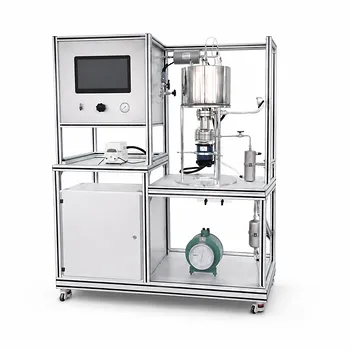
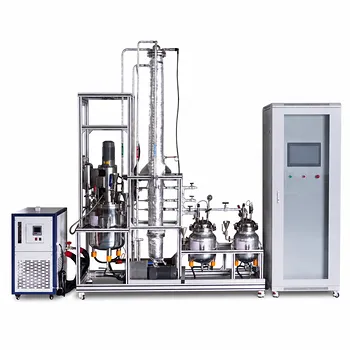
The definitive answer is that laboratory testing creates an incomplete, idealized picture. A pilot plant is the only tool that bridges the gap between a chemical equation and a commercial reactor by accurately replicating real-world impurities, recycling effects, and true-scale physical phenomena. It’s not an optional step; it’s the essential risk-management tool that validates whether a catalyst will succeed or fail when it matters most.
The core challenge in catalyst selection isn't screening for activity; it's predicting lifetime, selectivity, and stability in a complex, non-ideal industrial soup. Pilot plants transform this selection from an educated guess into an empirical, bankable decision.
The Chasm Between Theory and Mega-Ton Reality
The Limits of Mathematical Models
Commercial reactor design cannot rely solely on theoretical kinetics and fluid dynamics. These models are invaluable starting points, but they are simplifications of reality.
A pilot plant provides the experimental data necessary to verify and adjust these models. It forces theory to confront the unpredictable realities of scale, heat transfer, and mass transfer.
When Physics Behaves Differently
Chemical reactions and physical phenomena do not scale linearly. The heat transfer, mass transfer, and fluid dynamics that are manageable in a beaker can become rate-limiting or even dangerous in a large vessel.
A pilot plant serves as the critical intermediate scale. It allows you to study these interactions under conditions that mimic commercial operations, ensuring that the increased scale doesn’t devastate your yield, safety, or equipment.
The Invisible Hand of Flow Dynamics
A catalyst’s true performance is inseparable from the reactor’s hydrodynamics. In a lab, mixing is often near-perfect, but a full-scale reactor has dead zones, channeling, and bypassing.
Advanced pilot reactor designs must facilitate precise control over residence time distribution and mixing behavior. This lets you see how mass transfer resistance impacts selectivity before you commit to a multi-million-dollar design.
Why Your Lab Reactor is Telling You a Beautiful Lie
The Poison You Didn't Know You Had
Laboratory feedstocks are often pristine, pure chemicals. Real industrial feeds are a chronicle of impurities—sulfur, nitrogen compounds, and trace metals.
A pilot plant allows you to feed this real stream over controlled temperatures and high pressures. This is how you see the true effects of impurity accumulation and whether your chosen transition metal sulfide or noble metal catalyst can withstand the constant poison in its diet.
The Heat Hidden in the Flask
Small-scale reactors mask thermal management problems. The high surface-to-volume ratio of a lab flask makes highly exothermic reactions like selective oxidations look safe.
In a pilot plant, the challenge of precise temperature control becomes brutally apparent. You can observe the potential for hotspot formation and runaway reactions, which directly degrade catalyst selectivity and create hazardous byproducts, eliminating downstream separation costs on paper that will cripple you in reality.
The Truth About Recycling
A single pass through a lab reactor tells you nothing about long-term stability. Real processes continually recycle unconverted reactants and generate byproducts.
Only a pilot plant can simulate these recycling effects. It reveals how build-up of trace heavies or recycled intermediates affects catalyst activity and drives unexpected deactivation mechanisms over time.
Measuring What Truly Matters: Lifetime, Not Just Activity
The Economic Decoupling
Here is a fundamental truth many novices miss: the unit cost of a catalyst is often a minor fraction of overall operating expenses.
The metric that dictates profitability is selectivity and lifetime performance. Pilot plants provide the data on regeneration cycles and long-term deactivation rates, allowing you to trade off a slightly higher catalyst cost for dramatically better stability and atom economy.
Watching the Catalyst Die, in Slow Motion
Deactivation is a certainty; the only question is the pace. Corrosion databases and handbooks provide initial screening data, but they are blind to your specific chemistry.
Minor variations in temperature or trace impurities can alter corrosion rates and failure modes overnight. Running test campaigns in a dedicated pilot plant provides accurate empirical data on mechanical stress, catalyst strength, and attrition, preventing catastrophic material failures during commercial production.
The Hidden Architecture of the Support
Catalyst formulation goes far beyond the active metal. The impact of the carrier’s physical properties is often invisible in kinetic tests but dominates pilot-scale results.
For instance, testing can show why a low-surface-area, macroporous inert material like α-Al₂O₃ is non-negotiable. The pilot plant demonstrates how this structure minimizes unwanted mass transfer resistance and secondary reactions, preserving your desired product.
Understanding the Trade-offs and Common Validation Pitfalls
The Cost of "Fast Failure"
Running a pilot plant is capital-intensive and time-consuming. The trade-off is that skipping it to "save time" is the single most expensive mistake you can make.
The financial risk of moving directly from lab to commercial plant is astronomical. A pilot plant validates chemical economics—raw material utilization, by-product handling—and provides the design requirements for full-scale equipment without betting the company.
Confusing Correlation with Validation
A common error is to run a pilot plant at only the optimal "design point." You must map the boundaries of failure.
The true value lies in deliberately stress-testing the catalyst with fluctuations in space velocity and aggressive temperatures. This explores the safe operating window, revealing the trade-offs between maximum reactor throughput and the resulting hit to catalyst lifetime.
Making the Right Choice for Your Scale-Up Goal
After evaluating all the evidence, your pilot plant strategy should be tailored to your primary commercial risk.
- If your primary focus is validating catalyst lifetime and deactivation: Run extended-duration campaigns with real feedstocks, closely monitoring impurity accumulation and activity loss to map regeneration cycles.
- If your primary focus is confirming yield and selectivity at scale: Focus on heat and mass transfer effects by deliberately varying space velocity and temperature to identify the boundaries where secondary reactions become dominant.
- If your primary focus is preventing catastrophic material failure: Integrate corrosion coupons and monitor mechanical attrition under simulated process upsets and temperature fluctuations.
- If your primary focus is verifying process economics: Use the pilot plant to close material balances around by-product formation and raw material utilization, as these hidden costs will define profitability far more than the catalyst's purchase price.
The path from a promising powder in a lab to a profitable commercial reactor is always paved with empirical reality, not theory alone.
Summary Table:
| Parameter | Laboratory Testing | Pilot Plant Validation |
|---|---|---|
| Feedstock Purity | Pure, idealized chemicals | Real industrial feeds with impurities |
| Thermal Management | Masked heat effects | Real-world heat transfer & hotspots |
| Recycling Effects | Single-pass observations | Simulates long-term accumulation |
| Hydrodynamics | Idealized near-perfect mixing | Captures channeling and dead zones |
| Deactivation Rate | Short-term activity screening | Accurate lifetime & mechanical attrition |
Scaling up chemical processes demands reliable empirical data. LABPARK provides state-of-the-art Educational and Vocational Unit Operations Pilot Plants in chemical engineering, bioprocess & biotech, and environmental & water treatment.
We empower universities, research institutes, and enterprises to bridge the gap between laboratory theory and commercial reality—ensuring safe, optimized, and cost-effective catalyst validation.
Ready to eliminate scale-up risks? Contact us today to find the perfect pilot plant solution.
Related Products
- Methanol Synthesis and Catalyst Performance Evaluation Educational Unit Operations Pilot Plant
- Educational Unit Operations Pilot Plant for Intraparticle Diffusion Effective Factor Measurement
- Micro-Scale Gas-Solid Catalytic Reaction Educational Pilot Plant
- Internal Circulation Gradient Free Catalytic Reaction Educational Pilot Plant
- Fixed Bed Gas Solid Catalytic Reaction Educational Pilot Plant
People Also Ask
- Why is a purge system necessary when operating a gas recirculation loop in a methanol synthesis pilot plant? (Guide)
- How do temp & pressure affect methanol synthesis pilot plants? Optimize equilibrium and catalyst performance.
- Why do modern methanol pilot plants operate at lower pressures? Catalyst & Feed Requirements Explained
- What are the operational requirements for catalyst activation? Safe Methanol Pilot Plant Operation
- Why Compare Predicted and Experimental Excess Enthalpy? Key to Accurate Pilot Plant Scale-up