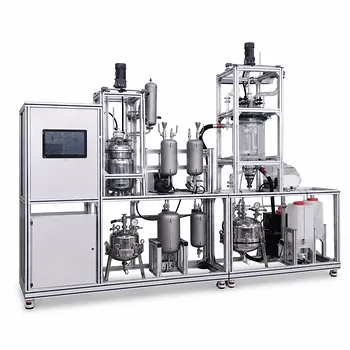
Understanding speciation and pH-dependence is not just a theoretical subtlety—it is the primary lever you pull to achieve selective metal recovery, prevent hazardous unintended reactions, and generate scalable, trustworthy data from your pilot plant. In aqueous wastewater and hydrometallurgy systems, metal ions do not simply float freely; they exist as an equilibrium mixture of hydrolyzed complexes (e.g., Ni²⁺, NiOH⁺, Ni(OH)₃⁻) whose proportions shift dramatically with temperature and hydrogen ion activity. If your pilot plant's pH control and thermodynamic model fail to account for this speciation, your solubility predictions, dosing regimes, and ultimately your separation efficiency will be dangerously wrong.
The core need is not just to answer “what is speciation,” but to recognise that pilot-plant operation becomes a high-stakes guessing game without it. Speciation defines which solid phase precipitates, where toxic volatiles can form, and how to calibrate sensors—transforming the pilot plant from a simple mimic of industrial hardware into a reliable instrument for process validation and scale‑up.
The Chemical Foundation of Metal Speciation in Water
Before any pump is turned on or pH probe calibrated, you must anchor the pilot design in the watery reality of cation hydrolysis. Precisely because wastewater and leach solutions are never pure water, the very identity of the target metal species is fluid.
Hydrolysis Creates an Entire Family of Species, Not Just One
When a metal salt dissolves, the cation immediately begins to react with water molecules, stripping protons and forming a suite of hydroxo complexes. The primary reference highlights that for a metal like nickel, you are simultaneously dealing with Ni²⁺, NiOH⁺, and even anionic species such as Ni(OH)₃⁻. Each of these species possesses a distinct solubility product, adsorption tendency, and reactivity with precipitants.
That Speciation Is a Sensitive Function of pH and Temperature
The equilibrium constants governing hydrolysis are highly temperature-dependent. A speciation distribution that is dominated by a readily filterable hydroxide at 25 °C can shift to a stubbornly soluble charged complex at 30 °C. Consequently, a thermal upset in your pilot reactor is not just an energy balance problem—it is a direct chemistry perturbation that can collapse your separation efficiency.
pH Is the Job of Selectivity When Complexing Agents Are Present
The supplementary references clarify that many industrial ligands—EDTA being the archetype—are weak acids whose donor atoms protonate at low pH. This means pH competes directly with the metal ion for the ligand. A shift from pH 5 to pH 3 will protonate the EDTA carboxylate groups, decomposing the Zn–EDTA complex while leaving less‑stable Ca–EDTA already fully dismantled. In a pilot plant designed for selective metal recovery, the pH setpoint is not a monitoring metric; it is the switch that turns selectivity on or off.
How pH-Dependence Directly Drives Pilot Plant Operation
A pilot plant is not a black box that magically scales a bench beaker to a production tank. Its value lies in its ability to expose the interplay between chemical equilibrium and physical unit operations—and pH is the thread that ties them together.
Setting the Precipitation Window to Avoid Co‑Precipitation and Toxic Volatiles
Predominance diagrams (potential‑pH or Eh‑pH diagrams) map out the thermodynamic stability fields of solid metal hydroxides, sulfides, and dissolved ions. By overlaying your target pH operating band onto such a diagram, you can immediately identify the safe region where the desired solid phase precipitates while undesirable ones remain dissolved or ungassed. For instance, controlling redox potential alongside pH prevents the release of volatile iron‑sulfur compounds in a sulfidic precipitation process—a critical safety and emissions‑control consideration in any pilot plant handling toxic heavy metals.
Compensating for Temperature-Induced Shifts in the Neutral Point
The supplementary references remind us that water’s auto‑ionization is endothermic: K_w rises from 1.15 × 10⁻¹⁵ at 0 °C to 5.45 × 10⁻¹³ at 100 °C, shifting the pH of neutrality from 7.47 down to 6.13. A pH sensor calibrated at room temperature will misread the true hydrogen ion activity at an elevated reactor temperature. If your pilot plant’s dosing algorithm treats pH 7.0 as “neutral” at 80 °C, you are actually operating in a significantly alkaline regime. Using temperature‑compensated pH probes informed by speciation‑aware calibration curves is a non‑negotiable operational discipline.
Bridging Theory and Real‑Time Process Control with Graphical Tools
Solving the multi‑component equilibrium for a spent caustic solution containing hydroxide, hydrosulfide, and sulfide ions analytically can overwhelm even experienced engineers. Supplementary content demonstrates that nomographs and alkalinity relationship diagrams let operators convert a simple titration result (total alkalinity) directly into the active molarity of HS⁻. In a pilot plant, placing a straightedge across these graphs delivers instantaneous process intelligence—allowing the operator to adjust pH or sulfide dosing without the computational lag that would otherwise destabilise the run.
Understanding the Trade‑offs and Common Pitfalls
Speciation‑guided piloting delivers enormous control, but it also introduces traps that can silently corrupt your data and decisions.
Thermodynamic Predictions vs. Kinetic Reality
A predominance diagram tells you what is thermodynamically stable, not what forms fast enough to matter. In a continuous pilot reactor with a residence time of minutes, metastable species or slow precipitation‑ripening kinetics can dominate. Relying solely on equilibrium speciation without pilot‑scale residence‑time experiments gives a false sense of separation performance.
Sensor Drift and Calibration Errors Amplify Chemistry Mistakes
If your pH probe’s temperature compensation fails or its reference junction fouls in a high‑ionic‑strength brine, the displayed pH may be off by 0.3–0.5 units. On the steep slope of a metal hydroxide precipitation curve, that error can halve or double the residual soluble metal concentration. The pilot plant must be instrumented with redundant, frequently verified sensors and, ideally, periodic grab‑sample ICP validation.
Over‑Simplification of the Ligand Landscape
Real wastewater contains a cocktail of competing cations (hard and soft acids) and dissolved organic carbon. An EDTA‑based separation designed for a pure binary system may fail dramatically when humic substances or competing iron ions consume the chelator. The pilot plant’s mission is to expose these matrix effects, so operating it with a rigid, over‑simplified thermodynamic model defeats its purpose.
Making the Right Choice for Your Pilot Campaign
Effective pilot‑plant strategy hinges on matching your depth of speciation analysis to your development goal.
- If your primary focus is validating a precipitation flowsheet for a known matrix: Start by constructing a temperature‑specific predominance diagram for your key metals, then run a series of pH‑staged jar tests directly in the pilot to verify the precipitation edge. Use temperature‑compensated pH sensors and confirm residual solubilities with analytical backup.
- If your primary focus is demonstrating selective metal recovery with a chelating agent: Map the conditional stability constants (log K’ vs. pH) for every major competing cation. Then run pilot trials at the pH where the target‑metal‑complex formation is optimal while competitor binding is minimal, and sample at multiple points to confirm selectivity holds under dynamic flow.
- If your primary focus is training students or operators on industrial water treatment: Integrate nomographs and alkalinity diagrams into the pilot‑plant control interface. Teach operators to spot the tell‑tale signs of pH‑probe drift by cross‑referencing titration‑based speciation checks, making chemistry the central diagnostic tool rather than a black‑box instrument reading.
- If your primary focus is ensuring emissions safety and avoiding toxic volatile species: Use potential‑pH diagrams to define a strict operational envelope that excludes the formation fields of H₂S, volatile metal carbonyls, or other hazardous gases. Install continuous gas‑phase monitors at the reactor headspace and interlock the pH dosing to shut down if the envelope is breached.
When speciation and pH-dependence are treated as the central nervous system of your pilot plant—not afterthoughts—the data you gather become truly representative, the separations become predictable, and the path from pilot to full‑scale plant becomes a confident, quantitative step rather than a risky leap of faith.
Summary Table:
| Operational Challenge | Impact on Pilot Plant Performance | Speciation-Aware Solution |
|---|---|---|
| Cation Hydrolysis | Shifts in temperature alter metal solubility and species identity. | Deploy temperature-compensated pH sensors calibrated to specific thermo-models. |
| Ligand Protonation | pH changes disrupt selective metal complexation (e.g., with EDTA). | Set precise pH windows based on conditional stability constants mapping. |
| Reaction Kinetics | Thermodynamic equilibrium models fail to account for slow precipitation rates. | Conduct pilot residence-time trials to verify dynamic separation efficiency. |
| Toxic Gas Emission | Incorrect pH/redox control can release hazardous volatiles (e.g., $H_2S$). | Implement headspace gas monitors interlocked with automatic pH dosing systems. |
Scale Up Safely and Predictably with LABPARK Pilot Plants
Transitioning wastewater treatment and hydrometallurgy processes from the lab to industrial scale requires precise chemical control. LABPARK designs and manufactures premium Educational and Vocational Unit Operations Pilot Plants in chemical engineering, bioprocess & biotech, and environmental & water treatment.
Specially tailored for universities, research institutes, and enterprises, our pilot plants deliver the robust process control, sensor reliability, and safety safeguards needed to study complex speciation and pH-dependent reactions under realistic conditions.
Don't let chemical variables compromise your data. Contact LABPARK today to discuss your research, training, or development needs and find the ideal pilot plant solution for your facility!
Related Products
- Solid Waste Pyrolysis and Refining Educational Pilot Plant for Unit Operations
- Gallium and Indium Selective Extraction Educational Pilot Plant
- Thermal Desorption Exhaust Gas and Tail Water Treatment Educational Pilot Plant
- Electrochemical Water Treatment Educational Unit Operations Pilot Plant
- Dual-Mode Rectification Pilot Plant for Practical Training Unit Operations
People Also Ask
- How do educational unit operations pilot plants bridge theory and design? Bridge the Engineering Gap
- How do unit operation requirements differ between traditional chemical processes and bioprocesses? Build Better Pilot Plant Curricula
- How do educational unit operations pilot plants address safety and waste management when scaling up?
- How do educational unit operations pilot plants bridge theory and industrial process development? Hands-On Learning
- How do steady-state and dynamic simulations complement pilot plants? Validate scale-up and controllability