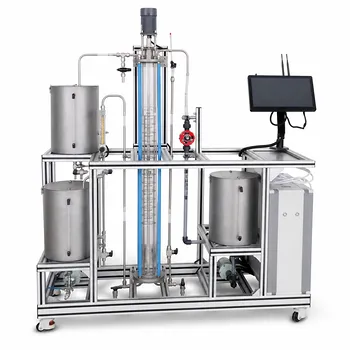
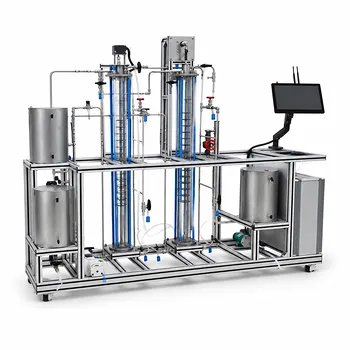
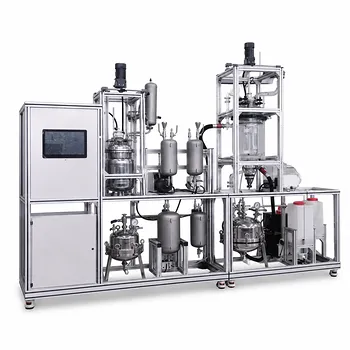
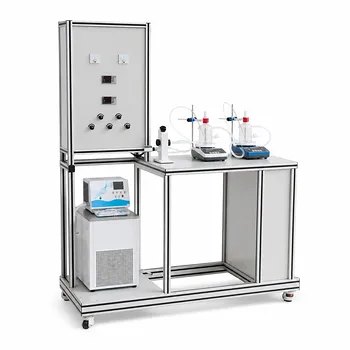
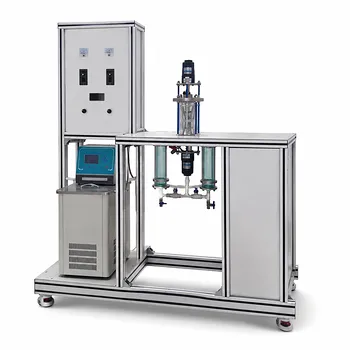
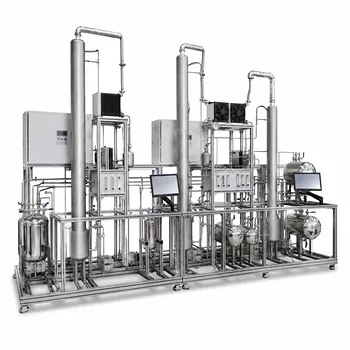
The answer lies in direct visual access. Glass-walled columns and sight glasses are not a luxury in liquid-liquid extraction pilot plants—they are an operational necessity. They provide the only window into the complex, dynamic behavior of immiscible liquid phases as they contact, mix, and separate. This visibility is the bedrock for accurately estimating phase separation times, detecting the liquid-liquid interface during critical operations like drainage, and capturing the robust data required to confidently scale a process from the laboratory to a production column.
In a unit operation where the internal physics dictate success or failure—and where industrial-scale columns are completely opaque—glass components transform the pilot plant from a blind experiment into an observable, controllable system. The ability to see phase continuity, dispersed droplet size, emulsion severity, and interfacial "rag" layers is not just helpful; it is the primary method for generating the fundamental engineering data that prevents catastrophic scale-up failures.
The Fundamental Role of Visual Observation in LLE Pilot Plants
The laboratory pilot plant is the bridge between theoretical chemistry and industrial reality. In liquid-liquid extraction (LLE), that bridge cannot be crossed without watching what happens inside the column. Glass-walled columns and strategically placed sight glasses turn the invisible into the visible, allowing engineers and researchers to witness every nuance of phase contacting and separation.
Unmasking the Hidden World Inside the Column
Industrial extraction columns are made of metal—totally opaque. You can measure temperatures and pressures, but you cannot see whether the dispersed phase is coalescing properly or if an emulsion is building. At the pilot scale, glass walls eliminate this blindness. You directly observe the formation of stable emulsions, the accumulation of interfacial solids known as rag layers, and the precise dynamics of the phase boundary. These phenomena are the earliest warning signs of trouble that can render a full-scale column inoperable.
From Visual Cues to Quantitative Data
What you can see, you can measure. Glass systems allow you to time phase separation precisely under varying flow rates and agitation intensities. You can watch the interface recede during a drainage or shutdown procedure and know exactly when to isolate streams. Without this visual feedback, experiments would rely on indirect inferences—leading to data that is at best incomplete and at worst misleading. Observing the actual droplet size distribution and the onset of local flooding provides the direct empirical evidence needed to calculate the Height of a Transfer Unit (HTU) and Height Equivalent to a Theoretical Stage (HETS) accurately.
The Critical Connection to Scale-Up
Scaling an LLE process without visual pilot data is a gamble. The plait point—the condition where extract and raffinate compositions become identical and phases merge into one—is a theoretical boundary, but its approach is often signaled by subtle changes in the appearance of the dispersion. A glass column lets you see the phases begin to blur before total failure occurs, enabling you to establish a safe operating margin (e.g., limiting solute loading well below the plait point). This visual validation of the operating window is the single most important insurance policy against a failed scale-up.
Essential Phenomena That Only Glass Can Reveal
Several specific physical behaviors, critical to LLE success, are utterly dependent on visual observation for detection and quantification.
Emulsion Stability and Phase Separation Time
When two liquid phases contact, unwanted emulsions can form—dispersions that refuse to separate. In a glass column, you can see the thickness and persistency of this emulsion band. You can determine whether it grows with time, stabilizes, or breaks readily. This direct observation allows you to calculate realistic phase-separation residence times, which directly influence the diameter of an industrial settler.
The Rag Layer and Interfacial Solids
Impurities, suspended solids, and trace surfactants often accumulate at the liquid-liquid interface, forming a rag layer—a viscous, semi-stable mixture that inhibits mass transfer and can ultimately choke the column. Through a sight glass or glass wall, this layer is immediately apparent. You can monitor its growth rate under different pre-treatment strategies and make critical decisions about filtration or solvent washing before the layer becomes unmanageable at scale.
Detection of Incipient Flooding and Operational Limits
All extraction columns have a maximum throughput, beyond which one phase is entrained in the other and mass transfer efficiency collapses. With a glass column, you can observe the early symptoms of flooding: a sharp increase in droplet density, the reversal of the dispersed phase, or a sudden rise of the interface. This allows you to map the true hydraulic envelope of the column internals—packed beds, sieve trays, or rotating disks—rather than relying on empirical correlations that may not apply to your specific chemical system.
Balancing Visibility with Safety: The Trade-offs of Glass Systems
While the engineering value of a glass column is undeniable, it comes with physical and operational constraints that must be managed with rigor. Glass is inherently fragile and, if not handled properly, presents a safety hazard.
The Reality of Fragility and Pressure Limits
A glass column is not a pressure vessel. It is unsuitable for high-pressure operations and requires robust support structures. Its fragility means that any mechanical shock, bolt over-tightening, or unexpected thermal gradient can cause catastrophic failure. Consequently, these systems are confined to the controlled environment of a pilot plant, not a production floor. The very feature that makes them indispensable—transparency—bars them from industrial-scale use, where strength and safety take precedence.
Mitigating Hazards with Engineering Controls
The hazards of glass breakage and chemical release are well understood and can be mitigated. PTFE (polytetrafluoroethylene) gaskets must be used exclusively to ensure chemical-resistant, reliable sealing without exerting excessive stress on the glass flanges. All external glass surfaces should be wrapped with protective plastic tape, a simple measure that contains shards and liquid spray in the event of an impact. Additionally, the system must be designed with adequate atmospheric venting to prevent any pressure buildup, however slight, from turning a small leak into a violent rupture.
When Sight Glasses Offer a Pragmatic Middle Ground
For some pilot units, a fully glass-walled column is impractical due to diameter or structural constraints. In these cases, strategically placed sight glasses—small, robust glass windows on an otherwise metal column—provide a targeted window to the most critical zones: the dispersion band near the feed point and the main interface level. They offer a compromise, allowing visual access to the essential phenomena while reducing the overall risk and fragility of the system.
Making the Right Choice for Your Investigation
The decision to use a glass-walled column or sight glasses should be driven entirely by the goal of your pilot-plant study. Align your equipment selection with the specific data you need to de-risk your full-scale design.
- If your primary focus is generating fundamental scale-up data: A fully glass-walled packed or rotating-disk column is irreplaceable. It allows you to directly measure HTU/HETS values, define flooding limits, and visually characterize rag-layer formation under a wide range of conditions.
- If your primary focus is troubleshooting a specific phase-separation problem: Install multiple sight glasses at the feed point, the main interface, and the coalescing zone. This targeted visibility will let you isolate the root cause of an emulsion or rag layer without the fragility of a full glass column.
- If your primary focus is building a safe, hands-on teaching platform: A glass-walled column wrapped in protective tape, with PTFE gaskets and open venting, provides the most intuitive and unforgettable lesson in two-phase hydrodynamics, turning theoretical concepts like the plait point and mass transfer zones into observable realities.
The transparency of glass is not merely about seeing; it is about understanding. In the opaque world of industrial extraction, the glass pilot column is the light that ensures your process design reaches the finish line safely and successfully.
Summary Table:
| Phenomenon Observed | Visual Benefit | Impact on Scale-Up |
|---|---|---|
| Emulsion & Separation | Monitors phase separation times & emulsion bands | Optimizes settler diameter sizing |
| Rag Layer & Solids | Detects viscous accumulation at the interface | Guides solvent washing & filtration |
| Incipient Flooding | Identifies droplet density surge & phase reversal | Maps maximum column throughput limits |
Optimize Your Research with LABPARK Pilot Plants
Bridge the gap between laboratory chemical research and industrial production. LABPARK provides premium Educational and Vocational Unit Operations Pilot Plants in chemical engineering, bioprocess & biotech, and environmental & water treatment designed for universities, research institutes, and enterprises. Our systems feature engineered glass columns and sight glasses to give you the precise visual insights needed to de-risk your processes.
Contact our experts today to customize the perfect pilot plant system for your laboratory!
Related Products
- Educational Rotary Disc Liquid-Liquid Extraction Pilot Plant
- Comprehensive Liquid-Liquid Extraction Pilot Plant for Engineering Education
- Gallium and Indium Selective Extraction Educational Pilot Plant
- Ternary Liquid-Liquid Equilibrium Educational Pilot Plant
- Liquid-Liquid Mass Transfer Coefficient Determination Educational Pilot Plant
People Also Ask
- How do density and IFT affect liquid-liquid extraction pilot plants? Optimize Column Performance
- In a liquid-liquid extraction pilot plant, how is a ternary-phase diagram utilized to determine solvent feed requirements?
- How are ternary phase diagrams and LLE data applied in extraction experiments? Optimize Pilot Plant Scale-up
- How Do Selectivity & Distribution Coefficients Influence LLE Pilot Plant Solvent Choice?
- How to Validate BIPs for LLE Pilot Plants? Steps to Align Simulations with Reality