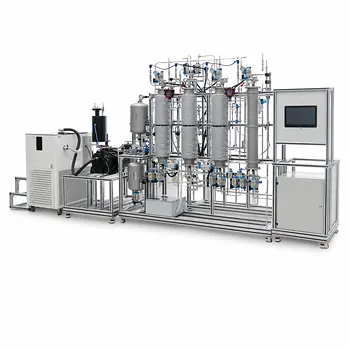
The move to in-line PAT directly addresses the two greatest threats in pilot plant operations: uncontrolled hazards and data-driven guesswork.
Transitioning from offline sampling to in-line process analytical technology (PAT) is critical because it fundamentally removes the operator from direct contact with hazardous or volatile materials, while delivering continuous, representative data that enables instant process corrections. Instead of relying on intermittent grab samples that can degrade, misrepresent reaction conditions, and create waste, in-line analyzers feed real-time information directly into the control system, protecting both people and the integrity of the entire experiment.
Offline sampling creates a dangerous lag between process changes and operator awareness, risking safety and data integrity. In-line PAT closes this loop instantly, providing the real-time, representative data needed for rigorous process control and true operator protection.
The Safety Imperative: Removing the Operator from the Hazard Zone
The Danger of Direct Contact Sampling
Manual sampling of toxic, volatile, or otherwise hazardous process streams forces operators to don specialized protective equipment and enter the immediate risk area. Every sampling event becomes a potential exposure incident, especially during rapid or runaway reactions where conditions change faster than human response. The primary reference makes it clear that offline sampling of these materials is inherently unsafe in a pilot-plant setting.
Waste and Environmental Burden
Every sample withdrawn from the process becomes a chemical waste stream that must be properly collected, stored, and disposed of. This creates continuous hazardous-waste liabilities and environmental compliance overhead. The transition to in-line analysis eliminates this secondary waste source at the point of measurement.
How In-line PAT Eliminates Operator Exposure
In-line analyzers place sensors or probes directly in the process flow, so no material is removed and no operator interaction is required. Measurements are automated and can be triggered continuously. Systems with fiber-optic interfaces even allow the sensitive analyzer to reside in a safe, climate-controlled room while only the probe contacts the hazardous environment, as noted in the supplementary references regarding purged enclosures and intrinsically safe designs.
The Data Fidelity Gap: Why Offline Sampling Fails Process Control
The Representativeness Trap
Heterogeneous process streams—such as slurries, two-phase flows, or mid-reaction mixtures—are nearly impossible to sample representatively with a grab method. The supplementary references stress that physical, chemical, and optical properties must all be accounted for. An offline sample may settle, react further in transit, or simply not capture the true composition at the sampling point, leading to non-representative analysis and flawed conclusions.
In-line Analysis Captures the True Dynamic State
In-line analyzers measure the process as it is, in its actual hydrodynamic and chemical state. There is no time lag from transport, no opportunity for phase separation, and no operator-induced error. This means the data mirrors the process reality—essential for detecting transient intermediates, impurities, or critical quality attributes that offline methods routinely miss.
Real-Time Control: From Reaction to Prevention
Rapid Feedback for Immediate Correction
The most dangerous moments in a pilot plant occur during rapid reaction changes, like unexpected exotherms. In-line PAT provides measurements in seconds, allowing the control system to trigger corrective actions—cooling, quenching, reagent cut-off—automatically. This shifts the paradigm from post‑event troubleshooting to pre‑emptive, safe operation.
Integrating with Automation for Safe, Efficient Operations
Real-time data from in-line spectroscopy or process mass spectrometry feeds directly into distributed control systems. This closed-loop capability enables precise deviation monitoring, adaptive process optimization, and reliable scale‑up data. It is the exact same approach used in modern industrial plants, making pilot‑scale work directly translatable to production.
Understanding the Trade-offs and Pitfalls
The Hidden Cost of Poor Sampling System Design
While in-line PAT eliminates manual sampling hazards, it does not automatically guarantee reliability. The supplementary references warn that upwards of 80% of all maintenance problems in analyzer implementations originate in the sampling system. A poorly designed sample loop, dead leg, or fouling‑prone interface can create high maintenance overhead and unreliable data—often worse than a simple offline method.
Environmental Vulnerabilities and Instrument Drift
In‑line analyzers must be protected from humidity, temperature swings, and corrosive vapors. Without adequate purging, pressurized enclosures, or hydrophobic coatings on moisture‑sensitive optics like KBr, instrument drift and failure are common. Online methods also demand regular verification, as lamp intensity fluctuations or fiber degradation can introduce subtle biases.
Sample State and Complexity
Not every process stream is amenable to a simple in‑line probe. NMR, for example, requires the sample to be entirely liquid and delivered at tightly controlled flow rates and temperatures (260–340 L/h, with less than 3°C variation), as described in the supplementary references. Waxy or highly viscous streams demand heating to about 80°C just to remain measurable. Ignoring these physical requirements will lead to poor signal quality and inaccurate predictions.
Making the Right Choice for Your Pilot Plant
The transition to in‑line PAT must be tailored to your plant’s real constraints, but the safety and control advantages are decisive when hazardous or dynamic processes are involved.
- If your primary focus is operator and environmental safety: Prioritize in‑line PAT that removes all manual handling. Use fiber‑optic separation and intrinsically safe electronics to keep personnel entirely out of the hazard zone.
- If your primary focus is high‑fidelity research data and scale‑up: In‑line monitoring is non‑negotiable. Only continuous, representative data can expose reaction kinetics, intermediates, and critical quality attributes that offline snapshots miss.
- If your primary focus is educational value and workforce training: Deploy robust dual‑beam spectroscopic systems (e.g., UV‑Vis with reference fiber loops) that let students practice real‑time deviation monitoring and direct control—exactly what industry demands.
- If your primary focus is cost control and low maintenance: Engineer the simplest possible in‑line interface. Keep sensitive electronics in safe rooms via fiber optics, use rugged optical materials like Zinc Selenide, and avoid complex sampling loops that become maintenance black holes.
By strategically adopting in‑line PAT, you transform your pilot plant from a hazard‑prone, data‑starved environment into a safe, predictive, and highly efficient research asset.
Summary Table:
| Feature | Offline Sampling | In-line PAT |
|---|---|---|
| Operator Safety | High exposure risk during manual sampling | Zero exposure; sensors measure directly in-situ |
| Data Fidelity | Time-lagged and prone to non-representative errors | Real-time, continuous, and highly representative |
| Waste Generation | Generates secondary hazardous chemical waste | Zero waste; sample remains in the process loop |
| Control Action | Reactive; response lag risks runaway reactions | Proactive; automated closed-loop corrections |
Elevate Your Pilot Plant Safety and Control with LABPARK
Transitioning to in-line process analytical technology is essential for modern chemical engineering and bioprocess workflows. LABPARK provides premium Educational and Vocational Unit Operations Pilot Plants in chemical engineering, bioprocess & biotech, and environmental & water treatment for universities, research institutes, and enterprises.
Our systems are engineered to seamlessly integrate advanced process control, ensuring operator safety, research precision, and reliable scale-up data.
Ready to upgrade your research and training capabilities? Contact us today to find the perfect pilot plant solution for your facility.
Related Products
- Continuous Batch Extractive Distillation Educational Pilot Plant
- Polymerization Granulation and Pellet Processing Educational Unit Operations Pilot Plant
- Centrifugal Pump Performance and Orifice Flowmeter Calibration Educational Pilot Plant
- Multi Functional Catalytic Reaction and Reactor Evaluation Educational Unit Operations Pilot Plant
- Educational Unit Operations Pilot Plant for Intraparticle Diffusion Effective Factor Measurement
People Also Ask
- How is an extractive distillation pilot plant configured? Setup & Entrainer Roles
- Wilson vs. UNIQUAC: How to Choose the Right Thermodynamic Model for Your Pilot Plant
- How to Configure a Distillation Pilot Plant? Key Steps for Multi-Mode Setup
- How does the feed thermal state influence distillation pilot plant design and utility consumption?
- Why use non-ideal VLE calculations in distillation pilot plants? Ensure accurate scale-up & purity