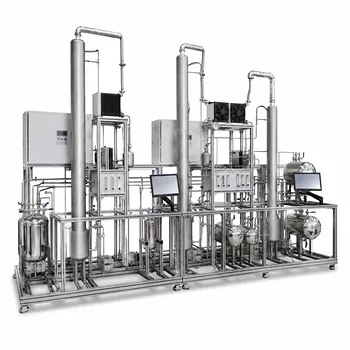
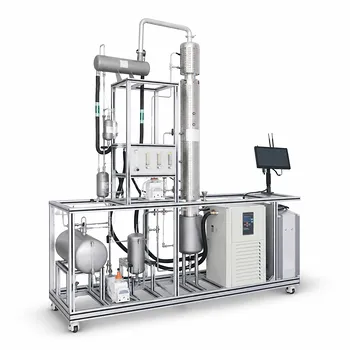
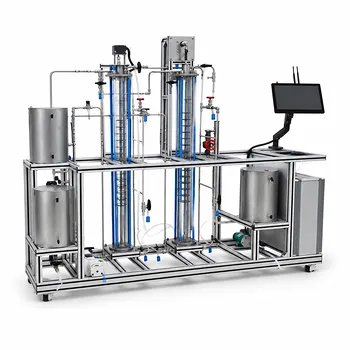
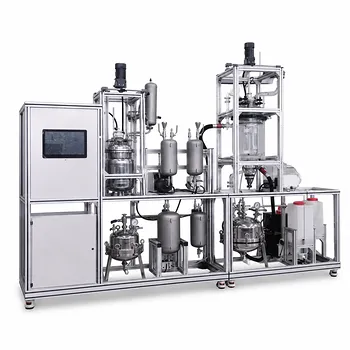
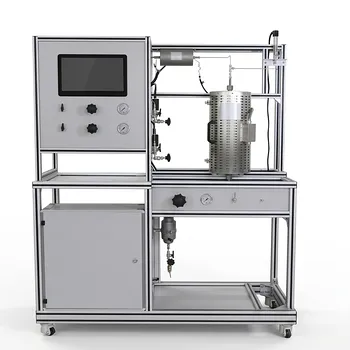
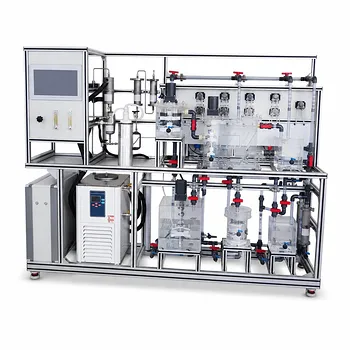
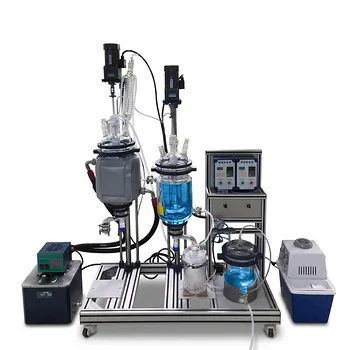
The stark efficiency penalty in an extractive distillation pilot plant is not a sign of malfunction—it’s an inherent hydraulic consequence of the process. A conventional distillation column relies on balanced internal flows of vapor and liquid to create intimate contact for mass transfer. In extractive distillation, the flow rate of the solvent entering the column is typically much larger than that of the feed mixture itself. This floods the column with a liquid-heavy flow, causing the liquid phase flow rate inside the column to far exceed the vapor phase flow rate. The resulting poor vapor-liquid contact means the overall tray or packing efficiency is significantly lower—typically only about 50% of a conventional distillation column.
The core insight is that the very component enabling the separation—the high-volume solvent—is also the primary factor that degrades contact efficiency. The operational challenge is therefore not to eliminate this penalty, but to meticulously control the variables that can make it catastrophically worse, such as reflux ratio and solvent temperature.
The Fundamental Hydraulic Bottleneck
The low efficiency you observe is rooted in the hydraulic fundamentals of the column. It's not a failure of design, but a predictable physical outcome of introducing a large external liquid stream.
A Flood of Liquid, a Trickle of Vapor
In any distillation column, efficient separation depends on a well-mixed, turbulent interface between rising vapor and falling liquid on each tray or within a section of packing. This interface area and contact time are maximized when the internal vapor and liquid flow rates, or mass velocities, are within a specific balanced range. An extractive distillation column fundamentally disrupts this balance. The entering solvent, which is itself a liquid, massively inflates the total internal liquid load. The vapor flow generated in the reboiler simply cannot keep pace, creating an extremely high liquid-to-vapor (L/V) ratio.
The 50% Efficiency Rule of Thumb
This imbalance physically hinders the mass transfer of components from the liquid phase into the vapor phase. When liquid cascades down too quickly relative to the vapor moving up, the vapor can channel through the liquid, reducing bubble formation and interfacial surface area. This is why you see a direct, measurable drop in overall efficiency. The performance metric of a theoretical plate is simply not achievable under these conditions, with extractive column internal efficiency often benchmarked at only half that of a conventional column.
Critical Operational Precautions
Because the process baseline efficiency is already compromised, the margin for operational error is razor-thin. Two variables demand unwavering attention.
The Pitfall of Raising the Reflux Ratio
Your instinct from conventional distillation is to improve purity by increasing the reflux ratio. In extractive distillation, this instinct can backfire dramatically. At a constant solvent flow rate, increasing the reflux returns more condensed distillate to the top of the column. This action dilutes the solvent concentration on every tray below. The entire purpose of the solvent is to alter the relative volatility of the mixture, and when it is diluted by excess reflux, this effect diminishes. Separation can actually get worse, not better. The operational precaution is clear: never blindly chase a higher reflux ratio to fix a purity problem. You must instead carefully balance the reflux ratio against the solvent-to-feed ratio to find an optimal, non-intuitive set point.
Stabilizing Solvent Temperature
The massive solvent volume is also a massive source of thermal inertia and potential instability. A seemingly minor fluctuation in the solvent’s feed temperature introduces a significant cold or hot liquid stream into the column. Because the solvent flow represents the dominant liquid load, a small temperature delta rapidly translates into a huge disturbance in the column’s internal liquid flow rate. A slug of cold solvent will condense a large amount of rising vapor, momentarily collapsing the vapor flow and severely degrading mixing. The only operational safeguard is strict, precise control and stabilization of the solvent feed temperature to prevent these self-inflicted hydraulic shocks.
Understanding the Trade-offs
No engineering choice is free, and extractive distillation embodies a fundamental compromise between thermodynamic capability and hydraulic performance.
The process is designed to solve an impossible separation, like breaking an azeotrope, by introducing a foreign agent. This solves one problem—the relative volatility between the key components is now usable—but instantly creates another: the column’s internal hydraulics are severely compromised. You accept this lower plate-by-plate efficiency in exchange for the overall ability to achieve the separation at all. This is why process design cannot optimize individual units in isolation. The solvent choice, its flow rate, its temperature, and the column’s reflux ratio are a deeply interdependent system. Optimizing one unit operation’s reflux ratio without considering its effect on solvent concentration sacrifices the entire process’s performance.
Making the Right Choice for Your Goal
Your operational decisions must be tailored to the specific objective of your pilot plant run, always with an awareness of the process’s inherent constraints.
- If your primary focus is maximizing product purity: Do not reflexively increase the reflux ratio. Systematically find the optimal balance between reflux and the solvent-to-feed ratio to avoid diluting the solvent and nullifying its effect.
- If your primary focus is operational stability and repeatability: Invest the majority of your control strategy on the solvent feed. A precisely maintained solvent temperature is the single most effective guard against massive internal flow disturbances that destroy separation performance.
- If your primary focus is scaling up from pilot plant data: Never linearly scale the tray or packing efficiency. You must calibrate your design models using a de-rated efficiency factor, typically around 50% of the expected conventional value, to account for the hydraulically limited contact.
Mastering an extractive distillation pilot plant means unlearning a conventional distillation rulebook and strictly controlling the unique variables that govern this hydraulically complex but thermodynamically essential process.
Summary Table:
| Feature | Conventional Distillation | Extractive Distillation |
|---|---|---|
| Liquid-to-Vapor Ratio | Balanced | High (flooded with solvent) |
| Tray/Packing Efficiency | High (Baseline) | Lower (~50% of conventional) |
| Reflux Ratio Effect | Increases purity | High ratio dilutes solvent |
| Critical Control Focus | Reflux ratio & boil-up | Solvent temperature & feed ratio |
Scale Your Lab Capabilities with LABPARK
Mastering complex chemical separations requires reliable, high-precision equipment. LABPARK designs and manufactures advanced Educational and Vocational Unit Operations Pilot Plants for chemical engineering, bioprocess & biotech, and environmental & water treatment.
Whether you represent a university, research institute, or enterprise, we provide the robust systems and technical support you need to ensure accurate training and research outcomes.
Contact LABPARK today to optimize your pilot plant setup!
Related Products
- Green Anhydrous Ethanol Purification Extractive Distillation Unit Operations Training Pilot Plant
- Continuous Batch Extractive Distillation Educational Pilot Plant
- Multi-Functional Special Distillation Educational Pilot Plant
- Green Anhydrous Ethanol Refining Practical Training Pilot Plant
- Continuous Sieve-Plate Distillation Pilot Plant for Unit Operations Laboratory Education
People Also Ask
- How can energy balance equations for condensers & reboilers be validated experimentally? Guide
- Fugacity vs Activity Coefficient: How to Choose VLE Models for Distillation Pilot Plants
- How can real-time carbon number prediction improve distillation pilot plants? Optimize control.
- How Reflux Ratio Affects Distillation Pilot Plant Separation Efficiency & Limits
- Why run shortcut fractionation before rigorous distillation calculations? Optimize your pilot plant.