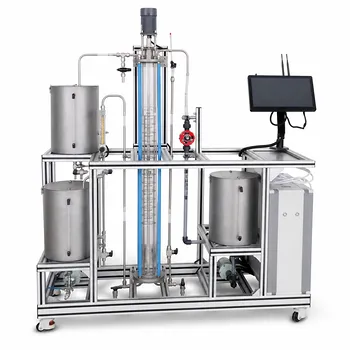
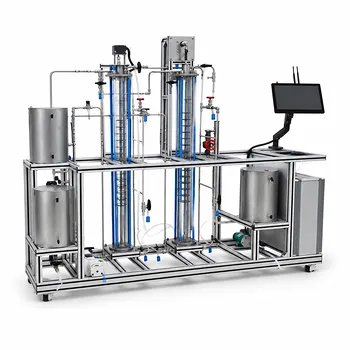
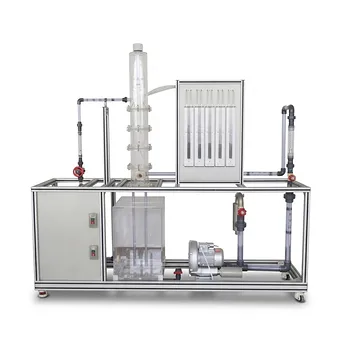
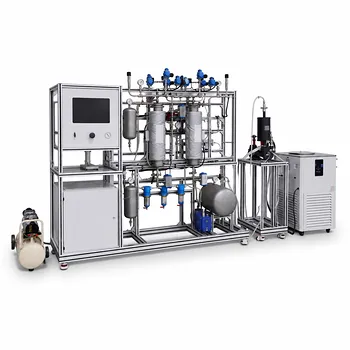
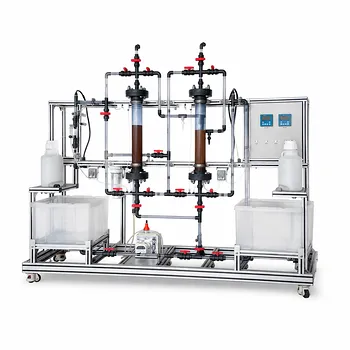
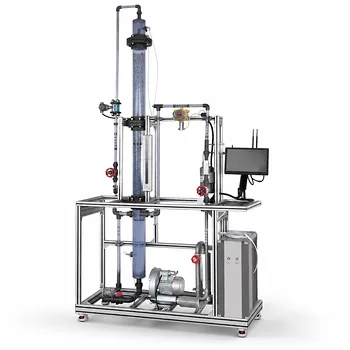
A sensitive plate is not just a convenient measurement point; it is the lynchpin of reliable temperature-based purity control. In a distillation column pilot plant, selecting the correct sensitive plate is critical because online composition analyzers are often too slow or complex for real-time control. Instead, temperature serves as a rapid, indirect indicator of mixture composition. The sensitive plate is the specific tray that exhibits the maximum temperature change in response to a disturbance, making it the earliest and clearest warning signal for maintaining product quality.
The primary purpose of a temperature control loop in a distillation pilot plant is to counteract disturbances before they affect product purity. Because the purest ends of the column show negligible temperature variation during composition shifts, placing a sensor on a sensitive plate—where the thermal signal is loudest—is the only reliable way to achieve fast, stable, and accurate indirect quality control.
The Fundamental Problem: The Tyranny of Purity
To understand the selection of the sensitive plate, you must first recognize a core physical limitation. The very top and bottom of a high-purity column are the worst places to look for trouble.
Why End-Point Temperatures Are Misleading
For a binary mixture, the temperature at the top of the column is dominated by the boiling point of the light component, while the bottom is fixed by the heavy component. When a disturbance like a pressure drop or feed composition change occurs, a near-azeotropic high-purity zone acts like a thermal buffer. The temperature barely moves, even as trace impurities begin to rise or fall.
The Core Insight for Control
This "flat" temperature profile at the extremes creates a dangerous blind spot for operators. By the time a standard temperature sensor detects a clear change at the top or bottom, a significant off-specification product wave may have already traveled far up or down the column. The control system is reacting too late.
How the Sensitive Plate Unlocks Stability
The selection logic is, therefore, a search for maximum signal-to-noise ratio. You are strategizing where to place your "guard" so it hears the faintest footstep of an approaching disturbance.
Creating a High-Gain Control Channel
According to the principles of process dynamics, an effective control loop requires a large static gain. The sensitive plate provides exactly this. When a feed rate or heating medium fluctuation occurs, the internal temperature profile deforms most sharply at this location. By placing the temperature sensor here, you maximize the controller's "view" of the problem, allowing for small, precise corrective actions on the reflux or boil-up rate.
Overcoming Time Delays
The location of the sensitive plate directly combats process dead time, the enemy of all feedback loops. Control theory dictates that dead time must be minimized to prevent oscillation. A sensor at an insensitive end-point experiences a dead time while the disturbance wave travels through the high-purity buffer zone. Identifying a sensitive plate further inside the column shortens this response time dramatically. A manipulation like changing the reflux flow rate, which has a smaller time constant compared to altering reflux temperature, can then act swiftly on a fresh, accurate signal from this sensitive location.
Determining the Sensitive Plate: A Two-Step Process
Finding this optimal tray is a rigorous exercise in pilot plant analysis, not guesswork. It bridges the gap between theoretical stages and physical equipment.
Step 1: Steady-State Profile Mapping
First, you map the base operating condition. This involves calculating the temperature gradient across the column. In a tray column, you are not looking for the hottest or coldest point, but the location of the steepest temperature inflection. You conduct sensitivity analysis by simulating small, deliberate step changes in the primary disturbance variables—typically feed composition or reboiler duty—and then pinpointing the stage that shows the largest absolute temperature deviation from its steady-state value.
Step 2: Dynamic Validation and Gain Assessment
A static calculation isn't enough; the tray must also prove itself dynamically. During pilot-scale runs, you introduce a small pulse disturbance and log the real-time thermocouple data along the column. The sensitive plate reveals itself as the tray with the largest temperature change and the earliest detectable rate of change. Critically, this measurement point must demonstrate a strong correlation with the top or bottom product purity, confirming its direct link to the overall separation efficiency.
Understanding the Trade-offs
A slavish focus on the wrong sensitive plate, however, introduces its own risks.
The Danger of Misplaced Sensitivity
A plate that is too sensitive can be counterproductive. If a tray reacts violently to a disturbance that has no actual bearing on product quality—such as a localized pressure fluctuation—it creates a false alarm. The controller will move a valve unnecessarily, injecting variability into the process that harms, rather than helps, product consistency. The goal is to identify a plate with high sensitivity to relevant composition disturbances, not just thermal noise.
The Composition-Temperature Non-Linearity
The relationship between temperature and composition is fundamentally non-linear. For a given pressure, a sensor’s sensitivity changes with the mixture’s slope on the boiling-point curve. An optimal location for a 95% purity target might be anemic for a 99.9% target. When the target product purity changes, the entire column temperature profile shifts, and the previously optimal sensitive plate may become buried in a flat zone. The selection is tied intrinsically to the specific set of operating conditions.
Making the Right Choice for Your Pilot Plant Goal
The selection of a sensitive plate is a strategic decision that directly supports your plant’s objective, whether it’s research, education, or process development.
- If your primary focus is control system stability: Select the tray with the highest dynamic gain and the shortest dead time relative to your manipulated variable. Validate that its temperature deviation correlates tightly with the final product purity to ensure the controller’s target is meaningful.
- If your primary focus is understanding column dynamics: Instrument multiple candidate positions to compare theoretical sensitivity predictions from process simulation software against real, live pilot plant data. This teaches the critical lesson that the ideal location shifts with feed composition and energy input.
- If your primary focus is preventing product contamination: Choose a sensitive plate located just a few stages away from the product end where an off-spec condition first begins to form. This gives you the earliest possible warning, buying time for a controller adjustment before the impurity front reaches the product draw.
The entire purpose of a pilot plant is to uncover the profound gap between theoretical equilibrium stages and physical reality. Selecting the sensitive plate is the moment this theory becomes actionable control, proving that the most powerful lever for maintaining quality isn't at the destination, but at the point of maximum change.
Summary Table:
| Step | Method | Objective |
|---|---|---|
| 1. Steady-State Mapping | Simulate step changes in feed/reboiler duty. | Find the stage with the steepest temperature inflection. |
| 2. Dynamic Validation | Introduce pulse disturbances during pilot runs. | Identify the tray with the fastest and largest temperature response. |
Optimize Your Distillation Training and Research with LABPARK
Are you looking to equip your laboratory with robust, high-performance process systems? LABPARK designs and manufactures premium Educational and Vocational Unit Operations Pilot Plants tailored for chemical engineering, bioprocess & biotech, and environmental & water treatment applications.
Whether you are a university teaching complex column control, a research institute mapping dynamic process profiles, or an enterprise scaling up chemical operations, our pilot plants deliver the precise instrumentation and control sensitivity your projects demand.
Contact LABPARK today to discuss your custom pilot plant requirements and elevate your engineering capabilities!
Related Products
- Continuous Sieve-Plate Distillation Pilot Plant for Unit Operations Laboratory Education
- Multi-Functional Special Distillation Educational Pilot Plant
- Multi-Modal Distillation Unit Operations Training Pilot Plant
- Continuous Batch Extractive Distillation Educational Pilot Plant
- Dual-Mode Rectification Pilot Plant for Practical Training Unit Operations
People Also Ask
- Why is vacuum operation capability an essential feature for a distillation unit operations pilot plant? Unlock Efficiency
- How to select the right activity coefficient model (Wilson, NRTL, UNIQUAC) for distillation pilot plants?
- What are the primary reflux ratio control strategies? Master Distillation Unit Operations
- How can real-time carbon number prediction improve distillation pilot plants? Optimize control.
- How does catalyst water concentration affect distillation pilot plant design? Key separation train choices.