The very first decision you make when simulating a recycle loop—which stream to "tear" and what value to give it—determines whether your simulation will work at all. In the sequential modular solvers used to model educational pilot plants, the tear stream is the point where the circular dependencies are broken so the solver can start guessing and iterating. A poorly chosen tear stream or an unrealistic initial value causes the calculation to diverge before students can ever study the steady-state behavior of the physical distillation column, reactor, or heat exchanger they are meant to understand.
The tear stream acts as the launchpad for a numerical journey around the loop. Its selection defines how the solver navigates the system, and its initial guess provides the first "nudge" toward the true steady state. If the launchpad points in the wrong direction or the nudge is too violent, the solver will crash—and with it, the student’s chance to connect simulation results to real pilot plant data in a single lab session.
The Fundamental Role of a Tear Stream in Recycle Loop Simulation
Breaking the Computational Circle
Recycle loops create a circular logical dependency: the reactor inlet depends on the recycle from the separator, but that separator feed comes from the reactor outlet. A sequential modular simulator cannot solve all units simultaneously. It must guess the value of one stream, calculate forward through the units, and then check whether the guess matches the result. The stream that is guessed is the tear stream—the computational "cut" that transforms the loop into a straight-line calculation for one iteration.
Why the Location You Tear Matters
Not all streams behave equally well as tear points. If you tear a stream with high sensitivity to upstream changes (e.g., the reactor inlet where composition swings wildly with small temperature shifts), the solver will oscillate and fail. Tearing a stream that tends to stabilize—often the reactor outlet after conversion has already occurred, or a settled liquid product from a separator—reduces the number of iterations and keeps the calculation well‑behaved. In educational settings, choosing the wrong tear location can turn a 30‑minute learning exercise into an hours‑long debugging session.
Impact on Pilot Plant Education
Educational pilot plants are about connecting theory to a real, operating system. When a student launches a simulation expecting to see how a physical plant should operate, a non‑converging model due to a bad tear stream breaks the learning loop: the student loses trust in the tool, cannot validate the experimental data, and misses the core insight about recycle dynamics. A stable, fast‑converging simulation, on the other hand, lets them explore multiple operating scenarios in the limited lab period.
Why the Initial Guess Is the Make‑or‑Break Data Point
Turning a Guess into a Calculated Estimate
The primary reference is clear: the accuracy of the initial value directly affects convergence speed. In unit operations pilot plants, simply setting the tear stream to zero or to an arbitrary number almost guarantees failure because the solver must overcome a massive initial error. The supplementary references show exactly how to create thermodynamically sound initial estimates:
- For products, estimate the recycle flow rate as the net product output divided by the separation recovery rate. Typically, this gives a value just above the net output (≈101%), which immediately anchors the solver near reality.
- For excess reactants, use the known conversion rate or stoichiometric excess ratio to back‑calculate how much unreacted material must circulate.
- For non‑recycled components, set the initial estimate to zero exactly.
These manual, pre‑simulation mass balances prevent the solver from wasting time in physically impossible territory.
Preventing the Solver from Self‑Destructing
Numerical acceleration methods, such as the Wegstein method, are widely used to speed up convergence. But they amplify errors if the initial guess is far off. An unrealistic initial tear stream value can cause the Wegstein method to oscillate violently between impossibly high and low numbers, producing a "converged" solution that is numerically valid but physically nonsense—or, more commonly, causing a hard divergence. In the educational context, this looks like a simulation that crashes repeatedly, frustrating students who may not yet have the diagnostic skills to recognize a bad initial guess as the root cause.
Bridging the Gap to Real Pilot Plant Operation
The process of calculating the initial tear stream value is itself a powerful teaching moment. To do it correctly, a student must understand the plant’s mass balance, conversion, and separation efficiency. When they then see the simulation converge rapidly to a steady state that matches the physical pilot plant’s readings, they internalize why recycle loop behavior is predictable—and that predictability starts with the tear stream initialization.
Understanding the Trade‑offs and Common Pitfalls
The Sensitivity Trade‑off
Tearing at a point that is "easy" to guess (like a pure product stream) might give a simple initial value, but if that stream is also tightly coupled to multiple downstream variables, the solver will still struggle. Conversely, a point with fewer degrees of freedom may be harder to estimate manually. The art is finding a location that is both stable and reasonably intuitive to initialize.
The Hidden Danger of Accumulating Inerts
In gas‑recycle loops or systems with unreacted inerts, an improperly initialized tear stream can mask a build‑up of inert components. If the initial guess inadvertently assumes zero inerts, the simulation may converge to a steady state that violates the real plant’s mass balance, where inerts must be continuously purged. The supplementary references stress that purge streams must be considered when setting the tear stream’s composition; otherwise, the solver might converge to a low‑efficiency operating point or fail to reflect true pilot plant behavior.
Classic Student Mistakes
- Setting all recycle flows to zero as an initial guess, forcing the solver to "invent" a massive circulation out of nothing.
- Tearing the fresh feed stream instead of a genuine recycle loop, which defeats the whole iterative logic.
- Ignoring the separation recovery factor, leading to a gross over‑ or under‑estimation of product in the recycle, which pushes the solver into an unrealistic region.
These errors are almost always the direct cause of failed simulation runs in unit operations labs.
Making the Right Choice for Your Educational Goal
After a brief introductory experiment, students and instructors can align tear stream strategy with the learning outcome.
- If your primary focus is teaching steady‑state convergence principles: Select the reactor outlet or a separator liquid product as the tear stream. These locations decouple the calculation and allow students to see the classic convergence profile.
- If your primary focus is linking manual mass balances to simulation accuracy: Require students to calculate the initial tear stream composition using conversion and recovery data from the pilot plant’s design specifications. This forces a deep understanding of recycle stoichiometry.
- If your primary focus is troubleshooting pilot plant upsets: Use the simulation to demonstrate how a poor tear stream choice mimics real process instability, then guide students to correct it by moving the tear point and re‑initializing with a valid steady‑state estimate.
A converged recycle simulation is not just a numerical success—it is the moment where a student sees the physical pilot plant’s behavior reflected in the model, and that connection is only possible when the tear stream is chosen and initialized with expert care.
Summary Table:
| Aspect | Best Practice | Impact on Simulation |
|---|---|---|
| Tear Location | Choose stable streams (e.g., separator liquid, reactor outlet) | Reduces sensitivity and prevents solver oscillation |
| Initial Flow Estimate | Calculate based on net product / recovery rate (approx. 101%) | Anchors solver near reality, preventing numerical crashes |
| Composition Guess | Match physical mass balances; avoid setting recycle inerts to zero | Ensures realistic steady-state convergence without error accumulation |
Elevate Your Unit Operations Lab with LABPARK
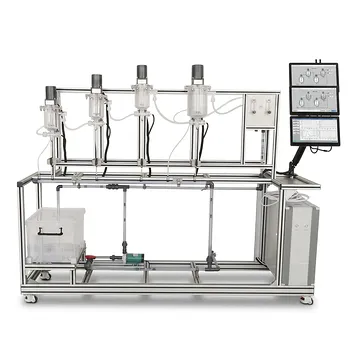
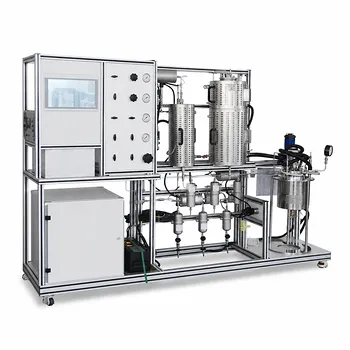
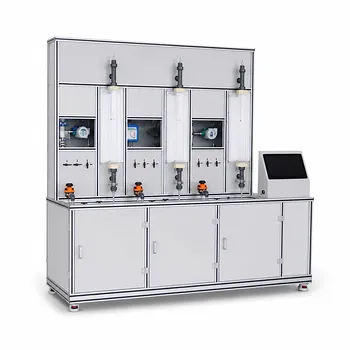
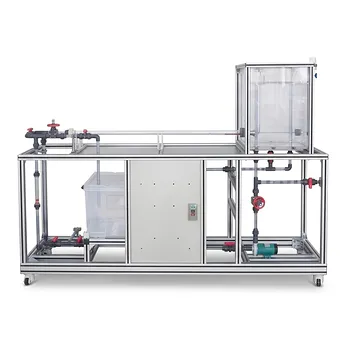
Bridging the gap between process simulation and physical reality requires reliable experimental equipment. LABPARK provides state-of-the-art Educational and Vocational Unit Operations Pilot Plants across chemical engineering, bioprocess & biotech, and environmental & water treatment for universities, research institutes, and enterprises. Our systems enable students to successfully validate their simulation models against accurate, real-world physical data.
Ready to enhance your training and research capabilities? Contact LABPARK today to find the perfect pilot plant solution for your lab!
Related Products
- Cavitation Phenomenon Demonstration and Analysis Educational Unit Operations Pilot Plant
- Bernoulli Equation Demonstration Unit Operations Pilot Plant
- Rising and Falling Film Evaporation Educational Unit Operations Pilot Plant
- Tubular Reactor Flow Characteristics Determination Educational Unit Operations Pilot Plant
- Centrifugal Pump Performance and Orifice Flowmeter Calibration Educational Pilot Plant
People Also Ask
- How do pilot plants teach U-tube manometers? Master Differential Pressure Calculations
- How to teach pump cavitation vs. gas binding? Interactive pilot plant teaching guide.
- What factors should be considered when selecting float valve types? F1 vs. V-4 vs. T-type Guide
- How does an FIA biosensor improve fermentation monitoring compared to HPLC? Speed & automation.
- What are key parameters for stable biosensor FIA in bioprocess training? Achieve optimal performance.