Knowledge Bioprocess and Biotechnology Education How does an FIA biosensor improve fermentation monitoring compared to HPLC? Speed & automation.
Author avatar

Tech Team · LABPARK

Updated 1 month ago

How does an FIA biosensor improve fermentation monitoring compared to HPLC? Speed & automation.


FIA biosensors cut fermentation monitoring time from lengthy HPLC runs down to about two minutes while removing the need for complex sample preparation. Traditional online HPLC in pilot plants demands extensive dilution and pre-separation steps, which slow down data delivery and complicate workflow. A flow injection analysis system with an integrated amperometric biosensor directly samples from the bioreactor, automatically dilutes within a mixing chamber, and delivers substrate concentrations across a wide dynamic range—making it a fast, low-maintenance alternative ideal for training and process development.

Bioprocess teams often choose between HPLC’s precision and FIA’s speed. For pilot plants focused on frequent monitoring and minimal hands-on labor, an FIA biosensor outperforms traditional HPLC by delivering results in under two minutes, eliminating manual sample prep, and staying clog-free—all while simplifying operator training.

Why FIA Changes the Game in Pilot Plant Monitoring

Instant Feedback Without the HPLC Bottleneck

Traditional on-line HPLC in bioprocessing is accurate but painfully slow. It relies on column separation, gradient elution, and often requires offline dilution or filtration before injection. This turns a single measurement into a lengthy delay, making it impossible to respond to fast metabolic shifts in real time.

An FIA biosensor bypasses this entirely. It uses a direct sample injection loop and a mixing chamber for automatic dilution. You get a measurement in roughly two minutes, not 20–30 minutes. That speed lets operators make timely feed adjustments during a fermentation run.

No Filtration, No Fouling, No Headaches

The primary reference explicitly states that the FIA-based amperometric biosensor design “avoids common issues like membrane clogging, air entrapment, and biofouling.” In pilot plants, sampling loops often foul due to cell debris or proteins. HPLC systems with guard columns and inline filters still face pressure spikes and frequent maintenance.

The FIA approach described here circumvents that. Samples flow directly from the bioreactor into the carrier stream without a dialysis step or fragile membrane barrier. This robust, direct-to-detector path drastically cuts downtime and operator intervention.

Automatic Dilution and a Wide Dynamic Range

Fermentation substrates like glycerol can swing from grams to tens of grams per liter. Traditional HPLC requires manual dilution or a carefully selected injection volume, which can introduce handling errors. The FIA biosensor incorporates sequential injection with a mixing chamber to perform automatic dilution on the fly. This extends its working range to 0.2–50 g/L without any manual recalibration or dilution steps. It’s built to handle the entire concentration profile of a batch without breaking stride.

Operator-Friendly and Ideal for Training

The primary reference positions this system as an “efficient, low-maintenance training tool.” In a pilot plant used for education or process development, simplicity is as important as performance. The FIA setup reduces the number of complex steps—no solvent gradients, no column conditioning, no delicate detector tuning. Operators learn the principles of on-line monitoring without being overwhelmed by instrument complexity. This aligns with the educational value highlighted in supplementary references, where automated FIA systems are presented as ideal technology to demonstrate modern Process Analytical Technology (PAT).

Continuous, Automated Monitoring with Higher Throughput

Supplementary references emphasize that FIA systems routinely deliver analysis times under 30 seconds for low-molecular-weight metabolites, enabling up to 120 samples per hour. Even the two-minute cycle time in the primary reference is a huge leap over HPLC’s typical 15–30-minute intervals. This high sampling frequency reveals transient changes—like a sudden glucose depletion or a metabolite spike—that an HPLC might miss entirely.

Understanding the Trade-offs

When HPLC Still Holds an Edge

Online HPLC provides more accurate and reliable measurements for precise feedback control, according to the supplementary materials. If your goal is tightly regulated fed-batch control where a small concentration error has big consequences, the higher fidelity of HPLC may justify its slower pace and higher capital cost.

FIA biosensors, while fast and robust, typically target a single analyte or a small set of chemically related species. For simultaneous quantification of multiple complex nutrients or secondary metabolites, a well-configured HPLC with diode array detection can cover more ground in a single run. The FIA system shines when you need high-frequency data on a key substrate like glycerol or glucose, not a full chemical profile every half hour.

Calibration and Long-Term Drift

Amperometric biosensors can drift due to enzyme degradation or electrode fouling. The primary reference alludes to low maintenance, but supplementary references note that ex-situ FIA configurations allow for automated sensor recalibration to correct for drift. This is a design choice, not an inherent weakness—if your FIA system can run periodic standards, you maintain accuracy over days. Without it, however, long-term continuous runs may see declining precision compared to HPLC’s more stable retention-time-based quantitation.

Making the Right Choice for Your Pilot Plant

Your decision hinges on what matters most: speed and simplicity or breadth and uncompromising accuracy. Use these goal-oriented lenses to decide.

  • If your primary focus is rapid feedback and high sampling frequency: Choose the FIA biosensor. Its two-minute cycle times and automatic dilution keep you ahead of metabolic changes without manual effort.
  • If your primary focus is training and PAT demonstration: Choose the FIA biosensor. Its low maintenance and straightforward operation make it the ideal platform for teaching modern continuous-monitoring concepts.
  • If your primary focus is precise feedback control with multiple analytes: Stick with online HPLC. Its accuracy remains the benchmark for critical control loops, and its multi-component capability justifies the longer analysis time.
  • If your primary focus is minimizing maintenance in a high-cell-density run: Choose the FIA biosensor. The absence of membrane clogging, air entrapment, and biofouling issues keeps the loop running when HPLC filters and guard columns would demand constant attention.

The core strength of the FIA biosensor in a pilot plant environment is that it turns monitoring into an uninterrupted, automated conversation with the bioreactor rather than a sporadic check-in.

Summary Table:

Feature FIA Biosensor Traditional HPLC
Analysis Time ~2 minutes 15–30 minutes
Sample Preparation Automated online dilution; no filtration Manual or offline dilution & filtration
Maintenance Low (clog-free direct-to-detector path) High (column conditioning & pressure spikes)
Target Analytes Single or select related substrates (e.g., glycerol) Multiple complex nutrients & metabolites simultaneously

Optimize Your Bioprocess Training & Research with LABPARK

Looking to upgrade your pilot plant with modern Process Analytical Technology (PAT)? LABPARK provides state-of-the-art Educational and Vocational Unit Operations Pilot Plants in chemical engineering, bioprocess & biotech, and environmental & water treatment. Designed specifically for universities, research institutes, and enterprises, our systems simplify operator training while delivering industrial-grade performance.

Ready to enhance your lab's capabilities and streamline fermentation monitoring? Contact LABPARK today to find the perfect pilot plant solution for your facility!

Related Products

People Also Ask

Related Products

Orifice and Venturi Flowmeter Calibration Educational Pilot Plant for Fluid Mechanics Laboratory

Orifice and Venturi Flowmeter Calibration Educational Pilot Plant for Fluid Mechanics Laboratory

Enhance fluid dynamics education with the Orifice and Venturi Flowmeter Calibration Educational Unit Operations Pilot Plant, featuring transparent orifice and Venturi meters, industrial sensors, touchscreen interface for real-time data analysis and automatic coefficient calculations in engineering student laboratories.

Centrifugal Pump Performance and Orifice Flowmeter Calibration Educational Pilot Plant

Centrifugal Pump Performance and Orifice Flowmeter Calibration Educational Pilot Plant

This versatile educational pilot plant enables engineering students to conduct centrifugal pump performance tests, orifice flowmeter calibration, and fluid mechanics experiments using a transparent flow loop, industrial HMI, and 3D virtual simulation for a comprehensive hands-on learning experience.

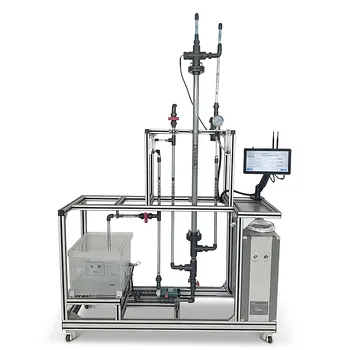
Cavitation Phenomenon Demonstration and Analysis Educational Unit Operations Pilot Plant

Cavitation Phenomenon Demonstration and Analysis Educational Unit Operations Pilot Plant

Advanced educational pilot plant for demonstrating and analyzing cavitation phenomena in fluid systems. Features a transparent acrylic Venturi test section, high-precision pressure and flow sensors, digital data acquisition, and integrated safety relief valves for engineering curricula.

Two Phase Flow Pattern Velocity Resistance Measurement Educational Pilot Plant

Two Phase Flow Pattern Velocity Resistance Measurement Educational Pilot Plant

Benchtop educational pilot plant for university labs studying gas-liquid two-phase flow patterns, velocity, and resistance across circular, square, and rectangular conduits. Features 15.6-inch touchscreen, 5G connectivity, differential pressure sensors, safe water-air operation. Supports chemical engineering curricula.

Multifunctional Membrane Separation Educational Pilot Plant with Ultrafiltration, Nanofiltration, Reverse Osmosis

Multifunctional Membrane Separation Educational Pilot Plant with Ultrafiltration, Nanofiltration, Reverse Osmosis

An integrated laboratory bench-scale membrane separation system for higher education engineering labs combining Ultrafiltration, Nanofiltration, and Reverse Osmosis processes. Features industrial PLC control with touch-screen HMI, transparent piping, and academic assessment software. Ideal for chemical and environmental engineering curricula.

Tubular Reactor Flow Characteristics Determination Educational Unit Operations Pilot Plant

Tubular Reactor Flow Characteristics Determination Educational Unit Operations Pilot Plant

Educational pilot plant for investigating tubular reactor flow characteristics and residence time distribution Features adjustable recycle for plug flow and backmixing studies industrial touchscreen interface and real-time data acquisition Ideal for chemical engineering unit operations laboratory training and education

Multi-Functional Membrane Separation Educational Pilot Plant for Unit Operations Lab

Multi-Functional Membrane Separation Educational Pilot Plant for Unit Operations Lab

The Multi-functional Membrane Separation Educational Unit Operations Pilot Plant is an integrated bench-scale laboratory system designed for teaching undergraduate engineering education. It features Ultrafiltration, Nanofiltration, and Reverse Osmosis modules in a compact, mobile unit for practical hands-on learning.

Multi Functional Catalytic Reaction and Reactor Evaluation Educational Unit Operations Pilot Plant

Multi Functional Catalytic Reaction and Reactor Evaluation Educational Unit Operations Pilot Plant

Bench-scale educational pilot plant for catalytic reaction and reactor evaluation, integrating fixed bed, fluidized bed, and stirred tank reactors. Students compare reactor designs, evaluate catalysts, and study reaction kinetics and hydrodynamics. Perfect for unit operations labs in chemical engineering curricula.

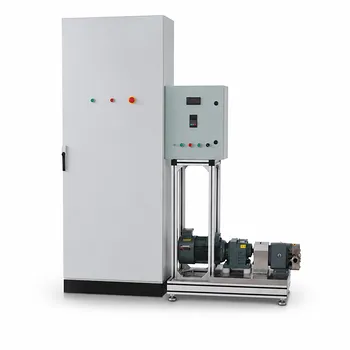
Quantitative Dosing and Liquid Flow Control Educational Unit Operations Pilot Plant

Quantitative Dosing and Liquid Flow Control Educational Unit Operations Pilot Plant

Explore industrial fluid transport and automated process control with this quantitative dosing and liquid flow control educational pilot plant, featuring local and remote control cabinets, variable speed metering pump, high-precision flow sensors, and PLC-based SCADA integration for engineering students.

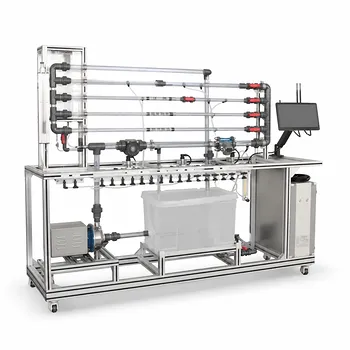
Fluid Friction Resistance Determination Educational Unit Operations Pilot Plant

Fluid Friction Resistance Determination Educational Unit Operations Pilot Plant

Engineered bench-scale system for university engineering labs. Provides hands-on fluid mechanics experience: quantitative energy loss analysis, flow regime observation, friction coefficient determination. Features four-point pressure measurement, transparent sections, industrial touchscreen PLC, 3D virtual simulation. Ideal for chemical, mechanical, civil engineering.

Educational Unit Operations Pilot Plant for Intraparticle Diffusion Effective Factor Measurement

Educational Unit Operations Pilot Plant for Intraparticle Diffusion Effective Factor Measurement

Designed for chemical engineering university labs, this pilot plant allows hands-on determination of catalyst particle intraparticle diffusion effective factors and gas-solid reaction kinetics using a fixed-bed tubular reactor with industrial touchscreen control, bridging theory and practical reactor design.

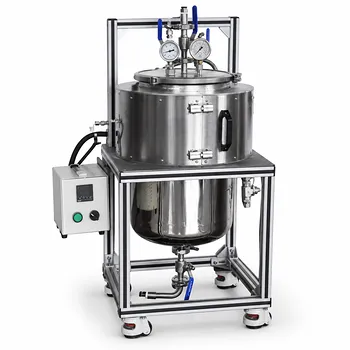
Hot Filtration Educational Unit Operations Pilot Plant Laboratory System

Hot Filtration Educational Unit Operations Pilot Plant Laboratory System

This integrated laboratory bench-scale hot filtration pilot plant enables students to study solid-liquid separation under thermal conditions, featuring a stainless steel vessel, removable heating jacket, and multi-layer filter plates for unit operations education, ideal for chemical engineering laboratory curriculum.

Constant Pressure Filtration Educational Unit Operations Pilot Plant

Constant Pressure Filtration Educational Unit Operations Pilot Plant

Hands-on educational pilot plant for constant pressure filtration. Classic plate and frame filter press allows students to study kinetics, determine specific cake resistance, perform cake washing and evaluate washing rates. Ideal for chemical engineering curriculum. Mobile, customizable, safety-compliant design.

Rising and Falling Film Evaporation Educational Unit Operations Pilot Plant

Rising and Falling Film Evaporation Educational Unit Operations Pilot Plant

Hands-on educational pilot plant for studying rising and falling film evaporation, flow regimes, and heat transfer. Customizable for university labs with industrial instrumentation and data acquisition. Enables comparative evaluation of evaporation modes and energy efficiency.

Liquid-Liquid Mass Transfer Coefficient Determination Educational Pilot Plant

Liquid-Liquid Mass Transfer Coefficient Determination Educational Pilot Plant

This bench-scale educational pilot plant for liquid-liquid mass transfer coefficient determination offers precise control of phase boundary, temperature, and agitation, enabling hands-on study of transport phenomena and unit operations in chemical engineering labs for teaching.

Multi-Reactor Educational Pilot Plant for Reaction Engineering Unit Operations

Multi-Reactor Educational Pilot Plant for Reaction Engineering Unit Operations

Integrated bench-scale educational pilot plant for chemical engineering teaching featuring fixed bed fluidized bed and stirred tank reactors with web-based digital twin controls and safety interlocks for hands-on unit operations and reaction engineering comparative studies in one compact system.

Bernoulli Equation Demonstration Unit Operations Pilot Plant

Bernoulli Equation Demonstration Unit Operations Pilot Plant

Laboratory pilot plant for Bernoulli's equation demonstration with transparent PVC pipes, 23 piezometer tubes for pressure measurement, and hands-on experiments. Designed for engineering education to study energy conservation, hydraulic grade line, and localized losses in fluid steady-flow systems.

Fluid Reynolds Number Demonstration Educational Unit Operations Pilot Plant

Fluid Reynolds Number Demonstration Educational Unit Operations Pilot Plant

Visual fluid dynamics pilot plant for engineering education demonstrating laminar, transitional, and turbulent flow regimes via dye injection in circular conduits. Verifies Reynolds number transitions and teaches dimensionless analysis. Modular design with digital simulation software enhances hands-on learning

Ultrafiltration Membrane Separation Educational Pilot Plant

Ultrafiltration Membrane Separation Educational Pilot Plant

This ultrafiltration membrane separation educational pilot plant enables undergraduate students to process PVA solutions, study hollow fiber membrane dynamics, and perform quantitative analysis with spectrophotometry for hands-on learning of unit operations and industrial maintenance and membrane cleaning protocols.

Comprehensive Heat Transfer Coefficient Determination Educational Unit Operations Pilot Plant

Comprehensive Heat Transfer Coefficient Determination Educational Unit Operations Pilot Plant

Advanced industrial-grade educational pilot plant for comprehensive heat transfer coefficient determination. Enables quantitative convective heat transfer analysis, evaluates double-pipe and shell-and-tube exchanger configurations, and includes digital data acquisition. Customizable for engineering curriculum. Ideal for engineering unit operations labs.


Leave Your Message