When an exothermic reaction moves from a lab flask to a pilot-plant reactor, the greatest risk isn’t the chemistry—it’s a dramatic shift in heat physics.
In a small beaker, the large surface-area-to-volume ratio lets reaction heat escape almost instantly. In a pilot-scale vessel, that escape path collapses, heat accumulates rapidly, and without precise, real-time monitoring you can trigger a thermal runaway in moments.
Monitoring heat release ((\Delta H < 0)) at pilot scale isn’t optional—it is the primary safeguard against runaway. Because the vessel’s geometry can no longer passively dump heat, every joule must be accounted for through energy balances, sensor feedback, and active cooling control. Without this vigilance, a safely behaved lab reaction becomes a process safety nightmare.
The Vanishing Surface-Area Lifeline
A Flask’s Built-In Safety Net
At bench scale, the surface through which heat can dissipate dominates the reaction volume. A small round-bottom flask exposes a high ratio of glass to liquid, so the energy released by an exothermic reaction quickly transfers to the surroundings. Cooling is passive and forgiving—even a strong exotherm rarely overwhelms the system.
The Pilot Plant’s Thermal Trap
When you scale to a unit operations pilot plant, volume grows with the cube of the linear dimension, but surface area grows only with the square. The very geometry that contained the reaction now traps heat. A reaction that generated a gentle temperature rise in the flask can, within minutes, produce an uncontrolled spike in a larger, less dissipative vessel. Monitoring becomes the only way to see heat before it sees you.
Why Thermal Runaway Becomes the Dominant Hazard
The Self-Accelerating Loop
Exothermic reactions are inherently rate-temperature positive-feedback systems: more heat raises the temperature, which raises the rate constant, which generates even more heat. In a lab flask, constant heat loss breaks this loop. At pilot scale, the loop closes. If cooling fails to keep pace, the reaction accelerates exponentially into runaway.
Runaway Isn’t “Just a Hotter Run”
Thermal runaway leads to boiling, overpressure, vessel rupture, or violent decomposition of reaction mass. For pilot plants—often used to train operators and students—an uncontrolled event destroys equipment, erodes trust, and can cause injury. Real-time heat monitoring is the only reliable breaker of that feedback loop.
The Energy Balance: Your Only Real-Time Truth
From Enthalpy Tables to Heat Duty
A reaction’s enthalpy change ((\Delta H_r)) gives the theoretical heat release per mole of reaction. Combined with the extent of reaction and an inlet-outlet enthalpy table, you can calculate the total thermal load on your cooling system. This isn’t an academic exercise; it is the baseline against which your pilot-plant sensors measure reality.
The Cascade Control Safety Net
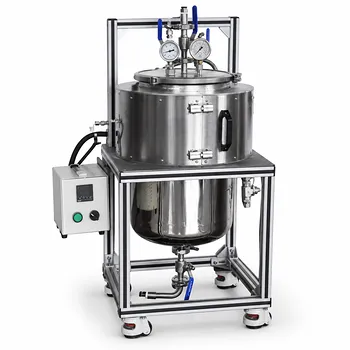
Educational and research pilot plants embed this balance into hardware. Cooling jackets, heat exchangers, and cascade control loops measure jacket inlet/outlet temperatures, coolant flow rates, and reactor temperature simultaneously. A sudden mismatch between calculated heat generation and measured heat removal triggers alarms or automatic cooling adjustments—long before the reactor wall temperature becomes the final signal of trouble.
Reactor-Specific Traps That Demand Monitoring
Fixed Bed Hot Spots
In gas-solid fixed bed reactors, an exothermic reaction can create radial and axial temperature profiles that hide dangerous hot spots. A single local hotspot raises the effective thermal conductivity gradient, accelerating that spot further. Without distributed temperature sensors, the average bed temperature can look normal while a zone is already in runaway. Monitoring the profile, not just a single point, is critical.
The Hidden Instability in CSTRs
A continuous stirred tank reactor operating non-isothermally exhibits multiple steady states—some stable, others unstable—because heat generation is a non-linear function of temperature. A minor shift in feed temperature or jacket coolant flow can fling the system across the unstable boundary into runaway or extinction. Modern pilot plants counter this with high-precision sensors and real-time data acquisition, allowing operators to map the heat-generation vs. heat-removal curves and stay firmly in the safe operating window.
Understanding the Trade-offs and Limitations of Monitoring
Even with rigorous monitoring, several pitfalls can undermine scale-up safety:
- Sensor placement and time lag: A temperature probe placed poorly may report a safe bulk fluid temperature while a stagnant zone overheats. Every sensor has a time constant, and during a fast exotherm, a delay of just a few seconds can mean the difference between controlled cooling and runaway.
- Model-reality mismatch: Calculated energy balances rely on accurate heats of formation and perfect mixing assumptions. Real pilot plants have non-idealities, side reactions, and fouling that slowly shift the actual heat load, requiring constant recalibration of monitoring baselines.
- Over-automation complacency: Installing cascade loops and alarms is essential, but it can breed a false sense of security. Operators must still understand the thermodynamics behind the numbers—otherwise, they may override critical safety actions during an ambiguous reading.
- Cost and complexity: Comprehensive thermal monitoring with multiple thermocouples, jacketed vessels, and data acquisition systems adds capital cost and maintenance. For some low-risk scouting studies, this overhead may be over-engineered, but for any reaction with a meaningful exotherm at scale, the investment is cheaper than a runaway.
How to Apply This to Your Scale-Up Strategy
Select your monitoring approach based on your operational priority:
- If your primary focus is process safety: Deploy distributed temperature sensing (multiple axial and radial points), link jacket flow to a cascade controller, and set hard shutoff interlocks on mismatched enthalpy balances. Prioritize sensor redundancy over minimalism.
- If your primary focus is teaching and workforce development: Use a pilot plant designed with transparent data acquisition, so students can see the heat generation/removal curves, experiment with controlled destabilization, and understand why non-linear steady states exist. Learning to monitor is as important as learning to react.
- If your primary focus is fast, lean scale-up: Start with a detailed (\Delta H_r) calorimetry study and inlet-outlet enthalpy table. Build a first-principles energy balance model, then instrument the pilot plant with just enough jacket thermocouples and flow sensors to validate—and continuously update—that model in real time.
Mastering exothermic heat monitoring at pilot scale transforms the reactor from a potential hazard into a true learning platform—one that bridges the gap between a beaker’s gentle warmth and a full-scale plant’s unforgiving thermodynamics.
Summary Table:
| Parameter | Lab-Scale (Flask) | Pilot-Scale (Unit Operations) |
|---|---|---|
| Surface-to-Volume Ratio | High (passive heat dissipation) | Low (traps reaction heat) |
| Thermal Runaway Risk | Very Low (forgiving) | High (self-accelerating loop) |
| Safety Mechanism | Ambient cooling | Active cascade control & energy balances |
| Monitoring Focus | Basic temperature | Real-time heat duty & multi-point profiles |
Ensure Safe and Precise Scale-Up with LABPARK
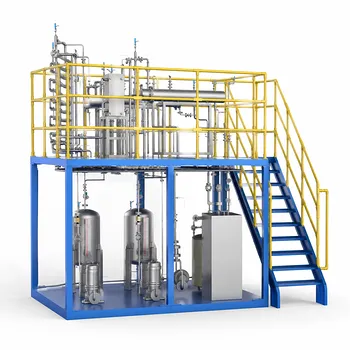
Transitioning from lab to pilot scale requires robust safety and control. LABPARK provides premium Educational and Vocational Unit Operations Pilot Plants in chemical engineering, bioprocess & biotech, and environmental & water treatment.
Designed for universities, research institutes, and enterprises, our systems feature advanced real-time thermal monitoring, cascade control, and data acquisition to prevent runaway hazards and train future engineers safely.
Ready to elevate your research or training facility? Contact our expert team today to customize the perfect pilot plant solution for your needs.
Related Products
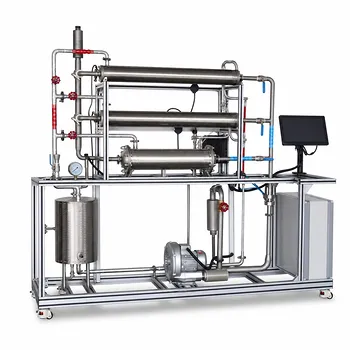
- Comprehensive Multi-Modal Heat Transfer Unit Operations Pilot Plant for Engineering Training
- Dual Mode Heat Transfer Pilot Plant for Unit Operations Training
- Multi-Reactor Educational Pilot Plant for Reaction Engineering Unit Operations
- Hot Filtration Educational Unit Operations Pilot Plant Laboratory System
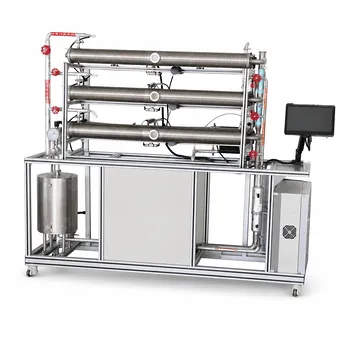
- Three-Tube Heat Transfer Educational Pilot Plant for Unit Operations Training
People Also Ask
- When is ε-NTU preferred over LMTD in pilot plants? Predict heat exchanger performance without iteration.
- How to configure heat transfer pilot plants for pinch analysis? Teach energy recovery.
- What engineering trade-offs must students analyze in a heat transfer pilot plant? Balance performance & cost.
- How can a heat transfer pilot plant demonstrate waste heat recovery? Learn to optimize industrial thermal systems.
- How does thermal conductivity affect pilot plant performance? Optimize heat transfer & accuracy