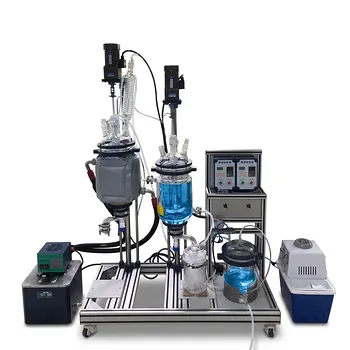
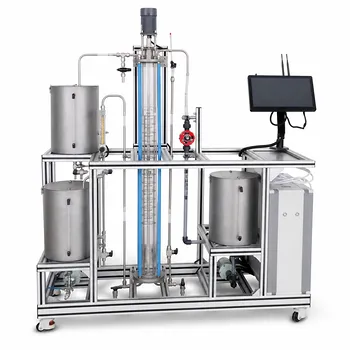
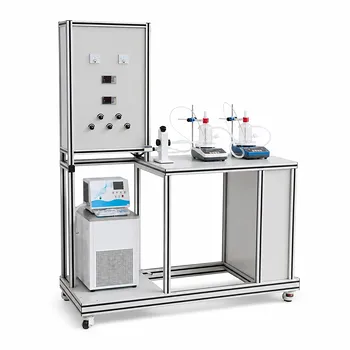
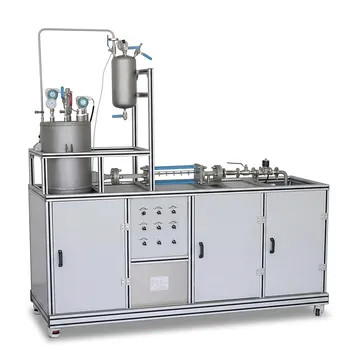
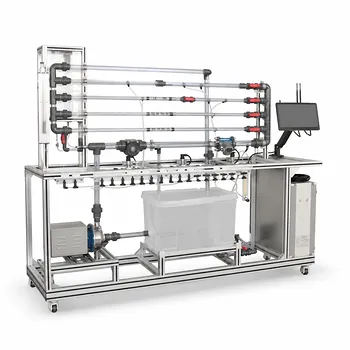
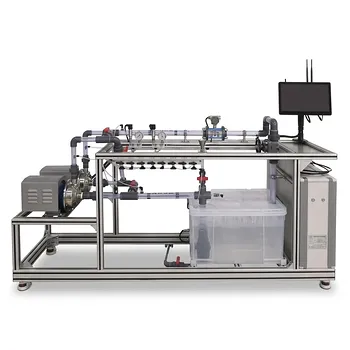
The difference between a successful pilot plant and a failed experiment often comes down to one invisible factor: the breakdown of ideal solution behavior. In environmental and water treatment, high-ionic-strength streams—like brine concentrator reject, industrial RO retentate, or chemical precipitation feed—render standard dilute-solution theory dangerously inaccurate. Computational modeling using frameworks such as the Pitzer model becomes critical because it corrects for these non-idealities, enabling accurate prediction of osmotic coefficients, scaling potential, precipitation thresholds, and ion-exchange equilibria that directly determine plant performance.
Training students to operate a pilot plant without computational non-ideality models produces operators who can turn valves but cannot diagnose why a membrane fouls prematurely or why a chemical dosage fails. Integrating Pitzer-type models ensures that both researchers and trainees can anticipate, control, and optimize the complex, often counterintuitive chemistry that governs high-salinity water treatment processes.
When Ideal Assumptions Break Down
The Nature of High-Ionic-Strength Streams
Industrial wastewater, landfill leachate, and desalination brines routinely reach ionic strengths where ions no longer behave as independent point charges. Close-range electrostatic interactions, ion pairing, and hydration effects become dominant. Under these conditions, activity coefficients deviate drastically from unity—the cornerstone of ideal solution models—making predictions based on concentration alone meaningless.
Why Dilute-Solution Theory Collapses
Classical Debye–Hückel theory works only in very dilute solutions. At high ionic strength, it systematically underestimates activity coefficients and completely misses specific ion-ion interactions that depend on the identity of each pair. For example, calcium and sulfate experience much stronger association than potassium and chloride, a nuance that ideal theory cannot capture. Without correction, calculated solubility products, osmotic pressures, and membrane transport driving forces become grossly inaccurate.
Consequences for Water Treatment Processes
Using ideal assumptions in a pilot plant leads to three common disasters: unexpected mineral scaling (e.g., gypsum or silica precipitating inside membranes), miscalculated chemical dosing (over- or under-feeding antiscalants, acids, or coagulants), and false confidence in ion-exchange capacity. Each of these translates directly into higher operating costs, reduced water recovery, and equipment damage—exactly the failures a pilot plant is supposed to prevent before full-scale deployment.
The Computational Fix: Models Beyond Ideality
The Pitzer Model as a Practical Tool
The Pitzer model extends the Debye–Hückel framework by adding virial equations with binary and ternary interaction parameters. These parameters, derived from experimental data for specific electrolyte pairs, allow the model to accurately calculate single-ion and osmotic coefficients up to ionic strengths of several mol/kg. For water treatment, this means you can reliably predict the solubility of sparingly soluble salts, the driving force for scaling, and the pH shifts that occur when mixing incompatible streams—all within a computational database that students can query alongside real-time plant data.
From Equations to Pilot Plant Control
When a pilot plant operator adjusts an antiscalant dose or sets a brine recirculation rate, they are implicitly trusting a chemical equilibrium prediction. With a Pitzer-based thermodynamic engine, chemical dosing becomes a calculated decision, not a guess. For instance, the model can tell you the exact supersaturation ratio of calcium carbonate at a membrane surface, allowing you to fine-tune pH or anti-scalant concentration before damage occurs. Training students to move fluidly between this computational layer and the physical plant creates a feedback loop where data validates the simulation and the simulation guides the operation.
The Learning Gap: Why Training Without Models is Incomplete
Bridging Theory and Practice
A pilot plant is not just a collection of pumps, valves, and instruments; it is a physical embodiment of thermodynamic principles. When students only learn to operate equipment, they develop a blind-spot for the root causes of separation failure. Conversely, students who only simulate without hands-on experience struggle to appreciate practical constraints like sensor lag or mixing non-idealities. Integrating a computational database forces the student to ask: “Why did the measured pressure drop increase exactly when the model predicted gypsum saturation?” That question is the essence of engineering judgment.
Predictive Competence for Real-World Scenarios
The true value of a pilot plant becomes apparent during unexpected events—a sudden change in feed composition, a heat exchanger leak, or an operator error. Trainees who have practiced with a Pitzer model can rapidly diagnose whether the observed turbidity is a simple particulate spike or the onset of catastrophic calcium phosphate precipitation. This predictive competence saves time, reduces waste, and instills the confidence to design robust full-scale plants that can handle variable, high-salinity feeds.
Understanding the Trade-offs
Data Requirements and Parameter Availability
Pitzer models require a matrix of interaction parameters for every major ion pair and triple in solution. While parameters exist for common systems (Na⁺-Cl⁻-SO₄²⁻-Ca²⁺, etc.), less-studied species or complex mixtures found in industrial wastewater may lack data. In such cases, the model becomes an educated approximation, and its accuracy must be verified against pilot plant measurements—a perfect teaching moment about model limitations.
Computational Complexity vs. Operational Speed
A full Pitzer calculation embedded in a real-time control loop may be computationally demanding. For live process control, simpler, linearized correlations are sometimes preferred. However, for training and research, the slower, more accurate model is invaluable because it reveals the underlying physics. The trade-off between model fidelity and computational speed is a critical lesson for students who will later design control strategies for full-scale plants.
The Danger of Over-Reliance
No model, however sophisticated, replaces direct observation. If a student blindly trusts a simulation that predicts no scaling when a pressure gauge shows a three-bar rise, they miss the moment to learn about unknown foulants or measurement errors. The critical discipline is to use the computational model as a hypothesis generator, not an oracle, and to always close the loop with physical data from the pilot plant.
Making the Right Choice for Your Goal
The path you take depends entirely on what you need from your training or research program. Use these priorities to decide how deeply to embed computational thermodynamics.
- If your primary focus is training competent plant operators: Integrate computational models early, using them to explain unexpected data and reinforce the connection between chemistry and equipment response.
- If your primary focus is research and process development: Use Pitzer-based simulations to design experiments, predict scaling regimes, and reduce costly trial-and-error runs on the pilot plant.
- If your primary focus is scaling up from pilot to full-scale: Rely on validated computational models to translate pilot results to larger systems, accounting for changes in residence time and mixing that alter local ionic strength.
Mastering the marriage of computational thermodynamics and hands-on pilot operation transforms a student into an engineer who can solve water treatment challenges, not just operate a plant.
Summary Table:
| Feature | Ideal/Dilute Solution Model | Pitzer Non-Ideal Model |
|---|---|---|
| Applicable Range | Low salinity (< 0.1 M) | High salinity (> 1.0 M) |
| Ion Interactions | Ignored (independent charges) | Specific binary/ternary interactions |
| Scaling Prediction | Underestimates precipitation | Highly accurate solubility products |
| Activity Coefficient | Assumed near unity (1.0) | Calculated dynamically |
| Process Application | General water transport | Brine concentration, RO retentate |
Bridge the Gap Between Theory and Practice with LABPARK
Equip your lab to handle complex, real-world chemical engineering challenges. LABPARK provides state-of-the-art Educational and Vocational Unit Operations Pilot Plants in chemical engineering, bioprocess & biotech, and environmental & water treatment for universities, research institutes, and enterprises.
- Train with Confidence: Prepare students to predict, diagnose, and solve critical issues like scaling and membrane fouling.
- Accelerate Research: Obtain reliable data on high-ionic-strength streams and non-ideal solution behaviors.
- Robust Scale-Up: Transition seamlessly from laboratory concepts to full-scale operations.
Take your training and research capabilities to the next level—contact our engineering experts today!
Related Products
- Electrolyte Distillation Purification and Formulation Educational Pilot Plant
- Ion Exchange Water Purification Educational Pilot Plant for Engineering Unit Operations
- Water Electrolysis Hydrogen Production and Storage Educational Pilot Plant
- Potassium Salt Thermal Dissolution and Crystallization Separation Educational Unit Operations Pilot Plant
- Alkaline Membrane Water Electrolysis Educational Pilot Plant Unit Operations Training System
People Also Ask
- Why does simple distillation yield higher efficiency than flash distillation? Key thermodynamic differences.
- How to Integrate Spectroscopy in Distillation Pilot Plants for Advanced Process Control
- How do batch and continuous distillation pilot plants differ? Master their dynamic behavior
- How does operating pressure influence Methylal/Methanol VLE? Discover its impact on distillation
- Why is the acentric factor important in pilot plants? Fluid property prediction.