Wet-air oxidation pilot plants operate at conditions where traditional ideal-gas models catastrophically fail. Accurately calculating saturated water content and gas-phase enthalpy is not a minor refinement—it is the foundation of safe design, reliable energy balance, and correct scale-up. Without precise thermodynamic modeling using specialized equations of state, you cannot predict the abnormally high water vapor carried by gas streams, size heat exchangers, or prevent condensation-induced corrosion and thermal imbalances.
Beneath the surface-level question lies an unspoken truth: a pilot plant is a scaling tool, not just a test. If the thermodynamic calculations that underpin its data are wrong, the full-scale plant will be wrong. In wet-air oxidation, the interplay of high pressure, CO₂, and water vapor creates a highly non-ideal system where small errors in enthalpy or water content propagate into dangerous design flaws and unreliable performance predictions.
The Trap of Ideal-Gas Assumptions in High-Pressure Oxidation
Wet-air oxidation runs at elevated temperatures and pressures where the gas phase behaves far from an ideal gas. The vapor leaving the reactor is a mixture of water, CO₂, N₂, and other components—and their interactions drastically alter the amount of water the gas can carry.
Why the Ideal-Gas Law Fails
The ideal-gas law predicts water partial pressure independently of other species. In reality, CO₂ enhances water solubility in the vapor phase through molecular interactions that ideal mixing ignores. At moderate temperatures, this effect can double the saturated water content compared to an ideal-gas prediction.
Designing a condenser or flash tank based on ideal-gas assumptions leads to undersized equipment, unexpected liquid dropout, and potential two-phase flow in piping not designed for it.
The Need for Specialized Equations of State
To capture these non-idealities, engineers turn to models like the de Santis and Breedveld formulation. This equation of state explicitly accounts for the fugacity coefficients of water, CO₂, and other gases in the mixture. Without it, you cannot accurately calculate:
- The true saturated water content of the process gas.
- The dew point of the mixture, which is critical for corrosion prevention.
- The gas-phase enthalpy, needed for energy balances around heat exchangers and the reactor.
The primary reference underscores this: thermodynamic modeling using such specialized equations is the only way to predict the enhanced water transport and ensure safe thermal balances during high-pressure pilot runs.
The Enthalpy Crisis: Why Gas-Phase Energy Content Is a Big Deal
Heat recovery is the economic and safety backbone of a wet-air oxidation plant. The hot, high-pressure effluent gas must be cooled, often through a series of exchangers that preheat the feed. Getting the enthalpy wrong is not a theoretical inconvenience—it changes equipment sizes, material requirements, and operational limits.
The Magnification of Small Errors
Supplementary data on water enthalpy shows that even at subcritical conditions, a deviation of a few BTU/lb in calculated vapor enthalpy can compound into large total energy flow errors when you multiply by mass flow. At wet-air oxidation conditions, the error is even larger because the real-gas behavior is stronger.
Consider the impact on a heat recovery exchanger: if the gas enthalpy is underpredicted, the exchanger will appear to transfer less heat, leading to oversizing—or worse, if overpredicted, the exchanger will be inadequate and the downstream temperature will remain too high, risking thermal degradation of materials or quenching failures.
The Condensation Domino Effect
Precise enthalpy data is directly tied to prediction of condensation onset. When you cool a gas stream containing CO₂ and water under pressure, carbonic acid can form at the dew point. If your model wrongly predicts the temperature at which liquid water condenses, you risk:
- Corrosion in carbon steel sections designed to stay above the dew point.
- Two-phase flow in lines sized for single-phase gas, causing vibration and erosion.
- False energy balance readings in the pilot plant, leading to incorrect scale-up parameters.
The primary reference states this bluntly: accurate enthalpy and water content data are essential for preventing unwanted condensation and ensuring safe thermal balances.
Understanding the Trade-offs in Thermodynamic Modeling
Rigorous modeling is non-negotiable, but it’s not without its own pitfalls. Every correlation has a domain of applicability, and blind trust can be as dangerous as no modeling at all.
The Cost of Model Complexity
Specialized equations of state like de Santis and Breedveld require binary interaction parameters that must be regressed from experimental data. If those parameters are not validated for your specific gas composition (CO₂/N₂/H₂O ratios), the model may still produce systematic errors.
The supplementary material highlights that different thermodynamic correlations for ethane recovery can yield predictions spanning 25.7% to 45.0%—a direct lesson that choosing the wrong model or parameters has design consequences just as severe as using ideal-gas assumptions.
The Calibration Imperative for Pilot Plants
Pilot plants serve a dual purpose: they generate data for scale-up, and they validate the thermodynamic model itself. When your pilot plant’s measured temperatures don’t align with your modeled energy balance, you must first suspect the water content and enthalpy correlations. A minor deviation in the ideal-gas heat capacity model, as noted in the supplementary references, can cause a 6 BTU/lb error at low pressures; at wet-air oxidation pressures, that error mushrooms.
Thus, the engineer must treat the thermodynamic model as a living hypothesis—one that the pilot plant data must continuously refine rather than blindly trust.
How to Build a Safe and Reliable Pilot Plant Design
Your approach must pivot on a few clear principles. The goal is not just to answer a calculation question, but to produce a pilot plant that yields scalable, trustworthy data while operating safely.
Start with a Validated, High-Fidelity Model
Before fabricating a single heat exchanger, run extensive sensitivity studies using a proven equation of state—such as the de Santis formulation—for your exact gas composition and pressure range. Map the dew point curve and enthalpy-temperature profile. This becomes your design basis for all metallurgy and exchanger sizing.
Design for the Worst-Case Condensation Scenario
Factor in the uncertainty of the model itself. If the literature shows that vapor enthalpy predictions can diverge by tens of BTU/lb at high pressures, add a design margin to your heat exchangers and install high-point vents and low-point drains in all gas lines. Specify materials that can tolerate brief acid condensation, even in “normally dry” zones.
Use the Pilot Plant to Close the Loop
The pilot plant is your ultimate validation tool. Instrument it densely: measure temperatures and pressures at multiple points in the gas cooling train, and sample condensed water rates to back-calculate actual saturated water content. Compare these with your model’s predictions continuously. If discrepancies emerge, update the interaction parameters or switch to a more appropriate fugacity model before scaling up.
Making the Right Choice for Your Project
The actions you take depend on your primary objective with the pilot plant.
- If your primary focus is safety: Overdesign the heat recovery train with conservative margins based on the upper bound of enthalpy and water content uncertainty. Install corrosion-resistant alloys wherever the gas may approach its dew point.
- If your primary focus is generating scale-up data: Invest heavily in thermodynamic validation. Run the pilot at multiple pressures and temperatures to map the real behavior of your specific waste stream and refine the equation-of-state parameters you will carry into full-scale design.
- If your primary focus is process efficiency: Chase every BTU/lb of enthalpy accuracy. Even a 2% improvement in predicted heat recovery can translate into millions of dollars in operating costs over the life of a full-scale wet-air oxidation facility—and the pilot plant is where you will confirm that improvement is real.
Your pilot plant is not simply a smaller version of the full-scale unit; it is a high-fidelity calorimeter that must report the truth about water, energy, and separations. Master those calculations, and the full-scale design becomes a straightforward extrapolation rather than a dangerous gamble.
Summary Table:
| Parameter | Ideal-Gas Assumption | Real-Gas Model (e.g., de Santis) | Impact on Pilot Design |
|---|---|---|---|
| Water Solubility | Underpredicts water in vapor | Accounts for CO₂-water interaction | Prevents undersized condensers |
| Enthalpy Calculation | Ignores high-pressure deviations | Calculates true mixture enthalpy | Ensures accurate energy balance |
| Dew Point Prediction | Inaccurate temperature profile | Precise condensation onset | Prevents corrosion & two-phase flow |
Scale Up Your Environmental & Chemical Research Safely
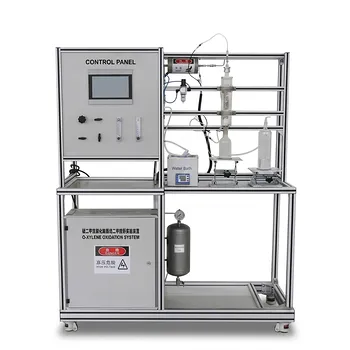
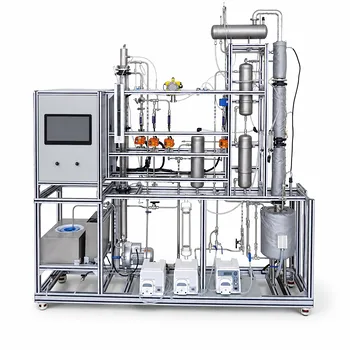
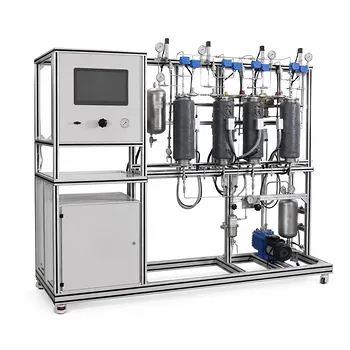
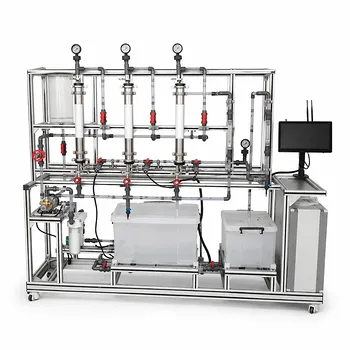
Building a reliable wet-air oxidation or chemical process system requires precise thermodynamic control and high-quality equipment. LABPARK provides state-of-the-art Educational and Vocational Unit Operations Pilot Plants in chemical engineering, bioprocess & biotech, and environmental & water treatment.
Designed specifically for universities, research institutes, and enterprises, our pilot plants ensure safe operation, accurate data collection, and seamless scale-up.
Ready to elevate your laboratory or testing facility? Contact LABPARK today to discuss your project requirements!
Related Products
- O-Xylene Oxidation to Phthalic Anhydride Educational Unit Operations Pilot Plant
- Carbon Dioxide Absorption and Desorption Educational Pilot Plant for Carbon Capture Studies
- Bench Scale Carbon Dioxide Capture Educational Unit Operations Pilot Plant
- Fixed-Bed Chemical Reaction and Gas Dust Tar Removal Unit Operations Pilot Plant
- Multifunctional Membrane Separation Educational Pilot Plant with Ultrafiltration, Nanofiltration, Reverse Osmosis
People Also Ask
- What materials fit high-temp oxidation pilot plants? Key Hastelloy & Titanium Requirements
- Under what conditions can axial diffusion be neglected? Reactor Simulation Guide
- What limitations exist in high-temp pilot reactor design? Key Material & Safety Rules
- What pressure parameters ensure pilot plant safety? Analyze reactor profiles & gas evolution.
- How are sensitivity functions applied to parameter estimation in chemical reactor pilot plants? Guide