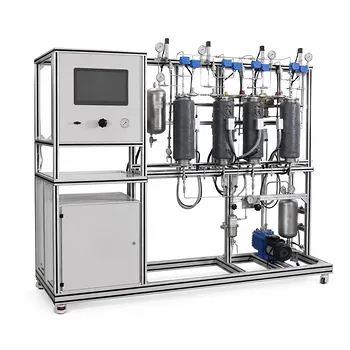
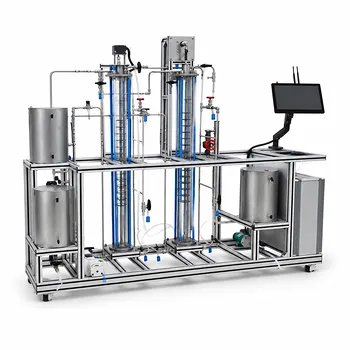
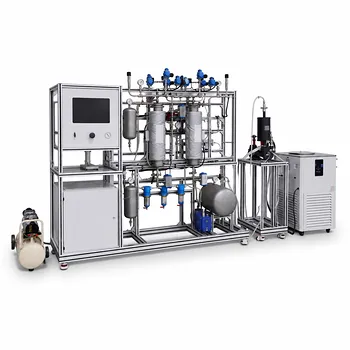
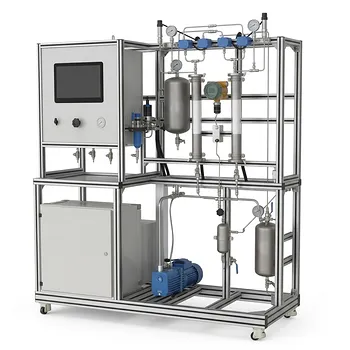
The assumption of negligible gas-side mass transfer resistance is the cornerstone that lets you decouple complex gas-liquid dynamics into a simpler, liquid-film-only problem. In gas-liquid absorption and reaction pilot plants, this assumption is significant because it dictates how you model the reactor, what parameters you vary, and ultimately how you scale up the process. By declaring the gas-side resistance to be near zero, engineers can focus experimental efforts entirely on the liquid phase—measuring liquid-side mass transfer coefficients and reaction enhancement factors—while knowing that the interfacial concentration of the gaseous reactant equals its bulk concentration. The true importance, however, lies in the rigorous experimental verification that pilot plants provide: without it, an invalid assumption can lead to disastrous over-simplifications in full-scale designs.
The assumption of negligible gas-side resistance simplifies reactor analysis dramatically, but its real significance emerges only when you use a pilot plant to prove when that simplification is justified—and when it will cost you. A pilot plant transforms a theoretical convenience into a safely validated scale-up tool.
The Simplifying Power of a Negligible Gas-Side Resistance
Collapsing the Two-Film Model
In the classic two-film theory, the overall mass transfer resistance is the sum of gas-film and liquid-film resistances. Mathematically, that sum is (1/K_{gi} = 1/k_{gi} + H_i/(k_{li}E_i)).
When the gas-side term (1/k_{gi}) is much smaller than the liquid-side term, the overall resistance is essentially (H_i/(k_{li}E_i)). This makes the overall mass transfer coefficient ((K_{gi})) a direct function of only the liquid properties, the Henry’s law constant, and any chemical enhancement.
Direct Experimental Focus
With negligible gas resistance, you can control the absorption rate by manipulating only the liquid flow rate, temperature, and catalyst concentration.
The interfacial partial pressure ((p_{Ai})) becomes equal to the bulk gas partial pressure ((p_A)). This eliminates the need to measure or model complex gas-side concentration gradients, letting pilot plant operators isolate liquid-phase kinetics and transport.
The Real-World Reality: Two-Film Resistance
Not All Systems Are Created Equal
The assumption is not universally valid. Many industrially critical systems exhibit significant gas-phase resistance.
The gas solubility—captured by Henry’s law constant ((H))—is the primary determinant. Highly soluble gases like ammonia push the resistance almost entirely into the gas film, making (K_G \approx k_g). Sparingly soluble gases like carbon dioxide concentrate the resistance in the liquid film.
Why Pilot Plants Are Indispensable
Practical chemical engineering applications rarely follow pure textbook scenarios. Both resistances can compete, especially when gas velocity is low, liquid reactivity is high, or the gas contains an inert diluent.
Pilot plants equipped with variable flow controllers and in-line concentration sensors allow researchers to experimentally determine mass transfer coefficients ((K_La)) across a range of flow rates. This reveals whether altering the gas rate changes the absorption rate—the hallmark of a gas-film bottleneck.
Using Pilot Plants to Uncover the Controlling Resistance
Identifying the Bottleneck Experimentally
Operators compare the magnitudes of gas-film resistance ((1/k_{aG})) and liquid-film resistance ((1/(H \cdot k_L))).
In a liquid-film controlled system, varying the liquid flow rate or packing wetting characteristics will dramatically shift the overall absorption rate, while altering gas turbulence will have almost no effect. In a gas-film controlled system, the opposite is true.
The Role of Gas Solubility and the Enhancement Factor
Henry’s law constant ((H)) acts as a weighting factor. For a large (H) (high solubility), the liquid-side term (H/(k_lE)) becomes small, making the gas-side term dominant.
The enhancement factor ((E_i)) also matters. A fast chemical reaction in the liquid phase can accelerate mass transfer so much that the liquid-side resistance drops to near zero, shifting control back to the gas film. Pilot plants let you test this directly by changing reaction temperature or catalyst concentration and watching whether the absorption rate becomes sensitive to gas-phase mixing.
Common Pitfalls and When the Assumption Fails
Mistaking a Liquid-Film Control for a Universal Truth
The most dangerous error is applying the negligible gas-resistance assumption to a system that has a hidden gas-film limitation.
In bubble-type pilot reactors, the gas-phase residence time is short, and turbulence is often high, making (1/k_{gi}) appear negligible. But if you scale up and the superficial gas velocity drops, the gas-film resistance can suddenly become the dominant bottleneck—a phenomenon easily missed if the pilot plant was never operated at low gas flows.
Ignoring Reactant Depletion in the Gas Phase
When the gas phase contains a reactive species alongside a large fraction of inert, the dilution effect can increase the effective gas-side resistance. The assumption of a constant bulk gas concentration may break down along the reactor height. Pilot plants that sample gas at multiple axial points can detect such concentration profiles before they ruin a full-scale design.
Overlooking the Enhancement Factor’s Double-Edged Sword
A high enhancement factor makes the liquid-side resistance very small, which is great for absorption but can push the process toward gas-film control. If you designed the pilot plant assuming liquid control, you may completely misinterpret a fall in reactor performance when the liquid reaction is deliberately accelerated.
Applying This Insight to Your Pilot Plant Studies
Your path forward depends on what you are trying to achieve with your pilot plant.
- If your primary focus is liquid-film controlled absorption (e.g., CO₂ capture): Start by manipulating the liquid flow rate and distributor design while keeping gas flow constant. The assumption of negligible gas resistance is likely valid, so your experimental campaign should prioritize improving liquid-side mass transfer and wetting efficiency.
- If your primary focus is gas-film controlled absorption (e.g., NH₃ scrubbing): Vary the gas velocity and turbulence generators. Do not assume the gas resistance is negligible; instead, use the pilot plant to measure (K_G a) as a function of gas Reynolds number and verify that liquid-side changes have minimal impact.
- If your primary focus is scaling up a reactive absorption process: Run experiments at both low and high gas flow rates, and at multiple reaction intensities. Prove where the controlling resistance lies under each likely operating condition. Only then can you confidently decide whether to neglect the gas-side term in your scale-up models.
- If your primary focus is student or researcher training: Deliberately choose a system that exhibits both limiting regimes by altering solubility or reaction rate. Demonstrate how the same hardware can switch from liquid-film to gas-film control, cementing the critical lesson that no assumption is safe without experimental proof.
The assumption of negligible gas-side resistance is not a universal law—it is a design choice that pilot plants let you validate, reject, or knowingly exploit. When you treat it as a testable hypothesis rather than a fact, you turn a scaling risk into a scaling certainty.
Summary Table:
| Controlling Regime | Primary Resistance | Key Indicators / Drivers | Pilot Plant Variables to Test |
|---|---|---|---|
| Liquid-Film Control | Liquid film ($1/k_L$) | Low gas solubility (e.g., $CO_2$), slow reaction | Liquid flow rate, temperature, distributor wetting |
| Gas-Film Control | Gas film ($1/k_g$) | High gas solubility (e.g., $NH_3$), rapid reaction | Gas velocity, turbulence, inert gas concentration |
Validate Your Mass Transfer Models with LABPARK Pilot Plants
Transitioning from theoretical assumptions to reliable, full-scale industrial operations requires precise experimental validation. LABPARK designs and manufactures premium Educational and Vocational Unit Operations Pilot Plants in chemical engineering, bioprocess & biotech, and environmental & water treatment.
Whether you are a university training the next generation of engineers, a research institute investigating gas-liquid dynamics, or an enterprise scaling up chemical reactions, our systems provide the precise control over gas/liquid flow rates and temperatures you need to isolate mass transfer resistances accurately.
Contact LABPARK today to request a quote or discuss your custom pilot plant needs!
Related Products
- Packed Bed Absorption Educational Unit Operations Pilot Plant
- Dual-Mode Gas Absorption and Desorption Unit Operations Training Pilot Plant
- Absorption and Desorption Educational Unit Operations Pilot Plant
- Carbon Dioxide Absorption and Desorption Educational Pilot Plant for Carbon Capture Studies
- Fixed-Bed Chemical Reaction and Gas Dust Tar Removal Unit Operations Pilot Plant
People Also Ask
- How Do Flow Regimes Transition in Packed Bed Pilot Plants? Key Scale-up Insights
- How does reactant concentration determine absorption column control? Gas-film vs. dual-film.
- How is the packing height of an absorption column calculated? Master HTU & NTU Concepts
- How does static vs. operating holdup affect pilot plant calibration? Avoid Critical Scale-Up Errors
- Why is counter-current flow selected for gas absorption? Maximize Pilot Plant Efficiency