Because it directly teaches the core tension at the heart of chemical process design.
The ability to feed excess reactants transforms an educational pilot plant from a recipe-following exercise into an active experimental platform. It empowers students to go beyond the textbook and manipulate a key process variable themselves. They can vary reactant ratios, calculate the percent excess, and directly observe the real-world consequences — both the improved conversion and the resulting burden on downstream separation. This hands-on analysis is essential for building the intuitive, decision-making skills demanded in industrial practice.
Feeding excess reactants in a pilot plant bridges the gap between theoretical stoichiometry and practical process design. It forces students to confront the unavoidable trade-offs between driving a reaction to completion and managing the subsequent separation costs, a foundational skill for any process or chemical engineer.
The Educational Power of an Adjustable Feed System
An adjustable feed system is more than a convenience; it is the key that unlocks the transition from academic knowledge to process design thinking.
From Fixed Recipes to Process Design Thinking
Without variable feed control, pilot plants become mere demonstration rigs. Students simply mix inputs at a preset, stoichiometric ratio and measure the output.
Adjustable feeding changes that dynamic. It puts students in the role of process designer. They must actively select a reactant ratio — say, adding 20% excess of a cheaper raw material — and then live with the outcome. This shift is crucial for developing an ownership mentality toward process performance.
Visualizing the ‘Percent Excess’ Concept
The term “percent excess” can feel abstract in a lecture hall. In a working pilot plant, it becomes a tangible, tunable knob.
By running experiments at different excess percentages, students create their own performance curves. They see that a small excess of hydrogen in a catalytic reaction might push conversion from 90% to 95%, but a larger excess delivers rapidly diminishing returns. This direct visualization of the law of diminishing returns is a lesson that stays with them far longer than any slide deck.
The Critical Insight: Uncovering Process Trade-offs
The deepest learning occurs not in the reactor itself, but in what happens downstream. Feeding an excess reactant makes the hidden costs of a reaction visible.
The Conversion-Separation Tension
The primary reference makes this point starkly. Maximizing conversion by flooding the reactor with one reactant creates a new problem: an accumulation of excess materials that must be separated out.
Students rapidly discover that a perfectly converted reactor is often a terrible overall process. The increased load on distillation columns, solvent extraction units, or other separation equipment can erase any profit gained from using the raw material more efficiently. This tangible insight into the conversion-separation trade-off is the single most important lesson a pilot plant can teach.
A Concrete Example: Temperature Control in Coal Gasification
The same principle applies beyond simple economics to the physical integrity of a unit. In educational moving-bed gasifier pilots, a deliberate excess of steam is not fed to improve conversion, but to act as a thermal moderator.
Excess steam controls the maximum temperature in the combustion bed. This is essential to keep the inorganic ash below its softening point (around 1200°C), preventing it from turning sticky and clinkering. Without this excess, the grate can seize, causing a mechanical blockage and a dangerous shutdown. The trade-off is clear: a high steam-to-oxygen ratio (like 7:1) lowers the unit’s thermal efficiency, yet it is non-negotiable for reliable operation. Students learn that a process variable can be optimized not just for yield, but for operability and safety — a lesson that purely economic models often miss.
Making the Right Choice for Your Lab
Translating this feature into meaningful learning outcomes requires a deliberate design of the laboratory experience.
- If your primary focus is teaching core stoichiometry: Use the adjustable feed to let students plot conversion versus percent excess. Have them identify the stoichiometric point on their graph and explain any deviation from exact theory.
- If your primary focus is introducing process economics: Add a simplified separation step after the reactor. Require students to calculate the total cost per kilogram of pure product, factoring in both raw material and separation energy costs for each excess ratio they test.
- If your primary focus is simulating real-world troubleshooting: Introduce a simulated “operational failure,” such as a column flooding when excess reactant levels get too high. Let students diagnose the root cause — their feed strategy — and reconfigure the system to restore stable operation.
An educational pilot plant without the ability to feed an excess reactant is like a car without a steering wheel. It may move, but the people inside will never learn to navigate the complexities of the road.
Summary Table:
| Feature / Aspect | Educational Benefit | Real-World Engineering Concept |
|---|---|---|
| Adjustable Feed Control | Shifts students from recipe-following to active process designers. | Reactant ratio optimization |
| Variable Percent Excess | Visualizes conversion curves and the law of diminishing returns. | Stoichiometric balancing |
| Downstream Separation | Highlights cost trade-offs between reactor conversion and separation loads. | Conversion-separation economic tension |
| Thermal Moderation | Teaches process operability and safety constraints (e.g., steam in gasification). | Safety margins and thermal control |
Empower the Next Generation of Chemical Engineers
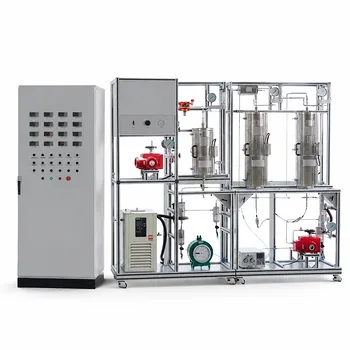
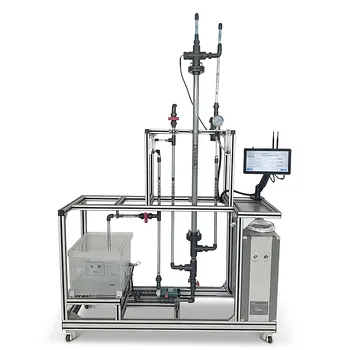
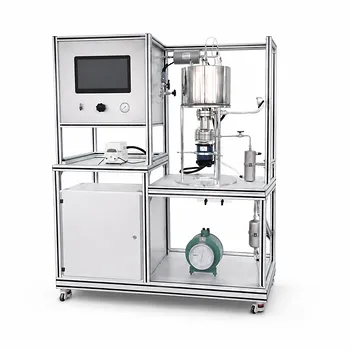
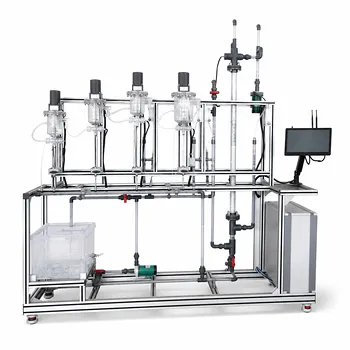
Bridge the gap between theory and industrial practice in your laboratories. LABPARK provides advanced Educational and Vocational Unit Operations Pilot Plants across chemical engineering, bioprocess & biotech, and environmental & water treatment for universities, research institutes, and enterprises. Our systems are built with the adjustable process controls students need to master complex design trade-offs.
Ready to elevate your training facilities? Contact LABPARK today to customize your pilot plant setup!
Related Products
- Multi-Reactor Educational Pilot Plant for Reaction Engineering Unit Operations
- Fixed-Bed Chemical Reaction and Gas Dust Tar Removal Unit Operations Pilot Plant
- Fixed Bed Gas Solid Catalytic Reaction Educational Pilot Plant
- Micro-Scale Gas-Solid Catalytic Reaction Educational Pilot Plant
- Fluidized Bed Gas Solid Catalytic Reaction Educational Pilot Plant
People Also Ask
- How do educational unit operations pilot plants address safety and waste management when scaling up?
- How do educational unit operations pilot plants bridge theory and design? Bridge the Engineering Gap
- Why Compare Predicted and Experimental Excess Enthalpy? Key to Accurate Pilot Plant Scale-up
- Why Use PTFE & Hastelloy in Chemical Pilot Plants? Prevent Corrosion & Ensure Safety
- How to study gasification in pilot plants? Compare exit gas composition & efficiency