Proper component selection isn’t a clerical task—it’s the fundamental bridge between a simulation that converges and a physical pilot plant that performs predictably. It determines whether your model can accurately predict separation efficiency, product purity, and temperature profiles. Get it wrong by including too few species, and the simulation will miss critical separation behavior; include too many, and you’ll likely face stubborn convergence failures, especially in columns with recycle loops.
The surface question is about simulation accuracy, but the deeper need is to learn how to build a model that faithfully mirrors pilot plant reality without burying the solver. The art lies in defining a lean, purposeful set of components—just enough to capture key product specifications, reaction intermediates, and accumulating impurities—so the simulation runs robustly and aligns with measured plant data.
The Balancing Act: Accuracy vs. Convergence
How Too Few Components Gut Predictive Power
If you undefine the chemistry, you handicap the thermodynamic engine. Omitting a key feed contaminant means the simulation can’t predict how that impurity will distribute between distillate and bottoms.
Product purity forecasts become unreliable. A component left out won’t appear in mass balances, giving a false sense of separation quality. You might design a column that fails to deliver on-spec product when the pilot plant runs.
The temperature profile also suffers. Each component contributes to vapor-liquid equilibrium; missing one distorts the dew and bubble points, leading to a modeled column that behaves thermodynamically differently from the physical unit.
When Too Many Components Break the Solver
An overloaded component list—packed with isomers, trace byproducts, or historical pollutants—creates a complex non-linear system that solvers may never untangle. Convergence failures cascade from the distillation column into every recycle loop and tear stream.
In a pilot-plant simulation meant to validate a design, a model that crashes repeatedly becomes a distraction, not a tool. The typical cause is that unnecessary species introduce minute flow fractions that force the solver to chase meaningless equilibrium calculations, often exceeding iteration limits.
Staying below roughly 40 components is a practical safeguard. It enforces discipline: include only what truly influences separation, accumulation, or safety.
Guiding Principles for Smart Selection
Start with the Separation’s Purpose
A simulation’s component list should be driven by what you must achieve. The absolute minimum set is:
- Key feed components whose separation is economically important.
- Product streams with strict purity requirements.
- Reaction byproducts that could accumulate in recycles or poison catalysts.
- Safety-critical compounds that must be tracked for environmental or hazard assessments.
For complex hydrocarbon mixtures, avoid itemizing thousands of individual molecules. Instead, pseudo-components lumped by boiling range can faithfully reproduce the distillation curve (e.g., ASTM D86) without overwhelming the solver.
Translate Pilot-Plant Reality into Digital Boundaries
The physical plant rarely sees a pristine feed. A trace impurity that builds up in a bottoms recycle can eventually upset the column. Your component list must include these accumulating species, even in trace amounts, if they affect separation performance or operating safety.
Conversely, a laboratory isomer that never forms and is present only on paper should be deleted. Every compound in the list must have a clear thermodynamic or process-safety justification. This filtering is exactly what turns an unmanageable list into a converged, predictive model.
From Simulation to Physical Validation
Why Pilot Data Aren’t Just for Verification
Process simulations rely on idealized tray efficiencies, perfect insulation, and equilibrium stages. The physical distillation pilot plant reveals what mathematics alone cannot: real heat losses, actual tray efficiencies, and unexpected azeotropes. Temperature profiles logged from the column provide an instant reality check on the chosen components.
When students or engineers compare stage-by-stage compositions and measured reflux ratios with simulation output, component selection errors become obvious. A missing heavy boiler will cause the bottom temperature to drift far from prediction, while an omitted light end can skew the overhead. This iterative feedback loop is how component lists are refined—and how users learn the limits of models like Fenske-Underwood-Gilliland (FUG) shortcuts.
Data Acquisition as the Marriage Counselor
Modern pilot plants stream real-time mole fractions, K-values, and thermal data into acquisition software. This data directly exposes mismatches between your chosen component set and actual plant behavior. A well-chosen list lets the simulation track these variables with high fidelity, while a poorly chosen one reveals itself in persistent discrepancy reports.
Understanding the Trade-offs
The Hidden Cost of Over-Simplifying
A student project that aims to match a pilot column’s operation but omits key impurities may converge easily—yet produce a model that teaches the wrong lesson. The simulation will predict a perfect separation that the real column never achieves, obscuring issues like flooding, weeping, or temperature pinches.
The Danger of “Just a Few More” Components
Every extra component adds an equation for the solver. In columns with internal recycles (pumparounds, side strippers), those equations multiply. An excess of 40 components often pushes a model into numerical instability, leading to oscillating mass balances or solver failures that training environments cannot afford. Teaching students to resist adding components “just in case” is as important as teaching them which ones to include.
Making the Right Choice for Your Goal
A smart component selection is not a one-size-fits-all list; it’s a strategy aligned with what you need the pilot plant–simulation marriage to deliver.
- If your primary focus is educational validation: Keep the list intentionally small and transparent—typically under 15 components—so students can easily trace the impact of each species on separation and temperature profiles.
- If your primary focus is industrial process development: Include all key feed components, reaction byproducts, and any impurity known to accumulate. Use pseudo-components for complex hydrocarbon feeds to stay under 40, ensuring convergence while capturing critical distillation curve behavior.
- If your primary focus is safety or environmental compliance: List every compound with a regulated or hazardous property, even at trace levels, to verify that your separation route does not lead to unsafe accumulation.
- If your primary focus is troubleshooting a mismatch between simulation and pilot data: Audit your component list first. Add the species whose absence could explain the deviation—often a missing heavy impurity or an unaccounted light end—then re-run and compare.
Your component list is the DNA of the simulation; design it thoughtfully, and the model will grow into a trustworthy mirror of your physical pilot plant.
Summary Table:
| Component Strategy | Impact on Simulation Accuracy | Impact on Solver Convergence | Recommended Use Case |
|---|---|---|---|
| Under-defined (Too Few) | Inaccurate purity forecasts & distorted temperature profiles | Fast convergence, but yields misleading physical reality | Basic educational validation |
| Overloaded (Too Many / >40) | Captures minor impurities, but introduces numerical noise | High risk of convergence failures & loop crashes | Complex safety & environmental audits |
| Balanced (Lean & Purposeful) | High fidelity; matches physical pilot plant data closely | Robust convergence & stable recycle loops | Process development & optimization |
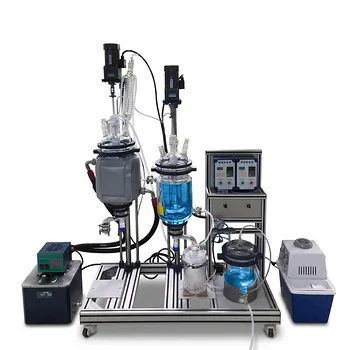
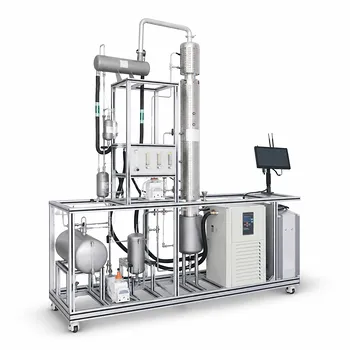
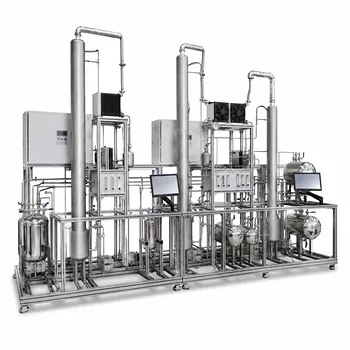
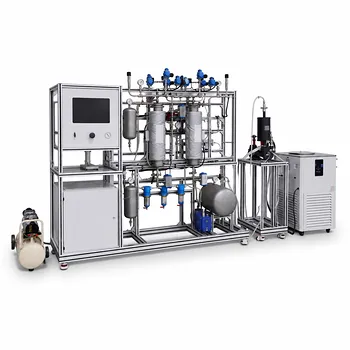
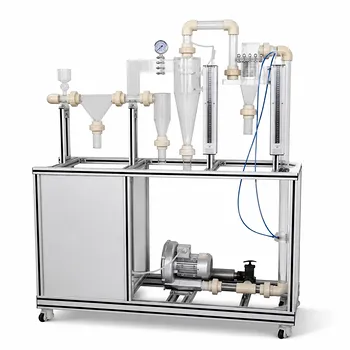
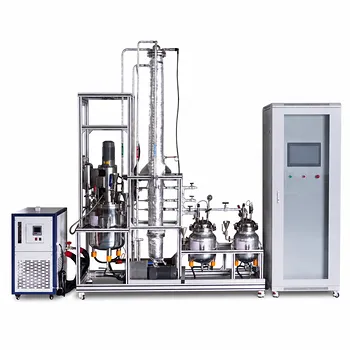
Bridging the gap between simulation models and physical reality requires high-quality, reliable equipment. LABPARK provides premium Educational and Vocational Unit Operations Pilot Plants in chemical engineering, bioprocess & biotech, and environmental & water treatment.
Specifically designed for universities, research institutes, and enterprises, our pilot plants deliver the precise, real-world data you need to validate your process models, conduct advanced research, and train future engineers.
Ready to elevate your laboratory's capabilities? Contact LABPARK today to discuss your project requirements!
Related Products
- Electrolyte Distillation Purification and Formulation Educational Pilot Plant
- Potassium Salt Thermal Dissolution and Crystallization Separation Educational Unit Operations Pilot Plant
- Continuous Sieve-Plate Distillation Pilot Plant for Unit Operations Laboratory Education
- Multi-Functional Special Distillation Educational Pilot Plant
- Continuous Batch Extractive Distillation Educational Pilot Plant
People Also Ask
- Why does simple distillation yield higher efficiency than flash distillation? Key thermodynamic differences.
- How to Integrate Spectroscopy in Distillation Pilot Plants for Advanced Process Control
- How does the feed thermal state influence distillation pilot plant design and utility consumption?
- Why use non-ideal VLE calculations in distillation pilot plants? Ensure accurate scale-up & purity
- How does double temperature difference control improve distillation pilot plants? Stabilize purity.