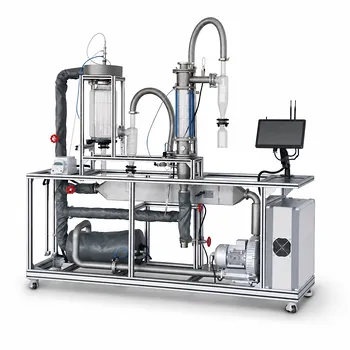
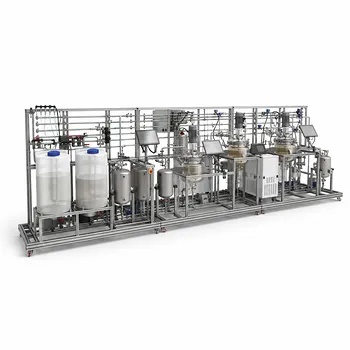
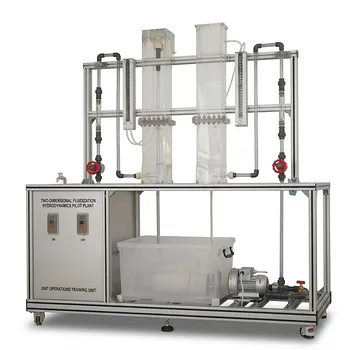
Simulation is a powerful prediction tool, not a replacement for physical reality. Physical experimentation on unit operations pilot plants remains essential because mathematical models and computer simulations are only as reliable as the assumptions, simplifications, and empirical data they are built upon. Engineering education must teach students to collect real-world data, confront non-ideal behaviors, and develop the instinct to know when a simulation is misleading.
The most sophisticated simulation is only as good as the data and assumptions fed into it. Physical pilot plants serve as the ultimate validation checkpoint, exposing the messy, non-ideal dynamics—particle attrition, unexpected azeotropes, ash agglomeration—that no equation of state fully captures. They don’t just build operational skills; they forge the critical intuition to know when to trust a model and when to question it.
The Limits of Pure Simulation
A digital twin is a mirror, but it cannot reflect what it has never seen. The gap between a clean simulation environment and a real process unit is where engineering judgment is forged.
The Model-Reality Gap
Every simulation rests on simplified governing equations and fitted parameters. Those parameters can only be determined and validated through physical experimentation. When students run a distillation column in software, they are seeing a mathematical ideal—not the column that may experience weeping, flooding, or non-ideal mixing. Pilot plants force them to measure actual variables, calculate dimensionless groups, and see firsthand where the model diverges from reality. This is how reliable engineering intuition is built.
When Thermodynamic Data Fails
Process simulators rely on thermodynamic models and equations of state to predict vapor-liquid equilibrium (VLE). However, historical data sets contain severe gaps. Consistent binary VLE data for hydrocarbon components above C10 is practically non-existent, and information on naphthenic, aromatic, and multicomponent systems is sparse. If a student blindly trusts a flash calculation without experimental backup, the entire design can be compromised. Physical pilot plant runs provide the only definitive way to check which thermodynamic model is accurate when data is missing.
The Unique Blind Spot: Solids Processing
Standard simulation software was historically developed for petroleum and fluid-based processes. Built-in models for solid operations are often absent or rudimentary. Processes like spray drying, fluid bed reactors, and rotary dryers involve complex particle behaviors—attrition, clogging, unpredictable phase separations—that require custom user subroutines. Without pressing a button and watching powder flow in a real centrifuge, a student remains dangerously unaware of how solids actually behave.
Why Physical Experimentation Builds Engineering Intuition
Reading about a runaway reaction is nothing like hearing the relief valve lift. Physical pilot plants turn abstract concepts into visceral understanding.
Learning to See the Invisible
Operating a pilot plant forces students to apply dimensional analysis and similarity theory to tangible systems. They must measure temperature profiles, pressure drops, and flow rates, then translate those into dimensionless groups that govern scale-up. This hands-on measurement reveals the dynamic interplay between heat transfer, fluid mechanics, and kinetics in a way that clicking through menus never will.
Detecting the Unexpected
Simulation software follows heuristic rules and known data. It cannot spontaneously invent a new azeotrope or predict an ash agglomeration zone. When testing a distillation sequence for a monomer, only a physical pilot plant can reveal unexpected azeotrope formation or the need for vacuum operation to prevent polymerization. In fluidized-bed gasification, the highly non-isothermal mixing near an oxygen nozzle defies reliable mathematical modeling. The only way to gather empirical data on reaction kinetics and mixing zones is to run the physical system.
The Smart Integration: Simulation and Experiment
The choice is not binary. The most effective education uses simulation and pilot plants as complementary tools.
Using Virtual Runs to Optimize Physical Trials
Computer-based thermodynamic modeling lets students safely explore a wide variable space—varying pH, temperature, and concentration—to predict crystallization points or gas-liquid equilibria. They can design and "pre-run" experiments virtually, reducing errors and standard-state mismatches before stepping into the lab. This maximizes the pedagogical value of the limited time on the physical pilot plant.
Validating Model Selection
When different thermodynamic models (NRTL, UNIQUAC, Peng-Robinson) predict wildly different phase equilibrium results, staring at the screen won’t solve the dilemma. A physical distillation, extraction, or absorption pilot plant provides the ground-truth data needed to select the accurate model and ensure the reliability of the final scaled-up design.
Understanding the Trade-offs
Nothing is free. Physical pilot plants demand time, capital, and safety infrastructure. They cannot cover every process condition as rapidly as a Monte Carlo simulation. However, the cost of a failed full-scale plant due to untested assumptions is orders of magnitude higher. The trade-off is between upfront educational investment and the long-term risk of engineers who have never touched a real valve, never smelled a leak, and never seen a simulation lie convincingly.
Making the Right Choice for Your Curriculum or Career
Understanding why both worlds exist lets you allocate your focus wisely. The ultimate goal is not to choose one, but to master the feedback loop between the two.
- If your primary focus is building fundamental engineering intuition: Spend as much time as possible on physical pilot plants. The feel of the real process teaches you to sense when a model’s output is physically impossible.
- If your primary focus is efficient process design and parameter screening: Leverage simulation to narrow the experimental space first. Then use targeted physical runs to validate the critical points and confirm the model selection.
- If your primary focus is scaling up a novel or poorly characterized system (especially solids or multi-phase reactions): Rely heavily on physical pilot testing. In the absence of reliable thermodynamic data, empirical data is your only defense against catastrophic design failure.
True expertise lies not in running the simulation, but in knowing exactly where it will fail—and that knowledge is born in the pilot plant.
Summary Table:
| Feature | Computer Simulation | Physical Pilot Plants |
|---|---|---|
| Data Basis | Idealized mathematical equations & assumptions | Real-world empirical measurements & VLE validation |
| Process Realities | Misses non-ideal dynamics (weeping, clogging) | Exposes actual physical behaviors & limitations |
| Solids Handling | Highly simplified or absent in standard tools | Handles complex particle dynamics & flow behaviors |
| Pedagogical Role | Safe exploration & parameter optimization | Builds tactile intuition & system scale-up skills |
Equip Your Lab with the Best of Both Worlds
While simulation software helps plan processes, only physical systems prepare future engineers for real-world challenges. LABPARK provides state-of-the-art Educational and Vocational Unit Operations Pilot Plants in chemical engineering, bioprocess & biotech, and environmental & water treatment. Designed specifically for universities, research institutes, and enterprises, our plants bridge the gap between theory and physical reality to build true engineering intuition.
Ready to elevate your training and research capabilities? Contact LABPARK today to request a quote or consultation!
Related Products
- Multi-Functional Drying Educational Unit Operations Pilot Plant
- General Purpose Cosmetics Production Unit Operations Training Pilot Plant
- Dual-Mode Rectification Pilot Plant for Practical Training Unit Operations
- Multi-Reactor Educational Pilot Plant for Reaction Engineering Unit Operations
- Multimodal Absorption and Desorption Pilot Plant for Unit Operations Training
People Also Ask
- How to study gasification in pilot plants? Compare exit gas composition & efficiency
- Why is the chemical plant startup schedule crucial? De-risk scale-up with pilot plants.
- Why Use PTFE & Hastelloy in Chemical Pilot Plants? Prevent Corrosion & Ensure Safety
- How do deviations in estimating latent heat impact pilot plant thermal systems? Avoid hardware mis-sizing.
- When to transition from PID to adaptive control in pilot plants? Key process indicators.