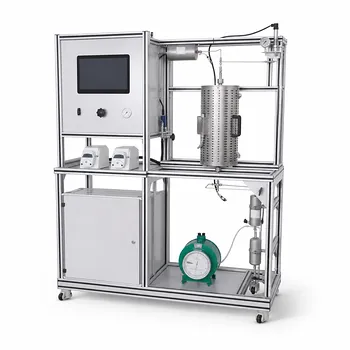
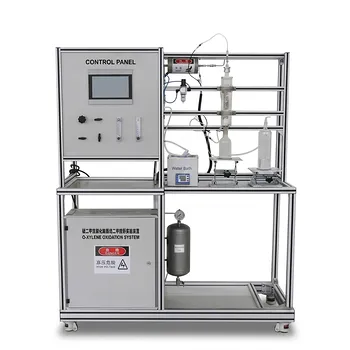
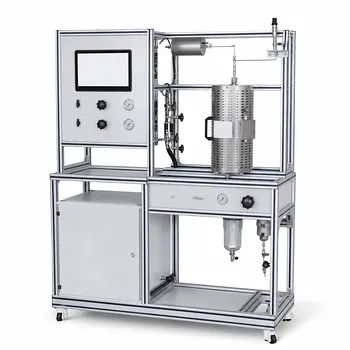
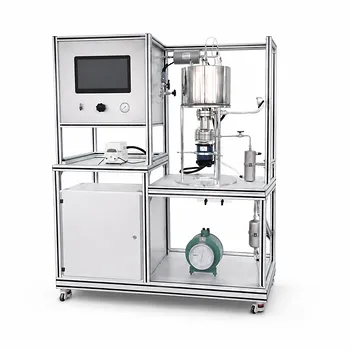
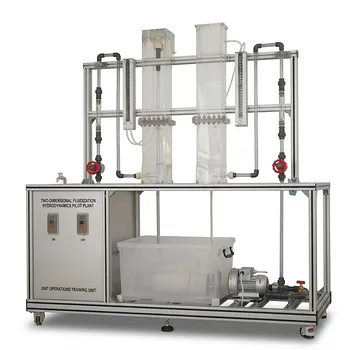
Your fixed-bed reactor is a precisely engineered pressure barrier—not just a piece of lab equipment.
Material selection and structural verification are critical because they are your primary defenses against sudden, catastrophic failure. Without corrosion-resistant alloys and verified weld integrity, exposure to high-pressure hydrogen or aggressive chemicals can lead to embrittlement, wall thinning, and loss of containment—placing researchers, equipment, and experimental integrity at risk.
A pilot plant reactor’s safety and longevity hinge on a single truth: the metal vessel is all that stands between a dangerous high-energy process and the outside world. Proper material choice and rigorous structural testing before commissioning turn a theoretical design into a trustworthy, repeatable platform for innovation.
The Hidden Threats Lurking Inside a Fixed-Bed Reactor
Chemical Warfare: Corrosion and Hydrogen Embrittlement
Reactive chemicals don’t just flow through the bed—they actively attack the containment. Hydrogen, at elevated pressures and temperatures, can dissociate and penetrate the metal lattice, causing hydrogen embrittlement that makes the steel brittle and prone to sudden cracking.
Similarly, acids, halides, or oxidizing agents gradually thin the reactor wall through uniform or localized corrosion. Once wall thickness drops below a safe margin, the vessel can no longer contain the design pressure.
The Heat Is On: Loss of Mechanical Strength at Elevated Temperatures
High-temperature operation is a silent enemy. The tensile strength of metals drops sharply with temperature—a common carbon steel loses more than half its room-temperature strength by 500°C.
Structural design must therefore calculate maximum allowable stress at the actual operating temperature, not just at ambient conditions. Ignoring this derating effect results in walls that are dangerously thin for the thermal load.
The Slow Creep: Why Time Matters as Much as Temperature
Under sustained stress at high temperature, metals undergo creep—a slow, continuous deformation that eventually leads to rupture. Reactor internals and pressure boundaries in long-duration catalytic runs must resist this time-dependent failure.
For these conditions, designers turn to high-creep-strength alloys like Inconel 600 or Incoloy 800, which maintain dimensional stability when standard steels would flow over weeks or months.
From Blueprint to Reality: The Critical Role of Structural Verification
Designing for the Worst-Case Scenario: Wall Thickness and Stress Analysis
The vessel wall must withstand the combined stresses of internal pressure, catalyst bed weight, and thermal expansion. A calculation error here is unforgivable.
Materials must be chosen to obey pressure vessel codes (such as ASME BPV), which explicitly restrict carbon steels above certain temperature thresholds (e.g., 482°C) and demand killed steel, low-alloy grades, or stainless steels for high-temperature service. The resulting minimum wall thickness is not a suggestion—it’s a life-safety requirement.
The Hydrostatic Pressure Test: Your Final Safety Check
No matter how elegant the design, fabrication defects like weld porosity, lack of fusion, or micro-cracks can remain hidden. A hydrostatic pressure test—filling the vessel with water and pressurizing it to a set multiple of the design pressure—exposes these flaws before the catalyst is ever loaded.
Water is used because its incompressibility minimizes stored energy; if a leak or rupture occurs, the energy release is far less violent than with gas. This test is the non-negotiable quality gate that proves the vessel can hold pressure safely.
Understanding the Trade-offs in Material Selection
Cost vs. Capability: Carbon Steel, Stainless Steel, and Beyond
Carbon steel (like A516) is cheap and widely available, but its corrosion resistance and high-temperature strength are limited. It can serve in mild service, yet in corrosive or high-pressure hydrogen environments it fails quickly.
Alloy steels (like A387) and austenitic stainless steels bring higher alloying element content that improves strength, corrosion resistance, and high-temperature stability—at a higher upfront cost. Choosing the right grade is a direct balance between process severity and budget.
The Conductivity Compromise: When Corrosion Resistance Costs You Heat Transfer
In pilot plants where heat transfer is central, material selection gets more nuanced. Titanium resists aggressive chlorides and acids exceptionally well, but its thermal conductivity is roughly one-twentieth that of copper.
This trade-off forces designers to calculate the real overall heat transfer coefficient (U) using the plate material’s conductivity and thickness. Students and researchers learn firsthand that chemical durability often demands a sacrifice in thermal performance.
The Invisible Catalyst: Preventing Unwanted Side Reactions
Even a corrosion-resistant metal surface is not always inert. Nickel-based alloys can catalyze methanation in the presence of CO and H₂, skewing experimental results and degrading product purity.
One solution is to apply barrier coatings via chemical vapor deposition (CVD)—for example, a thin TiO₂ film followed by a silica-doped alumina layer—to electrically and chemically isolate the metallic substrate. This approach retains the metal’s structural benefits while eliminating undesired catalytic activity.
Making the Right Choice for Your Pilot Plant
The final configuration depends on the specific blend of pressure, temperature, and chemical aggression you face. Use these goal-based decision guides to align your choices with your mission:
- If your primary focus is maximum safety and code compliance: Follow ASME BPV rules strictly, select an alloy that retains strength at your operating temperature, and never skip the hydrostatic test.
- If your primary focus is long-term durability in corrosive service: Prioritize high-alloy stainless steels or specialty alloys (e.g., Inconel/Incoloy) over carbon steel, even if it increases initial cost.
- If your primary focus is experimental purity and avoiding side reactions: Specify inert barrier coatings on metallic internals, or choose inherently non-catalytic materials like glass-lined or ceramic components.
- If your primary focus is educating students with a versatile, safe platform: Select broadly compatible materials (glass, Teflon, stainless steel) and integrate engineering controls like down-flow booths or fume hoods to teach industry-standard containment practices.
When you treat the reactor as a high-integrity pressure system rather than a simple vessel, material selection and structural verification become the invisible guardians of every successful experiment.
Summary Table:
| Operational Threat | Recommended Material / Solution | Key Benefit |
|---|---|---|
| Corrosion & Embrittlement | High-alloy stainless steels, Inconel | Resists chemical attack & hydrogen penetration |
| High-Temp Creep & Stress | Inconel 600, Incoloy 800 | Maintains mechanical strength and shape under heat |
| Side Reactions / Catalysis | CVD barrier coatings (TiO₂/silica) | Prevents unwanted catalytic activity on reactor walls |
| Fabrication Defects | Hydrostatic pressure testing | Verifies structural and weld integrity before commissioning |
Partner with LABPARK for Safe, Code-Compliant Pilot Plants
Designing high-pressure reactor systems requires absolute precision and safety. LABPARK provides advanced Educational and Vocational Unit Operations Pilot Plants in chemical engineering, bioprocess & biotech, and environmental & water treatment.
We help universities, research institutes, and enterprises design and construct high-performance pilot plants with verified structural integrity, precise material selection, and industry-standard containment.
Ready to elevate your research safely? Contact our engineering experts today to discuss your custom project requirements!
Related Products
- Fixed-Bed Chemical Reaction and Gas Dust Tar Removal Unit Operations Pilot Plant
- Fixed Bed Gas Solid Catalytic Reaction Educational Pilot Plant
- Multi-Reactor Educational Pilot Plant for Reaction Engineering Unit Operations
- Educational Unit Operations Pilot Plant for Intraparticle Diffusion Effective Factor Measurement
- Ethylbenzene Dehydrogenation Educational Unit Operations Pilot Plant
People Also Ask
- When to transition from PID to adaptive control in pilot plants? Key process indicators.
- How do deviations in estimating latent heat impact pilot plant thermal systems? Avoid hardware mis-sizing.
- Why Compare Predicted and Experimental Excess Enthalpy? Key to Accurate Pilot Plant Scale-up
- How to study gasification in pilot plants? Compare exit gas composition & efficiency
- Why Use PTFE & Hastelloy in Chemical Pilot Plants? Prevent Corrosion & Ensure Safety