Knowledge Chemical Engineering Education Why use mass flow rates for distillation tray hydraulics? Ensure accurate sizing and prevent flooding.
Author avatar

Tech Team · LABPARK

Updated 1 month ago

Why use mass flow rates for distillation tray hydraulics? Ensure accurate sizing and prevent flooding.


Your pilot plant's tray hydraulics will lie to you if you feed them standard volumetric flow rates—because the fluid you're actually flowing is a different size and weight at operating conditions. Standard volumetric flows assume a reference temperature and pressure, but inside a distillation column, liquids expand and vapors compress dramatically. The only way to get an accurate hydraulic rating is to use mass flow rates paired with the actual fluid density at the column's true temperature and pressure.

Standard volumetric flow rates ignore the thermal expansion and compressibility of real fluids, causing significant errors in column sizing, flooding predictions, and weeping checks. The industry’s best practice—mass flow plus density at operating conditions—anchors your pilot plant hydraulics to physical reality, not a set of reference conditions that don’t exist inside the column.

The Problem with Standard Volumetric Flow Rates

They Misrepresent What's Actually Flowing

Standard volumetric flow rates (e.g., m³/hr at reference conditions) count the space a fluid would occupy at a fixed temperature and pressure.

Inside your pilot-scale distillation column, the fluid is not at those reference conditions. A hot liquid has expanded, meaning the same mass occupies more volume. A vapor under pressure compresses to a smaller volume. Relying on standard flows blinds you to those volume changes.

Hydraulic Loads Are Determined by Actual Volume

Tray hydraulics—vapor velocity, liquid head, downcomer backup, entrainment—are all functions of the actual volumetric flow moving through the column at that moment.

If you don't account for thermal expansion or compressibility, you're not calculating the real vapor velocities through the holes or the true liquid loads on the tray deck. You will systematically over- or under-estimate every critical hydraulic limit.

Why Mass Flow and Actual Density Are Non-Negotiable

Mass Is the Invariant That Doesn't Lie

A mass flow rate (e.g., kg/h or lb/h) does not change with temperature or pressure. It's the true quantity of substance moving per unit time.

Once you know the mass flow, you can divide it by the actual density at the column's local conditions to get the exact volumetric flow that the tray internals experience. This closed loop eliminates guesswork and keeps your rating tightly coupled to physical reality.

The Two Critical Densities You Must Use

For any tray, you need two densities under real column conditions:

  • Hot liquid density: The density of the saturated liquid flowing across the tray at its bubble point.
  • Vapor density: The density of the vapor rising through the tray at the operating pressure and temperature.

Using reference-condition densities here is like measuring a bridge's load with a rubber ruler—the numbers shift every time the temperature changes. Only process-condition densities give you a stable, accurate picture.

Connecting Hydraulic Ratings to Column Performance

Every Key Limit Depends on These Numbers

Hydraulic verification steps—estimating column diameter, checking weeping, calculating pressure drop, and monitoring entrainment—are all built on actual velocities and loads.

For example, flooding limits are typically set at 80–85% of the flooding velocity. That velocity calculation must use the true vapor and liquid properties at operating conditions. If you use standard flows, your calculated approach to flood will be wrong, potentially leading you to run too close to the limit or leave capacity on the table.

Dynamic Phases Expose the Gaps

During startup, shutdown, or step-response experiments on a pilot plant, conditions deviate significantly from steady state.

Vapor and liquid rates are not equal during transients. If your hydraulic model doesn't track mass flows and actual densities through those phases, you won't understand transient weeping, froth heights, or downcomer choking. Mass-based ratings let you map the real behavior through every dynamic event.

The Intentional Exception: Gas Rate in Standard Units

Why Gas Is Sometimes Quoted as Standard Volumes

You will often see gas rates expressed in million standard cubic feet per day (mmscfd). This is a globally accepted shorthand that references a universal standard condition for ease of communication.

But the trick is this: the mmscfd is always combined with the true flowing gas density (lb/ft³ at actual conditions) when performing hydraulic calculations. The standard volume just provides a consistent mass proxy—you still convert it to actual mass flow and then back to actual volumetric flow using the real density.

This is not a contradiction; it's a consistent calculation pathway that never substitutes actual density with standard density.

Understanding the Trade-Offs

The Measurement Challenge

Getting actual densities requires pressure and temperature measurements at each tray, which can be sparse in a pilot plant.

If you only have top and bottom instrumentation, you may need to interpolate densities along the column, introducing some uncertainty. Even so, a reasonable density profile based on process conditions is far more accurate than blindly assuming standard conditions.

The Trap of Over-Simplification

Students and new engineers often reach for standard volumetric flows because they appear simpler and more intuitive.

The hidden cost is a hydraulic model that does not reflect the real column. You risk commissioning a pilot plant that floods unexpectedly or weeps at design rates, wasting time and generating invalid data. The ease of standard flows is a false economy.

Making the Right Choice for Your Pilot Plant Distillation Work

Your decision depends on your immediate goal, but the principles are universal for reliable data.

  • If your primary focus is achieving accurate flooding and weeping predictions: Use mass flow rates and actual fluid densities at every point you evaluate. This directly translates to correct vapor and liquid velocities.
  • If your primary focus is comparing pilot data to theoretical models: Base all model parameters on actual thermophysical properties along the column. Match your mass flows to the plant's measurements, not to idealized standard conditions.
  • If your primary focus is teaching or learning tray hydraulics: Insist on mass-based calculations from the start. It builds an intuitive understanding of how real fluids behave under varying temperature and pressure, which is the core of distillation plant design.

Stick to mass flows and actual densities—your column will behave as predicted, your data will be physically meaningful, and your pilot plant will become a trustworthy foundation for scale-up.

Summary Table:

Parameter Standard Volumetric Flow Mass Flow & Actual Density
Reference Conditions Fixed temp & pressure (idealized) Local operating column conditions
Accuracy in Column High error (ignores expansion/compression) High accuracy (reflects physical reality)
Hydraulic Limit Sizing Unreliable flooding/weeping checks Precise flooding & velocity calculations
Dynamic Phase Tracking Fails during startup/shutdown transients Accurately tracks transient behaviors

Bring Physical Accuracy to Your Lab

Designing and operating distillation columns requires precise, real-world data. LABPARK provides state-of-the-art Educational and Vocational Unit Operations Pilot Plants in chemical engineering, bioprocess & biotech, and environmental & water treatment. Designed specifically for universities, research institutes, and enterprises, our pilot plants ensure your students and researchers work with highly accurate, industry-standard process systems.

Ready to elevate your engineering lab's capabilities? Contact us today to find the perfect pilot plant solution for your institution!

Related Products

People Also Ask

Related Products

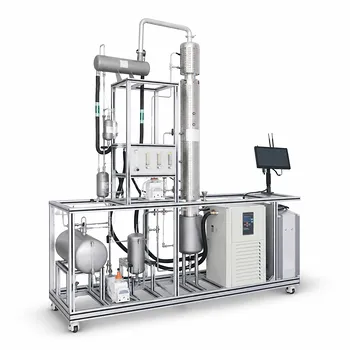
Continuous Sieve-Plate Distillation Pilot Plant for Unit Operations Laboratory Education

Continuous Sieve-Plate Distillation Pilot Plant for Unit Operations Laboratory Education

Integrated pilot-scale teaching system for continuous sieve-plate distillation studies. Visual demonstration of tray hydraulics, flexible feed positions, and automatic reflux control for hands-on unit operations education in engineering labs. Designed for higher education engineering laboratories.

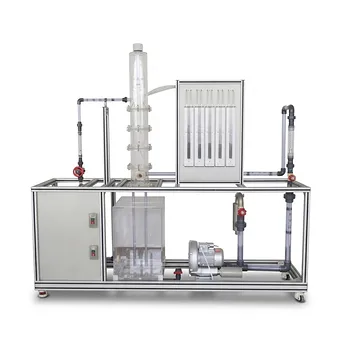
Plate Column Hydrodynamics Tray Demonstration Educational Pilot Plant

Plate Column Hydrodynamics Tray Demonstration Educational Pilot Plant

Advanced transparent educational pilot plant for chemical engineering labs demonstrates plate column hydrodynamics with industrial sieve bubble cap serrated valve trays for visual observation of gas-liquid contact pressure drop measurement and operational limit analysis including flooding weeping entrainment

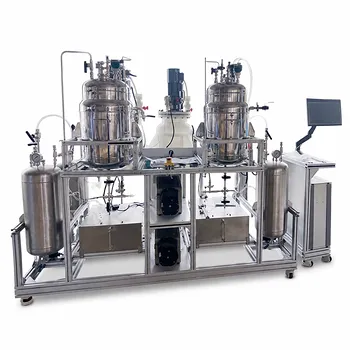
Multi-Functional Special Distillation Educational Pilot Plant

Multi-Functional Special Distillation Educational Pilot Plant

Versatile multi-functional special distillation pilot plant for chemical engineering education. Supports continuous, vacuum, azeotropic, reactive, extractive distillation. Transparent glass columns enable real-time visual observation of hydrodynamics and separation processes.

Green Anhydrous Ethanol Purification Extractive Distillation Unit Operations Training Pilot Plant

Green Anhydrous Ethanol Purification Extractive Distillation Unit Operations Training Pilot Plant

Modular pilot plant produces high-purity anhydrous ethanol from crude ethanol via extractive distillation in a zero-emission closed-loop process providing hands-on training in unit operations with PLC-based control SCADA software and digitalized process management focusing on green engineering principles

Multi-Modal Distillation Unit Operations Training Pilot Plant

Multi-Modal Distillation Unit Operations Training Pilot Plant

Multi-modal distillation pilot plant for practical unit operations training in chemical engineering education. Features real, analog, and semi-physical simulation modes, industrial construction, customizable for university labs. Hands-on fractionation columns, SCADA control, safety systems. Includes sight glasses, sampling ports, closed-loop recycling.

Continuous Batch Extractive Distillation Educational Pilot Plant

Continuous Batch Extractive Distillation Educational Pilot Plant

Versatile pilot plant for continuous, batch, and extractive distillation training. High-borosilicate glass column for visualizing hydraulics, 15.6-inch touchscreen with data logging, precise reflux ratio control 1-99, and durable corrosion-resistant frame. Ideal for chemical engineering education and process research.

Electrolyte Distillation Purification and Formulation Educational Pilot Plant

Electrolyte Distillation Purification and Formulation Educational Pilot Plant

Integrated bench-to-pilot scale educational pilot plant for electrolyte distillation, purification, and formulation with borosilicate glass construction, PLC automation, touchscreen HMI, and advanced industrial safety features for hands-on chemical process training, ideal for chemical engineering and materials science curricula.

Green Anhydrous Ethanol Refining Practical Training Pilot Plant

Green Anhydrous Ethanol Refining Practical Training Pilot Plant

Advanced integrated pilot plant for university labs demonstrating extractive distillation to produce high-purity absolute ethanol from crude feedstock, featuring multi-column continuous operation, closed-loop solvent recycling, and customizable controls for hands-on engineering education, ideal for chemical engineering training and research.

Dual-Mode Rectification Pilot Plant for Practical Training Unit Operations

Dual-Mode Rectification Pilot Plant for Practical Training Unit Operations

Industrial-scale dual-mode rectification pilot plant for chemical engineering practical training. Features real-material and simulated-material operation modes, sieve-plate column with sight glasses for visual observation of hydrodynamics, and customizable SCADA control for safe, hands-on learning of unit operations and mass transfer.

Multi Functional Membrane Crystallization Educational Unit Operations Pilot Plant

Multi Functional Membrane Crystallization Educational Unit Operations Pilot Plant

Integrated bench-scale membrane crystallization pilot plant for engineering education. Provides hands-on training in advanced separation technologies, combining membrane distillation crystallization and process intensification. Features variable scaling vessels, industrial-grade flow control, and interactive digital data acquisition. Customizable for university labs.

Ethyl Acetate Synthesis Unit Operations Pilot Plant for Practical Training

Ethyl Acetate Synthesis Unit Operations Pilot Plant for Practical Training

Modular and customizable pilot plant for ethyl acetate synthesis practical training. Integrates esterification reaction, liquid-liquid extraction, neutralization, and sieve-plate distillation unit operations. Bridging theory and real-world industrial processes. Designed for university chemical engineering labs

100L Continuous Loop Hydrogenation Educational Unit Operations Pilot Plant

100L Continuous Loop Hydrogenation Educational Unit Operations Pilot Plant

This 100L continuous loop hydrogenation pilot plant is designed for chemical engineering education, featuring 316 stainless steel construction, advanced gas-liquid mass transfer components, explosion-proof safety systems, and a 15.6-inch touchscreen with 5G connectivity, cloud data logging, bridging theory and industry.

Electrolytic Hydrogen Production Educational Unit Operations Pilot Plant

Electrolytic Hydrogen Production Educational Unit Operations Pilot Plant

Bench-scale electrolytic hydrogen production pilot plant designed for university engineering labs. Provides hands-on training in water electrolysis, gas-liquid separation, and process safety. Fully customizable system with digital PID control, corrosion-resistant components, and hydrogen gas detector. Ideal for chemical engineering curricula.

Multi Pump Fluid Transport Process Piping Unit Operations Training Pilot Plant

Multi Pump Fluid Transport Process Piping Unit Operations Training Pilot Plant

Industrial-scale multi-pump pilot plant for unit operations training in fluid transport and process piping, featuring real-material and semi-physical simulation modes, comprehensive pump and flowmeter calibration, and safety-enhanced two-tier platform, bridging academic theory and industrial practice for chemical engineering education.

Rising and Falling Film Evaporation Educational Unit Operations Pilot Plant

Rising and Falling Film Evaporation Educational Unit Operations Pilot Plant

Hands-on educational pilot plant for studying rising and falling film evaporation, flow regimes, and heat transfer. Customizable for university labs with industrial instrumentation and data acquisition. Enables comparative evaluation of evaporation modes and energy efficiency.

Natural Product Extraction Unit Operations Training Pilot Plant

Natural Product Extraction Unit Operations Training Pilot Plant

Integrated natural product extraction pilot plant for chemical engineering training bridges theory and industrial practice with modular extraction and evaporation/concentration units, hybrid touchscreen and manual control, realistic process simulation, and self-contained softened water and vacuum utilities.

Constant Pressure Filtration Educational Unit Operations Pilot Plant

Constant Pressure Filtration Educational Unit Operations Pilot Plant

Hands-on educational pilot plant for constant pressure filtration. Classic plate and frame filter press allows students to study kinetics, determine specific cake resistance, perform cake washing and evaluate washing rates. Ideal for chemical engineering curriculum. Mobile, customizable, safety-compliant design.

Bio-fermentation Ethanol Production Practical Training Unit Operations Pilot Plant

Bio-fermentation Ethanol Production Practical Training Unit Operations Pilot Plant

Bio-fermentation ethanol production pilot plant for hands-on training in unit operations: fermentation, solid-liquid filtration, membrane separation, and distillation. Bridges theory with industrial practice using industrial-grade components, customizable for university labs. Hybrid automated and manual control for comprehensive learning.

Water Electrolysis Hydrogen Production and Storage Educational Pilot Plant

Water Electrolysis Hydrogen Production and Storage Educational Pilot Plant

Integrated pilot-scale training system for higher education engineering labs. Features AWE/PEM electrolysis, adjustable DC power, PLC controls, gas-liquid separation, and pressurized hydrogen storage. Hands-on learning in green hydrogen, process control, and safety, ideal for chemical and energy departments.

Supercritical High-Gravity Flash Evaporation Educational Unit Operations Pilot Plant

Supercritical High-Gravity Flash Evaporation Educational Unit Operations Pilot Plant

Bench-scale integrated teaching system for advanced separation and mass transfer, combining supercritical high-gravity flash evaporation with heating, chemical reaction, and material collection, featuring modular design, Stainless Steel 316L construction, transparent visualization, touchscreen control, and safety systems for chemical engineering education.


Leave Your Message