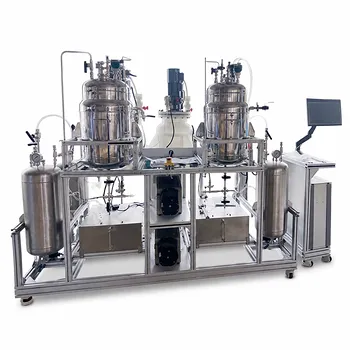
Distillation pilot plants are valuable but resource-intensive. You might wonder: why not jump straight to a detailed simulation or even start running the column? The answer lies in a two-step modeling approach—first a shortcut calculation, then a rigorous simulation, before touching any physical equipment. This strategy quickly provides reliable starting parameters, ensures your rigorous model converges without issue, and yields accurate operating conditions that minimize energy waste and prevent thermal overload during the physical run.
Shortcut models rapidly estimate the minimum reflux ratio, theoretical stages, and optimal feed location. Feeding these into a rigorous simulation prevents convergence failures and generates precise duty and temperature profiles. This two-step process ensures your pilot plant runs safely and efficiently, while teaching you the real-world limits of simplified assumptions.
Why Not Skip Ahead? The Challenge of Rigorous Simulation
Convergence Requires Accurate Initial Guesses
Rigorous distillation models simultaneously solve non-linear mass, equilibrium, summation, and enthalpy (MESH) equations on every tray. Without good starting values for reflux ratio, number of stages, and feed location, the algorithm often diverges or produces meaningless results. A shortcut model provides those critical first estimates.
The High Cost of Trial‑and‑Error on Physical Equipment
Guessing operating parameters and adjusting them on a running pilot plant wastes time, steam, cooling water, and product. The two-step approach narrows the experimental space so your physical run hits the right conditions on the first attempt.
The Shortcut Model: Building a Strong Foundation
Rapid Estimates of Critical Parameters
Methods like the Fenske‑Underwood equations quickly estimate the minimum reflux ratio, minimum number of theoretical stages, and optimum feed tray location. These values become the initial guesses for the rigorous model, drastically reducing setup time.
Clarifying the Separation Goal
For multicomponent mixtures, shortcut methods require you to designate light and heavy keys. This simple step forces a clear definition of the separation target, preventing ambiguous design targets later.
Recognizing the Limits of Simplified Assumptions
Shortcut methods assume constant molar overflow and constant relative volatility. They cannot predict individual stage temperatures or compositions, and they introduce errors in high‑pressure, wide‑boiling, or highly non‑ideal systems. Understanding these limitations is essential before trusting the results.
The Rigorous Simulation: Refining the Blueprint
From Estimates to Accurate Stage‑by‑Stage Profiles
Rigorous tray‑by‑tray simulations use thermodynamic models like the Soave‑Redlich‑Kwong (SRK) equation of state and solve the full MESH equations. Importing shortcut results ensures fast, reliable convergence, yielding realistic temperature, flow, and composition profiles for every stage.
Preventing Thermal Overload and Energy Waste
A rigorous simulation calculates actual reboiler heat duty and condenser cooling duty. Running the pilot plant with these pre‑calculated values avoids overheating the column, tripping safety systems, or wasting utility steam—directly addressing the risk of thermal overload and unnecessary energy cost.
Validating the Model with Real Sensor Data
Once the pilot plant is running, you can compare its temperature profiles, pressures, and product purities against the rigorous simulation. Discrepancies often reveal heat loss, inaccurate thermodynamic parameters, or non‑idealities—turning a simple experiment into a powerful learning moment.
Bridging Education and Real‑World Operations
Exposing the Shortcomings of Ideal Assumptions
By deliberately comparing shortcut predictions, rigorous simulation results, and physical pilot‑plant data, students see firsthand how constant molar overflow collapses under real conditions. This cements a deep understanding of distillation thermodynamics.
Building Confidence in Simulation Tools
Pilot‑plant validation shows when simulation software can be trusted and when it breaks down. That critical perspective is invaluable for future design and troubleshooting tasks.
Understanding the Trade‑offs
When Shortcut Methods Mislead
For columns with side draws, multiple feeds, or highly non‑ideal liquid mixtures, shortcut estimates can be far off. Even then, they still provide a logical starting point—but you must treat them with caution and possibly iterate between shortcut and rigorous steps.
The Risk of “Garbage In, Garbage Out” in Rigorous Models
A rigorous simulation converges quickly with good initial guesses, but if you use incorrect interaction parameters or an inappropriate thermodynamic package, the converged answer can be precise and wrong. Always verify model settings against physical data.
Time Investment vs. Reliability
The two-step approach adds some modeling time upfront. However, this is a tiny fraction of the time spent troubleshooting a pilot plant that won’t reach steady state or a simulation that won’t converge.
Making the Right Choice for Your Pilot Plant Project
Your specific goal will determine how you apply this two-step workflow.
- If your primary focus is safe, efficient operation: Use the shortcut‑to‑rigorous sequence to calculate accurate heat duties and avoid thermal overload.
- If your primary focus is educational insight: Run all three stages—shortcut, rigorous, and physical—and deliberately compare results to expose the limits of ideal assumptions.
- If your primary focus is rapid process screening: Apply shortcut models to quickly filter candidate column configurations before committing to detailed simulation.
- If your primary focus is scaling up a new separation: Build a validated rigorous simulation through the two-step method, then use it to design the pilot‑scale control scheme and interpret real‑time sensor data.
By investing in this sequential modeling approach, you transform a resource‑intensive pilot plant run into a predictable, educational, and cost‑effective experiment.
Summary Table:
| Modeling Phase | Primary Purpose | Key Outputs | Key Limitations |
|---|---|---|---|
| 1. Shortcut Model | Quick initial estimation | Minimum reflux ratio, theoretical stages, feed location | Assumes ideal behavior & constant molar overflow |
| 2. Rigorous Simulation | Detailed stage-by-stage analysis | Accurate heat duties, temperature and flow profiles | Requires good initial guesses to converge |
| 3. Physical Pilot Plant | Real-world process validation | Actual product purity, empirical sensor data | Resource-intensive; risk of thermal overload |
Enhance Your Chemical Engineering Lab with LABPARK
Bridge the gap between theoretical simulation and physical operations. LABPARK provides premium Educational and Vocational Unit Operations Pilot Plants in chemical engineering, bioprocess & biotech, and environmental & water treatment.
Tailored for universities, research institutes, and enterprises, our pilot plants are designed to help students and researchers safely validate thermodynamic models, understand real-world column behavior, and prevent costly operational errors.
Ready to upgrade your lab's training and research capabilities? Contact LABPARK today to find the perfect pilot plant solution for your institution!
Related Products
- Continuous Sieve-Plate Distillation Pilot Plant for Unit Operations Laboratory Education
- Multi-Functional Special Distillation Educational Pilot Plant
- Continuous Batch Extractive Distillation Educational Pilot Plant
- Multi-Modal Distillation Unit Operations Training Pilot Plant
- Electrolyte Distillation Purification and Formulation Educational Pilot Plant
People Also Ask
- Why is vacuum operation capability an essential feature for a distillation unit operations pilot plant? Unlock Efficiency
- How to select the right activity coefficient model (Wilson, NRTL, UNIQUAC) for distillation pilot plants?
- What are the primary reflux ratio control strategies? Master Distillation Unit Operations
- How can real-time carbon number prediction improve distillation pilot plants? Optimize control.
- How does catalyst water concentration affect distillation pilot plant design? Key separation train choices.