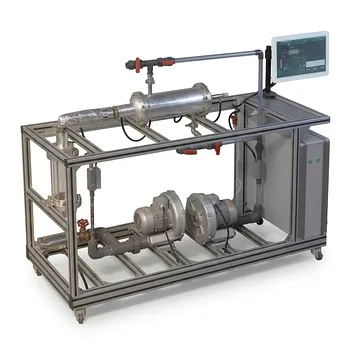
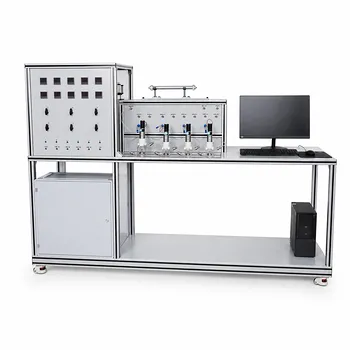
Equation unit conversion is essential because empirical heat-transfer correlations are tied to the unit system in which they were developed. If a gas-flow heat exchanger pilot plant records flow, temperature, density, or heat capacity in SI units while the correlation uses English units, applying the original numerical constant directly produces an incorrect heat-transfer coefficient. The dimensional constant must therefore be transformed along with the variables, or the complete equation must be rewritten in a consistent unit system.
The numerical value of an empirical constant is not universal when the equation contains dimensional variables. Convert every variable and transform the constant so that both sides of the correlation retain the correct physical dimensions.
Why Unit Conversion Matters in Pilot-Plant Analysis
Sensors and correlations often use different systems
Educational pilot plants commonly measure flow rate, temperature, pressure, and physical properties using SI instrumentation. However, many classic heat-transfer correlations were developed using English or Imperial units.
For example, a correlation may expect mass velocity in English units, heat capacity in Btu-based units, and diameter in feet, while the pilot plant supplies values in kilograms, meters, seconds, and joules.
Numerical errors can look like experimental effects
Using a constant from the wrong unit system can shift the predicted heat-transfer coefficient substantially. The resulting disagreement may be incorrectly attributed to turbulence, heat loss, fouling, sensor error, or poor exchanger performance.
Correct conversion separates genuine experimental behavior from a purely mathematical unit inconsistency.
Energy balances depend on consistent heat-transfer coefficients
The heat-transfer coefficient appears in relationships such as
[ Q = U A \Delta T ]
or, for a local convective coefficient,
[ Q = h A \Delta T. ]
The units of (h), (U), area, and temperature difference must combine to produce a heat-transfer rate. If (h) is reported in (\text{Btu}/(\text{h}\cdot\text{ft}^2\cdot{}^\circ\text{F})), it cannot be combined directly with area in (\text{m}^2) and heat duty in watts.
How Dimensional Constants Are Transformed
Method 1: Convert every variable explicitly
Suppose an empirical correlation has the general form
[ h = C,G^{a} C_p^{b} D^{c}, ]
where:
- (h) is a heat-transfer coefficient,
- (G) is mass velocity,
- (C_p) is fluid heat capacity,
- (D) is pipe diameter,
- (a), (b), and (c) are empirical exponents,
- (C) is the dimensional correlation constant.
To rewrite the equation in another unit system, substitute unit conversions for each variable:
[ G_{\text{old}} = \alpha_G G_{\text{new}}, ]
[ C_{p,\text{old}} = \alpha_{C_p} C_{p,\text{new}}, ]
[ D_{\text{old}} = \alpha_D D_{\text{new}}. ]
The original equation becomes
[ h_{\text{old}}
C_{\text{old}} (\alpha_G G_{\text{new}})^a (\alpha_{C_p} C_{p,\text{new}})^b (\alpha_D D_{\text{new}})^c. ]
After collecting the conversion factors, the new constant is
[ C_{\text{new}}
C_{\text{old}} \alpha_G^a \alpha_{C_p}^b \alpha_D^c \alpha_h^{-1}, ]
where (\alpha_h) converts the old heat-transfer-coefficient unit into the new one:
[ h_{\text{old}}=\alpha_h h_{\text{new}}. ]
Thus, the constant changes because every dimensional variable contributes its own conversion factor, raised to the variable’s exponent.
Method 2: Derive and convert the net units of the constant
An alternative is to determine the units required for (C) from the equation itself.
From
[ h = C,G^{a}C_p^{b}D^{c}, ]
the constant must have units
[ [C]
\frac{[h]}{[G]^a[C_p]^b[D]^c}. ]
The conversion is then performed on this complete compound unit rather than on each variable separately.
This method is often safer when the correlation contains many terms, fractional exponents, or several dimensional properties.
Why the exponent matters
A conversion factor is not applied only once when a variable is raised to a power. If diameter is converted using
[ D_{\text{old}} = \alpha_D D_{\text{new}}, ]
then a term (D^{c}) contributes
[ (\alpha_D)^c, ]
not simply (\alpha_D).
This is a common source of error in empirical correlations containing powers such as (D^{0.2}), (G^{0.8}), or other noninteger exponents.
Converting Common Heat-Transfer Quantities
Heat-transfer coefficient
A commonly required conversion is
[ 1\ \frac{\text{Btu}}{\text{h}\cdot\text{ft}^2\cdot{}^\circ\text{F}}
5.6782\ \frac{\text{W}}{\text{m}^2\cdot{}^\circ\text{C}}. ]
This factor allows a coefficient calculated using an English-unit correlation to be compared with an SI-based experimental value.
Temperature differences in degrees Fahrenheit and degrees Celsius have different interval sizes, even though absolute temperature conversions include an offset. For heat-transfer calculations involving (\Delta T), only the temperature-interval conversion is relevant.
Thermal conductivity, viscosity, and density
Property units must also be consistent with the correlation. Examples include:
- Density: (1\ \text{lb}/\text{ft}^3 = 16.018\ \text{kg}/\text{m}^3)
- Volume: (1\ \text{ft}^3 = 0.028317\ \text{m}^3)
- Dynamic viscosity: (1\ \text{lbm}/(\text{ft}\cdot\text{s}) = 1.4881\ \text{kg}/(\text{m}\cdot\text{s}))
The exact form of a viscosity conversion depends on whether the time unit is seconds or hours, so the complete unit should always be written before applying a factor.
Heat capacity and energy terms
Heat capacity correlations may be expressed in Btu-based units or in joules per kilogram-kelvin. A temperature-dependent polynomial must be converted carefully because its coefficients generally have different units.
For example, if
[ C_p = A + BT + CT^2, ]
then (A), (B), and (C) do not all have the same units. Converting only the final calculated value without accounting for the temperature-unit basis can produce an incorrect property correlation.
Why Dimensional Analysis Strengthens the Calculation
It reveals hidden unit dependence
A correlation may appear dimensionless while still containing a dimensional constant. Dimensional analysis exposes the units that the constant must carry and shows whether the formula can be used directly with the available measurements.
It supports comparison with dimensionless correlations
Many heat-transfer relationships are written using groups such as Reynolds, Prandtl, and Nusselt numbers. These groups are dimensionless, so their numerical values are independent of the chosen unit system when the underlying properties are used consistently.
However, dimensional property correlations and dimensional prefactors still require conversion. A dimensionless final group does not automatically make every intermediate expression unit-independent.
It improves scale-up and similarity analysis
Pilot plants are used to study how flow, geometry, and thermal conditions affect exchanger performance. Consistent units allow experimental results to be compared meaningfully across equipment sizes and operating conditions.
Dimensional analysis also helps identify the variables that control the process and supports the use of dimensionless groups for scale-up.
Understanding the Trade-offs
Direct equation conversion versus full re-derivation
Converting the existing equation is efficient and usually appropriate when the correlation is well documented. It preserves the original empirical relationship while adapting it to the pilot plant’s unit system.
A full re-derivation may be preferable when the original correlation has ambiguous units, inconsistent property definitions, or an unclear constant.
SI conversion does not improve the correlation itself
Changing units corrects dimensional consistency, but it does not make an empirical correlation universally valid. The correlation may still be limited to a particular gas, geometry, Reynolds-number range, temperature range, or flow regime.
Agreement after conversion confirms that the calculation is consistent; it does not prove that the model accurately represents the equipment.
Rounding conversion factors can affect results
Premature rounding of conversion factors can introduce noticeable discrepancies, particularly when several factors are multiplied and raised to powers.
Use full-precision factors during calculations and round only the reported result.
Absolute and gauge quantities must not be confused
Pressure correlations may require absolute pressure, while instrumentation may report gauge pressure. Similarly, temperature-dependent properties may require absolute temperature even though heat-transfer driving forces use temperature differences.
Unit conversion must therefore include both the unit scale and the correct physical reference point.
How to Apply This to Your Pilot-Plant Data
The correct workflow depends on whether you are evaluating an existing correlation or creating a new one.
- If your primary focus is matching SI instrumentation: Convert every input property and operating variable into the unit system required by the correlation, or transform the correlation constant into SI before calculating (h).
- If your primary focus is converting the empirical equation: Write the units of every variable, apply each conversion factor raised to its exponent, and derive the new constant from the complete dimensional relationship.
- If your primary focus is validating experimental data: Check the units of (h), heat duty, area, and temperature difference independently before comparing predictions with measurements.
- If your primary focus is scale-up or comparison between systems: Use dimensionless groups where appropriate, but verify that all dimensional properties and prefactors remain consistent.
A disciplined unit conversion turns pilot-plant measurements into reliable evidence rather than misleading numerical results.
Summary Table:
| Key topic | Practical takeaway |
|---|---|
| Unit consistency | Match every measured variable to the correlation's required unit system. |
| Dimensional constants | Transform constants using each variable's conversion factor raised to its exponent. |
| Heat-transfer coefficient | Confirm that h, U, area, and temperature difference produce a consistent heat rate. |
| Property correlations | Convert heat capacity, viscosity, density, and temperature-dependent coefficients carefully. |
| Dimensionless groups | Reynolds, Prandtl, and Nusselt numbers are unit-independent when properties are consistent. |
| Data validation | Check units before attributing discrepancies to fouling, turbulence, sensors, or exchanger performance. |
| Scale-up | Use consistent units and dimensionless analysis to compare equipment and operating conditions. |
Need reliable heat-transfer data for teaching, research, or process development? Contact LABPARK to discuss Educational and Vocational Unit Operations Pilot Plants for gas-flow heat exchangers and related chemical engineering, bioprocess and biotech, and environmental and water-treatment applications. LABPARK helps universities, research institutes, and enterprises obtain practical pilot-plant systems with consistent measurement, scalable experiments, and dependable engineering support for education, validation, and process improvement.
Related Products
- Shell and Tube Heat Exchanger Heat Transfer Coefficient Determination Educational Pilot Plant
- Three-Tube Heat Transfer Educational Pilot Plant for Unit Operations Training
- Gas Phase Mixing and Residence Time Distribution Determination Educational Unit Operations Pilot Plant
- Two Phase Flow Pattern Velocity Resistance Measurement Educational Pilot Plant
- Comprehensive Multi-Modal Heat Transfer Unit Operations Pilot Plant for Engineering Training
People Also Ask
- Why Apply LMTD Correction in Shell-and-Tube Pilot Plants & How to Determine It
- Why adjust baffle spacing in shell-and-tube heat exchanger pilot plants? Master heat transfer & pressure drop.
- How to Estimate Shell-Side Pressure Drop in a Shell-and-Tube Heat Exchanger Pilot Plant: Key Parameters Explained
- How is the fouling factor (Rd) evaluated? Key Pilot Plant Insights for Students
- How is fouling factor demonstrated using shell and tube pilot plants? Practical Lab Guide